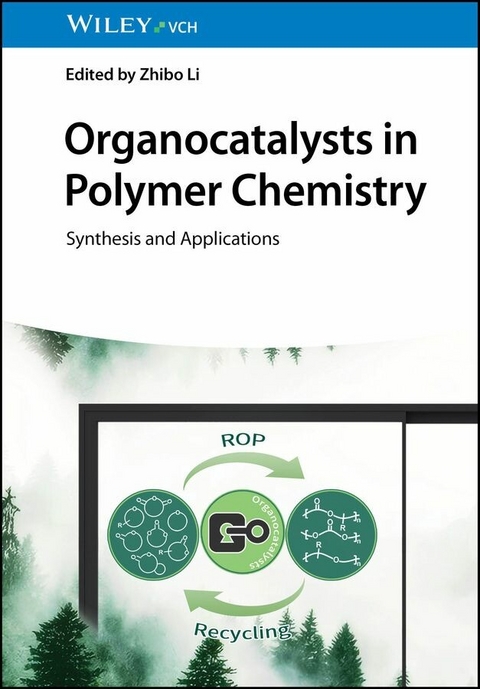
Organocatalysts in Polymer Chemistry (eBook)
817 Seiten
Wiley-VCH (Verlag)
978-3-527-84306-0 (ISBN)
Provides an up-to-date overview of organocatalysis in polymer chemistry, covers recent innovations and specific methodologies
Organocatalysis is revolutionizing polymer chemistry, offering a sustainable, cost-effective alternative to traditional metal-based catalysts. Organocatalysts in Polymer Chemistry: Synthesis and Applications presents a detailed summary of the development of organocatalysts and their transformative impact on polymer synthesis. Contributions by an international team of specialists present cutting-edge methodologies for creating precise macromolecular structures, covering a wide range of polymerization methods and practical applications.
Edited by Professor Zhibo Li, an acknowledged expert in polymer chemistry, the book covers the use of organocatalysts in processes such as ring-opening polymerization, controlled radical polymerization, and polymer depolymerization. It offers vital insights into the synthesis of advanced, biodegradable, and metal-free materials, making it a valuable resource of both foundational knowledge and the latest research breakthroughs in polymer chemistry.
Exploring the development, advantages, and applications of organocatalysts in polymer synthesis, this book:
- Presents advanced techniques for creating precise polymer architectures, including molecular weight, stereochemistry, and topology control
- Discusses applications of organocatalysts in ring-opening polymerization (ROP), controlled radical polymerization, and copolymerization techniques
- Highlights organocatalysis as a metal-free, cost-effective, and environmentally friendly alternative for polymer synthesis
- Examines the role of organocatalysts in recycling and depolymerizing commodity polymers such as PET and polycarbonate
- Addresses the synthesis of degradable polymers for biomedical, electronic, and environmental uses
- Summarizes advancements over the past two decades and explores emerging trends in polymer chemistry
Organocatalysts in Polymer Chemistry is essential reading for postgraduate students, researchers, and industrial professionals in polymer chemistry, materials science, and sustainable catalysis. It is also an essential reference for catalytic chemists, organic chemists, and chemical engineers engaged in the synthesis and application of polymers.
Zhibo Li is Distinguished Professor at Qingdao University of Science and Technology, China. He earned his PhD from the University of Minnesota and completed postdoctoral research at UCLA, USA. With over 280 publications, Professor Li's work spans polymer chemistry and catalysis. He is a recipient of the National Science Fund for Distinguished Young Scholars and serves as Associate Editor of Chinese Journal of Polymer Science and RSC Polymer Chemistry.
1
Organocatalyzed Ring‐Opening Polymerization of Cyclic Esters Toward Degradable Polymers
Feng Li1, Takuya Isono1, and Toshifumi Satoh12
1Division of Applied Chemistry, Faculty of Engineering, Hokkaido University, Sapporo 060-8628, Japan
2List Sustainable Digital Transformation Catalyst Collaboration Research Platform (List-PF), Institute for Chemical Reaction Design and Discovery (ICReDD), Hokkaido University, Sapporo 001-0021, Japan
1.1 General Introduction
The discovery of ring‐opening polymerization (ROP) of cyclic esters to afford polyesters dates back to the 1930s. The hydrolyzable nature of the ester functional group in the polymer chain endows the chain with degradability (e.g. thermal, chemical, bio), rendering polyesters as promising candidates for biomedical applications and as environmentally benign polymer materials. In addition, cyclic esters exhibit polymerizability with an extremely broad scope of catalysts. The ROP of cyclic esters can occur via anionic, cationic, and coordination mechanisms, using different types of catalysts such as transition‐metal catalysts, enzymes, and organocatalysts (Figure 1.1). Thus, the ROP of cyclic esters is the first and the most investigated organocatalyst‐based polymerization reaction to date.
Figure 1.1 ROP of cyclic esters into polyesters.
After extensive investigations over the past two decades, various organocatalysts have been reported to exhibit catalytic activity in the ROP of cyclic esters (Figure 1.2). The typical reaction mechanism for various catalysts is introduced in Section 1.2.
Figure 1.2 Representative organocatalysts for the ROP of cyclic esters.
After the numerous initial investigations of novel organocatalysts, driven by the scientific interest in transition‐metal‐free catalysts, several factors such as catalytic efficiency, selectivity, thermal stability, and safety have been considered in recent works toward meeting the requirement for industrial application. However, metal complexes, such as tin(II) 2‐ethylhexanoate (Sn(Oct)2), are still used in industries to produce polyesters. An increasing number of recent studies have indicated the promising future of organocatalysts, even under industrially relevant conditions. In Section 1.3, the paradigm shifts in the organocatalyzed ROP of cyclic esters are illustrated.
β‐Butyrolactone (β‐BL), lactide (LA), δ‐valerolactone (VL), and ɛ‐caprolactone (CL) are among the most studied cyclic ester monomers because of their relatively high ring strain, good polymerizability, biodegradability, and biocompatibility of their corresponding polyesters, poly(β‐butyrolactone) (P(β‐BL)), poly(lactic acid) (PLA), poly(δ‐valerolactone) (PVL), and poly(ɛ‐caprolactone) (PCL) (Figure 1.3a). However, five‐member and large‐ring lactones such as γ‐butyrolactone (γ‐BL) [1, 2] and ω‐pentadecalactone (DL) [3, 4] cannot be polymerized easily owing to their low ring strain (Figure 1.3b). The successful demonstration of controlled polymerization of low ring strain γ‐BL under low temperatures by highly active catalysts, including metallic catalysts and organocatalysts, and depolymerization of P(γ‐BL) back to γ‐BL monomer at an elevated temperature signified the impact of the closed‐loop polymerization methodology [1, 2]. Since this seminal work of Hong and Chen, chemically recyclable polyesters with novel monomer designs, especially the ones that can be easily derived from renewable biomass resources, have become an emerging research topic, and the number of research reports has increased rapidly in recent years. Although their research was largely focused on the monomer design, polymer properties, and recyclability, organocatalysts have been used extensively. Polyesters that can degrade easily under environmental conditions are also important, aside from the chemically recyclable polyesters. Therefore, the introduction of other facile functional groups to the main chain of polyesters for enhancing their degradability has also been an important topic in recent years. In Section 1.4, breakthroughs in achieving improved degradability and recyclability are discussed.
Figure 1.3 Representative cyclic esters with relatively high (a) and low (b) ring strains.
This chapter focuses on the features of organocatalysts, cyclic ester monomers, and the corresponding polymers. Utilizing the organocatalyzed ROP of cyclic esters for the synthesis of block copolymers and tailoring a highly complicated polymer architecture design for synthesizing advanced degradable materials are also important research directions; however, they are not the topics of this chapter.
Alkali‐metal salts, such as the salts of carboxylic acids, vitamin C, and (thio)ureas, are not completely organic compounds. The reaction mechanisms of these catalysts are similar to those of common organocatalysts, rather than transition‐metal catalysts. In addition, sodium and potassium ions are safe and essential for the human body; therefore, they have been categorized as organocatalysts herein.
1.2 Polymerization Mechanism
1.2.1 Nucleophilic Catalysts
Nucleophilic catalysts, e.g. 4‐dimethylaminopyridine (DMAP) and N‐heterocyclic carbenes (NHCs), are widely used in organic chemistry. The ROP of lactide by DMAP, as reported by Hedrick and coworkers in 2001, is recognized as the landmark that initiated the era of organocatalyzed polymerization [5]. Since this seminal work, many other nucleophilic catalysts, such as phosphines [6], amidines [7], and NHCs [8, 9], have been investigated.
The reaction conditions and polymerizable monomers largely depend on the catalysts employed. A quantitative comparison of the nucleophilicities of these catalysts can provide a better understanding. The Mayr reactivity parameters provide a scale for quantitatively evaluating and comparing the nucleophilicities of various nucleophilic catalysts. Four representative nucleophilic organocatalysts are shown in Figure 1.4, whose Mayr nucleophilic parameter N increases in the order of triphenyl phosphines, DMAP, 1,8‐diazabicyclo[5.4.0]‐7‐undecene (DBU), and NHCs [10].
Figure 1.4 Representative nucleophilic catalysts and their nucleophilicities evaluated using the Mayr reactivity parameters.
Regarding the reaction mechanism of nucleophilic catalysts for the ROP of cyclic esters, the catalytic cycle typically commences with a nucleophilic attack from the catalysts on the carbonyl group of the cyclic esters to open the ring and generate a zwitterionic intermediate. If the reaction is conducted in the presence of an alcohol chain‐transfer agent, i.e. ROH, the hydroxyl group can be activated by the anionic site of the zwitterionic intermediate, thus inducing an intramolecular nucleophilic attack and releasing the nucleophilic catalyst (Figure 1.5, upper reaction route). The iteration of this process affords linear polyesters. In the absence of ROH, the anionic site, i.e. alkoxide, of the generated zwitterionic intermediate continues to attack other cyclic ester monomers, and at a certain stage, the anionic chain end can nucleophilically attack the cationic activated carbonyl group and release the nucleophilic catalysts, affording cyclic polyesters (Figure 1.5, lower reaction route).
Figure 1.5 General reaction mechanism of the ROP of cyclic esters using nucleophilic catalysts in the presence and absence of alcohol initiators.
Nucleophilic catalysts typically exhibit a strong basicity; however, their reaction mechanism may not be identified easily. For example, DBU and 1,5,7‐triazabicyclo[4.4.0]dec‐5‐ene (TBD) are moderate/strong Brønsted bases, but they exhibit relatively high nucleophilicity. Therefore, they could follow the mechanisms of either nucleophilic catalysts [11] or Brønsted base catalysts [12].
1.2.2 Base Catalysts
Organobase catalysts constitute an important type of organocatalysts for the ROP of cyclic esters. Base catalysts can be divided into Lewis bases and Brønsted bases. This section focuses on Brønsted bases, which function as proton acceptors. Lewis bases with a high nucleophilicity have been categorized as nucleophilic catalysts in Section 1.2.1. In the ROP of cyclic esters, commonly used Brønsted bases catalysts include amines, amidines, guanidines, and phosphazenes [13–15]. Pyridines and other N‐containing heterocycles are Brønsted bases as well; however, considering their weak basicity and medium‐to‐high nucleophilicity, they have been introduced in Section 1.2.1 as nucleophilic catalysts (e.g. DMAP).
The basicity of the abovementioned Brønsted bases spans a wide range across 24 orders of magnitude – from the relatively weak triethylamine (pKBH+ 18.8 in acetonitrile) to the super strong base t‐BuP4 (pKBH+...
| Erscheint lt. Verlag | 4.3.2025 |
|---|---|
| Sprache | englisch |
| Themenwelt | Naturwissenschaften ► Chemie |
| ISBN-10 | 3-527-84306-X / 352784306X |
| ISBN-13 | 978-3-527-84306-0 / 9783527843060 |
| Informationen gemäß Produktsicherheitsverordnung (GPSR) | |
| Haben Sie eine Frage zum Produkt? |
 EPUB (Adobe DRM)
Kopierschutz: Adobe-DRM
Adobe-DRM ist ein Kopierschutz, der das eBook vor Mißbrauch schützen soll. Dabei wird das eBook bereits beim Download auf Ihre persönliche Adobe-ID autorisiert. Lesen können Sie das eBook dann nur auf den Geräten, welche ebenfalls auf Ihre Adobe-ID registriert sind.
Details zum Adobe-DRM
Dateiformat: EPUB (Electronic Publication)
EPUB ist ein offener Standard für eBooks und eignet sich besonders zur Darstellung von Belletristik und Sachbüchern. Der Fließtext wird dynamisch an die Display- und Schriftgröße angepasst. Auch für mobile Lesegeräte ist EPUB daher gut geeignet.
Systemvoraussetzungen:
PC/Mac: Mit einem PC oder Mac können Sie dieses eBook lesen. Sie benötigen eine
eReader: Dieses eBook kann mit (fast) allen eBook-Readern gelesen werden. Mit dem amazon-Kindle ist es aber nicht kompatibel.
Smartphone/Tablet: Egal ob Apple oder Android, dieses eBook können Sie lesen. Sie benötigen eine
Geräteliste und zusätzliche Hinweise
Buying eBooks from abroad
For tax law reasons we can sell eBooks just within Germany and Switzerland. Regrettably we cannot fulfill eBook-orders from other countries.
aus dem Bereich