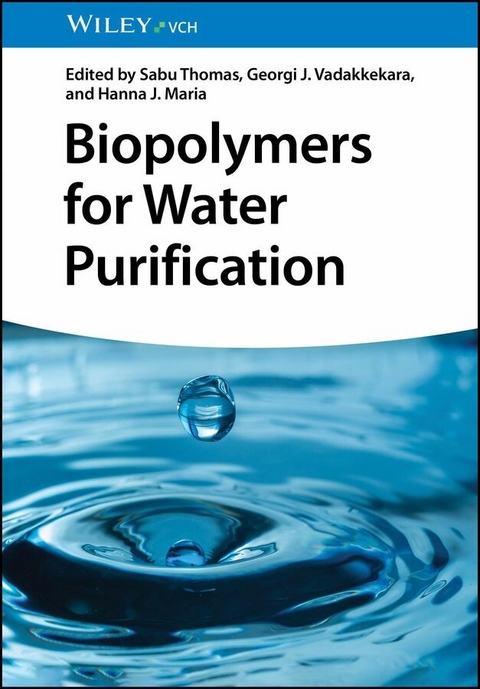
Biopolymers for Water Purification (eBook)
926 Seiten
Wiley-VCH (Verlag)
978-3-527-83589-8 (ISBN)
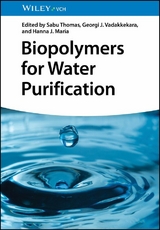
Understand the future of water treatment with this groundbreaking introduction
There are few more requirements for human life more vital than clean water. Increasingly, however, both developed and developing countries are facing significant challenges to the maintenance of clean water sources, with population growth, industrial pollution, hazardous water contamination, and climate impact all taking a toll. With conventional methods of water purification proving less and less satisfactory, attention is increasingly turning to biopolymers extracted from natural sources, such as cellulose and chitosan, for their potential as renewable water treatment agents.
Biopolymers for Water Purification provides an overview of this growing field of study and its recent developments. It covers key techniques for synthesizing and modifying biopolymers, as well as their roles in treating water pollution and meeting targeted water quality requirements. The result is a detailed, comprehensive introduction to this field with potentially immense ramifications for long-term human life. It is the first book solely dedicated to the engineering of biopolymer-based membranes for water purification and promises to become a landmark in the field.
Biopolymers for Water Purification readers will also find:
- Detailed treatment of important polymers including chitin, glycogen, kerating, and more
- Discussion of ongoing challenges and directions for future research
- Introduction to the history and characterization of biopolymers
Biopolymers for Water Purification is a useful reference for polymer chemists, water chemists, materials scientists, engineering scientists, and advanced postgraduate researchers in any of these or related fields.
Sabu Thomas, PhD, Chairman, Trivandrum Engineering Science & Technology Research Park (TrEST Research Park), Director, School of Energy Materials, Director, School of Nanoscience and Nanotechnology, Director, International and Inter-University Centre for Nanoscience and Nanotechnology, Former Vice Chancellor Mahatma Gandhi University, Kottayam, Kerala, India.
Georgi J. Vadakkekara, PhD, is Senior Researcher at Bharathiar University Coimbatore, Chennai, India.
Hanna J. Maria, PhD, Senior Research Associate, Director, School of Energy Materials, Mahatma Gandhi University, Kottayam, Kerala.
1
A Bibliometric Analysis on the Application of Biopolymers in Water Purification
Fabiula D.B. de Sousa1,2 and Júlia R. Gouveia2
1Universidade Federal de Pelotas, Technology Development Center, Rua Gomes Carneiro, 1, Pelotas, RS, 96010‐610, Brazil
2Universidade Federal do ABC, Center of Engineering, Modeling and Applied Social Science, Avenida dos Estados, 5001, Santo André, SP, 09210‐580, Brazil
1.1 Introduction
Biopolymers are macromolecules that are biologically synthesized from living organisms [1]. Biopolymers come from animals, microbes, plants, and algae. Their abundance, low cost, expandability, and chemical structure make them promising materials for water treatment applications [2].
It is known that for the sustainable progress and development of human society in the twenty‐first century, freshwater is essential, and its scarcity has been a terrible threat [3]. So, biopolymers emerge as ideal candidates for water treatment, besides being widely used in the literature in wastewater treatment. Other applications in the field of water and wastewater treatment are the removal of heavy metals,environmental remediation, among many others.
Bibliometric analysis is a powerful tool to provide an outline and to summarize results of an issue, subject, or field based on the available literature (by using quantitative methods), including the trends, information about authors, and sources, among many others. Several research areas take advantage of this approach, proving that this analysis is relevant and interdisciplinary. Some recent examples of using bibliometric analysis are in the analysis of human–wildlife conflict [4], aerobic digestion technology [5], consumer awareness of plastics [6], plastic effects on marine and freshwater environments [7], open innovation and tourism relationship [8], and multicriteria decision making [9], among many others.
In the present work, a bibliometric analysis of the use of biopolymers in water purification was performed using Bibliometrix R‐package. The analysis was focused on the discussion of the sources, authors, affiliations, countries, publications, and keywords, mainly showing an overview of the research area.
1.2 Methodology
The Scopus search was performed on 6th December 2021 by using the keywords biopolymer* AND (water purification* OR water treatment*), and resulted initially in 2562 publications (from 1972 to 2022). All the h‐index values were calculated by Bibliometrix.
The initial result was limited to articles and reviews in English from 2002 to 2021, resulting in 2017 publications: 1802 articles and 215 reviews. The first 2000 publications were exported to a .bib file and analyzed using Bibliometrix, an R‐package.
1.3 Results
1.3.1 Bibliometric Analysis
The annual scientific production from 2002 and the subject area of the publications are shown in Figure 1.1.
Figure 1.1 (a) Annual scientific production from 2002, and (b) subject area of the publications.
The results show that the area is interdisciplinary, with a predominance of publications in the environmental science area. Concerning the annual scientific production, the increase in the number of publications during the period with an annual growth rate of 19.26% can be observed. These results depict the relevance of biopolymers in the water purification research field. The discussion of results will be divided into sources, authors, affiliations, countries, publications, and keywords, which will be discussed in sequence.
1.3.1.1 Sources
The five most relevant sources concerning the number of publications are (number of publications in parenthesis). Water Research (130), Bioresource Technology (127), Journal of Applied Polymer Science (64), Carbohydrate Polymers (61), and Journal of Membrane Science (54). The dynamics of the number of publications of these most relevant sources in the last 10 years are shown in Figure 1.2.
Figure 1.2 Dynamics of the number of publications of the most relevant sources in last 10 years.
On the other hand, the most locally cited sources, i.e. the ones most cited from the reference lists of the 2000 analyzed publications, are (number of citations in parenthesis): Water Research (4987), Bioresource Technology (2669), Carbohydrate Polymers (2288), Environmental Science and Technology (2020), and Journal of Membrane Science (1912).
In Figure 1.2, the two most important journals in the research field of biopolymers in water purification point to an increase in the annual number of publications between 2013 and 2014, with a reduction and a tendency to stabilize by the year 2021. The other journals show greater stability regarding the annual number of publications within the analyzed period.
All the mentioned sources are relevant in the field of biopolymers for water purification. These journals are peer‐reviewed and of high quality, providing the authors the confidence to publish their works in these journals [10].
1.3.1.2 Authors, Affiliations, and Countries
The most relevant authors of the research field according to their h‐index are presented in Table 1.1.
Table 1.1 Most relevant authors of the research field of biopolymers for water purification, with their number of publications and local citations.
| Author | h‐Index | Number of publications | Local citations |
|---|
| Zhang W. | 16 | 28 | 38 |
| Jekel M. | 13 | 16 | 5 |
| Wang J. | 13 | 20 | 46 |
| Wang Z. | 13 | 21 | 14 |
| Chang I. | 11 | 14 | 8 |
| Vigneswaran S. | 11 | 13 | 4 |
| Wang Y. | 11 | 18 | 6 |
| Zhang L. | 11 | 21 | 22 |
| Zhang Y. | 11 | 18 | 15 |
| Zhang Z. | 11 | 17 | 14 |
In the list of the most important authors, Zhang W. is the one with the highest h‐index and number of publications. However, the author with the highest local citations is Wang J. (from the reference lists of 2000 analyzed publications). The largest number of publications of the author deals with sludge and correlated aspects. The second most important author based on Bibliometrix, Jekel M., studies the purification of wastewater by using membrane filtration and ultrafiltration. No consensus is shown in the literature about which of the measures is more effective for analyzing the importance of a certain author in a given research area (the number of publications/citations or the h‐index) [11]. An inaccurate interpretation of the measure of the author's influence may occur when the number of publications is analyzed, since in some cases the author can be at the beginning of career, whose scientific trajectory is in growth stage [12].
The most relevant affiliations according to the number of publications are (number of publications in parenthesis). Tsinghua University (40), China University of Geosciences (31), Tongji University (31), Nanyang Technological University (27), Chinese Academy of Sciences (25), and Delft University of Technology (25). Nanyang Technological University is from Singapore, Delft University of Technology is from the Netherlands, and all the others are Chinese.
The country's scientific production is shown in Figure 1.3.
Figure 1.3 Country's scientific production.
In Figure 1.3, the chart shows the scientific production which is presented on a scale of shades of blue, in which the darkest blue in the chart represents the most productive, and gray represents the countries with no publications. Through this general overview, it can be observed that the subject is studied across the globe, given its importance, showing that this issue is an international concern [11, 13]. The most productive countries are (number of publications in parenthesis). China (854), the USA (394), India (381), Brazil (283), Italy (211), South Korea (195), Canada (171), Australia (170), Spain (165), and France (162). However, when the most cited countries are presented, the scenario changes (number of citations in parenthesis): China (12502), the USA (7574), France (6511), India (5183), Canada (3512), Malaysia (3327), Italy (2580), Korea (2535), Australia (2083), and Germany (2073), being the countries with the highest average citations per publication France (155), Serbia (109), Switzerland (89), Hong Kong (81), Malaysia (70), Greece (69), Ethiopia (69), Egypt (63), the USA (54), and Singapore (53). These results depict the importance of countries such as China, the USA, and France in the literature about biopolymers for water...
| Erscheint lt. Verlag | 4.3.2025 |
|---|---|
| Sprache | englisch |
| Themenwelt | Naturwissenschaften ► Chemie |
| Schlagworte | adsorbents • Cellulose • Chitin • Chitosan • climate change • Developed nations • Developing Nations • Gelatin • Glycogen • kerating • Membranes • natural flocculants • petrochemical-based polymers • pollution • Population Growth • Water Treatment |
| ISBN-10 | 3-527-83589-X / 352783589X |
| ISBN-13 | 978-3-527-83589-8 / 9783527835898 |
| Informationen gemäß Produktsicherheitsverordnung (GPSR) | |
| Haben Sie eine Frage zum Produkt? |
 EPUB (Adobe DRM)
Kopierschutz: Adobe-DRM
Adobe-DRM ist ein Kopierschutz, der das eBook vor Mißbrauch schützen soll. Dabei wird das eBook bereits beim Download auf Ihre persönliche Adobe-ID autorisiert. Lesen können Sie das eBook dann nur auf den Geräten, welche ebenfalls auf Ihre Adobe-ID registriert sind.
Details zum Adobe-DRM
Dateiformat: EPUB (Electronic Publication)
EPUB ist ein offener Standard für eBooks und eignet sich besonders zur Darstellung von Belletristik und Sachbüchern. Der Fließtext wird dynamisch an die Display- und Schriftgröße angepasst. Auch für mobile Lesegeräte ist EPUB daher gut geeignet.
Systemvoraussetzungen:
PC/Mac: Mit einem PC oder Mac können Sie dieses eBook lesen. Sie benötigen eine
eReader: Dieses eBook kann mit (fast) allen eBook-Readern gelesen werden. Mit dem amazon-Kindle ist es aber nicht kompatibel.
Smartphone/Tablet: Egal ob Apple oder Android, dieses eBook können Sie lesen. Sie benötigen eine
Geräteliste und zusätzliche Hinweise
Buying eBooks from abroad
For tax law reasons we can sell eBooks just within Germany and Switzerland. Regrettably we cannot fulfill eBook-orders from other countries.
aus dem Bereich