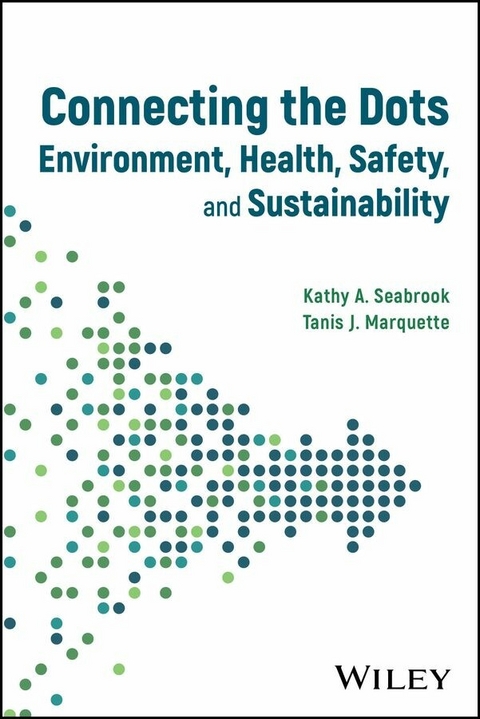
Connecting the Dots (eBook)
425 Seiten
Wiley (Verlag)
978-1-394-20425-0 (ISBN)
Understand how Environment, Health & Safety (EHS) and Sustainability are interconnected and take meaningful action
Global in scope, Connecting the Dots provides readers with a concise overview of how EHS and Sustainability intersect and offers immediately actionable activities to bring to their organizations in the context of worker safety, health, and wellbeing and environmental management, connecting the dots between the subject and the professional's role.
Written with standalone chapters to allow readers to apply relevant topics in situ or in study as needed, each chapter follows a standard format with integrated case studies, examples, and implementation advice. Interviews with leaders in the field and real-world examples of success are included throughout the text to elucidate key concepts.
This book is scalable to the size and nature of a company's operations, from a small, medium-sized enterprise to a global multinational company, it is applicable to all professionals in the field from the C-Suite to the front-line worker. The impact pathways in the Value: Creation, Assessment, Valuation and Impact Pathways chapter will be of interest to the finance department, the supply chain in the Stakeholder and Stakeholder mapping chapter will interest the procurement professional, and the sustainability strategy and decision-making roadmap chapter could be a focus for the enterprise risk team and applicable to procurement, as well as internal audit, corporate communications, investor relations and others.
Written by two veteran industry EHS and sustainability leaders, coverage includes:
- Commonalities and differences in the international taxonomy within the EHS and sustainability disciplines, helping bridge reader understanding and communication across their company's stakeholder groups
- Integrated business and risk management models related to associated frameworks, standards, assessments, themes, issues, impacts, and materiality
- Discipline processes to operationalize concepts, and the better approach of a Future Fit, Sustainability and Business excellence mindset instead of a compliance mindset
- Implementation and change management, highlighting important cultural and business considerations
Connecting the Dots is an essential guidance and reference resource for all professional readers, no matter where they sit in the value chain or industry sector. The text also serves as an excellent aid for advanced courses on topics such as sustainability and safety, environmental standards, and advanced safety, health and wellbeing management.
Kathy A. Seabrook, CSP, CFIOSH, EurOSHM, FASSP is CEO and founder of Global Solutions, Inc. and trusted advisor to Fortune 500 companies helping them strategically leverage the value of people and their safety, health, and wellbeing and the natural environment on operational and commercial excellence and overall sustainable, resilient corporate performance.
Tanis J. Marquette, CSP, ISSP-SEP, SMCP has 30 years of experience leading sustainability strategy and EHS programs across global specialty chemical companies including Hexion, PQ Corporation, and Ecovyst. She founded Sapheyr LLC in 2018 and currently leads management and execution of Sustainability and ESG projects as Director of Sustainability Advisory for TRC Companies.
Understand how Environment, Health & Safety (EHS) and Sustainability are interconnected and take meaningful action Global in scope, Connecting the Dots provides readers with a concise overview of how EHS and Sustainability intersect and offers immediately actionable activities to bring to their organizations in the context of worker safety, health, and wellbeing and environmental management, connecting the dots between the subject and the professional s role. Written with standalone chapters to allow readers to apply relevant topics in situ or in study as needed, each chapter follows a standard format with integrated case studies, examples, and implementation advice. Interviews with leaders in the field and real-world examples of success are included throughout the text to elucidate key concepts. This book is scalable to the size and nature of a company s operations, from a small, medium-sized enterprise to a global multinational company, it is applicable to all professionals in the field from the C-Suite to the front-line worker. The impact pathways in the Value: Creation, Assessment, Valuation and Impact Pathways chapter will be of interest to the finance department, the supply chain in the Stakeholder and Stakeholder mapping chapter will interest the procurement professional, and the sustainability strategy and decision-making roadmap chapter could be a focus for the c-suite and enterprise risk team and applicable to procurement, as well as internal audit, corporate communications, investor relations and others. Written by two veteran industry EHS and sustainability leaders, coverage includes: Commonalities and differences in the international taxonomy within the EHS and sustainability disciplines, helping bridge reader understanding and communication across their company s stakeholder groupsIntegrated business and risk management models related to associated frameworks, standards, assessments, themes, issues, impacts, and materialityDiscipline processes to operationalize concepts, with the better approach of a Future Fit, Sustainability and Business excellence mindset instead of a compliance mindsetImplementation and change management, highlighting important cultural and business considerations Connecting the Dots is an essential guidance and reference resource for all professional readers, no matter where they sit in the value chain or industry sector. The text also serves as an excellent aid for advanced courses on topics such as sustainability and safety, environmental standards, and advanced safety, health and wellbeing management.
Foreword
The authors and contributors in Connecting the Dots: Environmental, Health, Safety and Sustainability provide the reader with insight into a critical topic for the early twenty‐first century. Sustainability, ESG (Environmental, Social, and Governance), and CSR (Corporate Social Responsibility) are subjects that corporate leaders and the public have keen interest to demonstrate their commitment and understanding to protect people and the planet. Responsible businesses can demonstrate their value system by deploying the United Nations Global Compact Ten Principles. These principles provide the structure for company’s responsibility in areas of human rights, labor, environment, and anti‐corruption. There are influential drivers for businesses to manage their ESG impacts. They include consumer and investor expectations, risk mitigation, cost savings, access to capital, attract talent, and reputation enhancement. Executives and external stakeholders should continue to assess the role of business in solving the social and environmental ills that confront our planet. Ultimately, effective sustainability integration will allow an organization to achieve its full potential and competitive advantage.
The value of health, safety, and human capital and the relationship to the people side of sustainability is a key consideration. When organizations develop leading health and safety practices, employees are more engaged, productive, and loyal. Leading organizations will consider workplace health and safety as material to their stakeholders. The book describes impact pathways that will demonstrate how safety and health processes and other proactive mitigations positively impact and devise value for workers, communities, and businesses. The value created ultimately uplifts society and will improve the global economy.
Furthermore, human capital equates to an educated and skilled workforce that drives technological advancements and innovation which are key components in sustainable development. Education and training investments enhance workforce capabilities and demonstrate social responsibility and mitigate inequalities.
Climate change effects are a growing concern. An increase in global temperatures influences the hydrological cycle and affects permafrost and glaciers. There is an increasing number of severe weather events, including devastating floods and violent storms. Heatwaves will become more extreme, and droughts will last for extended periods and frequency will increase. Environmental climate risk has major implications to worker and community health issues. These environmental and public health issues may have a financial impact on a company’s ability to supply products and services. Additionally, proactive risk management is a book highlight that conveys the opportunity for physical and transitional risk reduction and leveraging sustainability‐related initiatives.
The book explores critical facets that define responsible business practices and evaluate the concept of materiality which is the framework of decisions shaped by significance. The essence of resilience as an indispensable force amid the dynamic challenges to our global economy is outlined. Connecting the Dots: Environmental, Health, Safety and Sustainability will navigate the landscape of disclosures and reporting, unraveling the importance of transparent communication in fostering trust. The reader will peer into the delicate ecosystem of biodiversity and recognize its pivotal role in sustaining life and the interconnectedness of all living beings. Examining the threads of supply chain is analyzed which aids in the understanding of responsible sourcing and production.
Additionally, the perils of greenwashing are outlined, as the book shines a light on the imperative of genuine environmental commitments amidst a sea of deceptive practices. A challenge for ESG professionals is that many businesses prioritize short‐term financial gains over long‐term sustainability. Quarterly earnings pressure can discourage investment in ESG initiatives with longer payback periods. To foster trust, business must operate to the highest ethical standards. Human capital emerges as a focal point by emphasizing the ethical treatment and development of the workforce as a cornerstone of sustainable business.
Finally, the intricate web of reporting standards and frameworks and how to utilize a structured approach to guide organizations toward accountability is examined. As you proceed through the landmark publication, the reader will gain insight that not only educates but inspires action which will foster a collective commitment to a world where sustainability is not just a goal but a pathway for sustainable communities.
Ultimately, Connecting the Dots: Environmental, Health, Safety and Sustainability describes a comprehensive and systematic way to think holistically and act on challenges confronting all interested parties to promote and advance sustainability and ESG.
Darryl C. Hill, PhD, MBA, CSP
Senior Vice President, Safety and Security
First Student, Inc.
Firstly, I thank the authors, Kathy Seabrook and Tanis Marquette, for giving me the opportunity to contribute via this foreword to their book, it is a real honor.
This is a subject that I have dedicated over 15 years of my life to trying to change the business conversation to be more people centric. As I started pulling together my notes, I realized that this was going to be a real challenge in deciding what to leave out!
Sustainability as a word was drawn to my attention in the late 1990s while working in Environment, Health, Safety (EHS) for a global aluminum and packaging company. At the time it seemed to be an extension of Corporate Social Responsibility incorporating business. I remember some company EHS departments adopting the title EHS and Sustainability. Sustainability was summarized as “People, Planet, Profit” and the idea was to drive profitable and sustainable business taking care of the environment and people. I still think this is still valid.
However, since then the world of EHS has been on a roller coaster involving increasing scrutiny from investors and other stakeholders. Unfortunately, this has resulted in more and more focus on the environmental aspect of sustainability to the extent that many people today associate sustainability only with protecting the environment and nature. Rightfully so, you may say, and to some degree I would agree. By protecting the environment and nature we are not only protecting the other species that live on this planet but also ourselves and maybe prolonging our future. We humans are the source of most of the earth’s environmental challenges … however, we are also the solution.
So, we are right in the center of the sustainability equation and for us to be innovative and creative we must be healthy, safe, and well. This is Maslow’s hierarchy of needs in action. We take care of ourselves and our loved ones and make sure they are safe, often before we take care of others and start to protect the environment. It’s the same at work as it is at home. How can we expect people to be motivated and passionate about their work, protecting the environment if they fear for their safety and health or those of their loved ones?
According to the International Labor Organization 2.93 million people lose their lives every year due to work‐related accidents and illnesses.
The conclusion is evident; a focus solely on the environment and nature and not on people and their health and safety makes no sense.
Stakeholders including investors and rating agencies have come a long way in the past 20 years, and more and more pressure has been put on companies and governments to act to protect the environment. There has been so much focus on environmental management that some companies are highly recognized for their sustainability, even while they continue to have fatalities and serious irreversible injuries and illnesses at work. We carried on working in our silos driven by stakeholders who also had a siloed approach, until the COVID‐19 pandemic changed perspectives. Now the world is waking up to the fact that people‐centered sustainability is vital to creating a win‐win future where people and planet are protected, and businesses thrive. We need to stop working in our silos and help business understand the true value of the people that work for them. Valuing people means taking care of their health, safety, and well‐being while at work.
This book has come at the right time, when we need to break the silos and work together. This book unpacks the interdependency of environment, and people health and safety. It gives direction, toward an integrated world, yet will allow you to adapt the trajectory to your needs and culture.
We are slowly coming full circle in the sustainability agenda back to where we started, with sustainability focused on people as well as planet. Successful companies of the future will certainly be those that have an integrated approach to sustainability; those that do not adapt are unlikely to survive.
Putting people at the center of sustainable organizations involves building bridges and seeking collaboration between EHS professionals, other business functions, and external stakeholders to embed human capital principles into decision‐making at all levels. Marquette and Seabrook, in this book, unpack what sustainability is, identify the stakeholders, and give practical guidance to help readers determine where they are in their sustainability journey, develop their own roadmaps and,...
| Erscheint lt. Verlag | 3.3.2025 |
|---|---|
| Sprache | englisch |
| Themenwelt | Naturwissenschaften ► Chemie |
| Schlagworte | Environment • Environmental Health and Safety • Environment Social Governance • ESG • ESG investing • future fit • Implementation Management • Occupational Health and Safety • Stakeholders • sustainability • Worker Health • worker safety • worker wellbeing |
| ISBN-10 | 1-394-20425-6 / 1394204256 |
| ISBN-13 | 978-1-394-20425-0 / 9781394204250 |
| Informationen gemäß Produktsicherheitsverordnung (GPSR) | |
| Haben Sie eine Frage zum Produkt? |
 EPUB (Adobe DRM)
Kopierschutz: Adobe-DRM
Adobe-DRM ist ein Kopierschutz, der das eBook vor Mißbrauch schützen soll. Dabei wird das eBook bereits beim Download auf Ihre persönliche Adobe-ID autorisiert. Lesen können Sie das eBook dann nur auf den Geräten, welche ebenfalls auf Ihre Adobe-ID registriert sind.
Details zum Adobe-DRM
Dateiformat: EPUB (Electronic Publication)
EPUB ist ein offener Standard für eBooks und eignet sich besonders zur Darstellung von Belletristik und Sachbüchern. Der Fließtext wird dynamisch an die Display- und Schriftgröße angepasst. Auch für mobile Lesegeräte ist EPUB daher gut geeignet.
Systemvoraussetzungen:
PC/Mac: Mit einem PC oder Mac können Sie dieses eBook lesen. Sie benötigen eine
eReader: Dieses eBook kann mit (fast) allen eBook-Readern gelesen werden. Mit dem amazon-Kindle ist es aber nicht kompatibel.
Smartphone/Tablet: Egal ob Apple oder Android, dieses eBook können Sie lesen. Sie benötigen eine
Geräteliste und zusätzliche Hinweise
Buying eBooks from abroad
For tax law reasons we can sell eBooks just within Germany and Switzerland. Regrettably we cannot fulfill eBook-orders from other countries.
aus dem Bereich