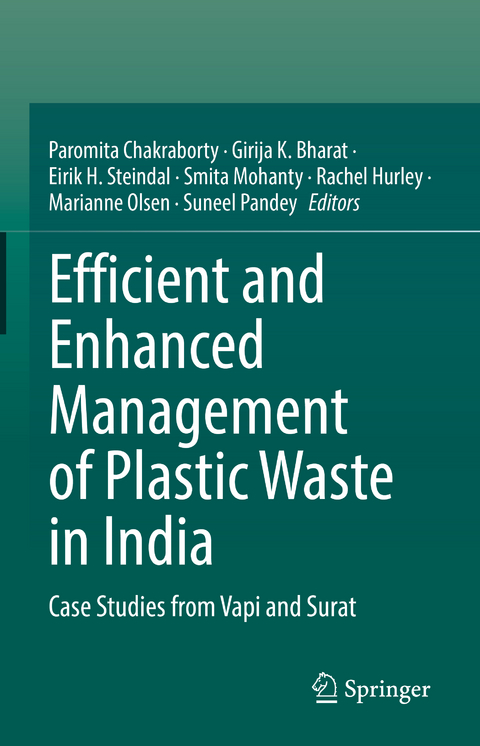
Efficient and Enhanced Management of Plastic Waste in India
Springer International Publishing (Verlag)
978-3-031-89397-1 (ISBN)
Rapid population growth, industrialization, urbanization and economic development have resulted in increased plastic waste generation globally. Challenges related to mismanaged plastic waste and associated pollution due to macroplastics, microplastics and chemical pollution are closely interlinked. Plastics contain chemical additives and contaminants, and thus are carriers of Persistent Organic Pollutants (POPs). To address this issue effectively, it is important to understand source of waste contribution, generation, transportation, and transformation. This contributed volume, which examines POPs primarily in the Indian context, focuses on a holistic insight into the domain of plastic pollution, assessment of the policy framework for managing POPs, fate of plastic waste, existing analytical and monitoring techniques of detecting macro and micro plastic in India and internationally. Further chapters detail the interlinkages of plastic and POPs and the associated health impacts, bestenvironmental practices (BEPs), Indian and international case studies, gaps in understanding the regulatory aspects.
Dr. Paromita Chakraborty is Professor and heading the Centre for Research in Environment, Sustainability Advocacy and Climate Change (REACH) under Directorate of Research in SRM Institute of Science and Technology, Kattankulathur, India. Prof Chakraborty is an expert scientific member for UNESCO Chair on Ecohydrology and Applied Ecology, Faculty of Biology and Environmental Protection, University of Lodz, Lodz, Poland.
Prof. Chakraborty leads the Environmental Science and Technology research group and works extensively on multi-media movement, risk assessment and cost-effective sustainable remediation techniques for micro-organic pollutants including several plastic associated chemicals. For more than a decade she has been conducting research by working closely with industrial partners on recycling/upcycling of waste plastics and developing new circular economy technologies. She is the Indo-US Science and Technology Forum s Water Advanced Research Innovation Fellow 2016, and recipient of the American Chemical Society Early Career Chemist Award 2015, Hiyoshi Environmental Award 2020 and Dr Ajmal Khan Award 2024. She has published 100+ scientific articles in peer reviewed international journals and is editor of 4 books of Springer/Elsevier. She is the Associate Editor for the Elsevier journal, Science of the Total Environment. She has been enlisted by the Elsevier and Stanford University as one of the top 2% global scientists.
Dr Girija K Bharat, is the Managing Director of Mu Gamma Consultants, Gurgaon and is an international expert with 34 years of experience in plastic pollution, chemical waste management, and water resource management. She has a PhD in Chemistry and was a Presidential Scholar at George Mason University, USA. She has over 130 publications on water resource management, plastic pollution, Persistent Organic Pollution, Endocrine Disrupting Chemicals, the Plastic Waste Strategy Report (Gujarat). She has co-developed the National Policy Framework on Safe Reuse of Treated Water (India), Global Sustainable Development Reports 2015 and 2016. She has been a Research Council Member for CSIR-NEERI, Technical Member of NITI Aayog. Dr Bharat has worked on over 50 projects funded by the Norwegian Embassy, Research Council of Norway, The World Bank, GIZ, UNEP, UNICEF, Swiss Development Cooperation and ADB. She is the recipient of several awards including the Women Transforming India Award (2021) from NITI Aayog and UNEP. Eirik Hovland Steindal is the Head of Business Policy and Public Relations at Grønt Punkt Norge and a PhD fellow in Environmental and Development Studies at the Norwegian University of Life Sciences. With over 20 years of international experience in environmental and development fields, he has worked in research, civil society, as well as the private and public sectors. As a trained biologist, Steindal focuses on sustainability, business, knowledge, and policy, particularly in regulatory development, environmental issues, and corporate social responsibility (ESG). Previously, he was a senior researcher at the Norwegian Institute for Water Research (NIVA), where he led large international research and capacity-building projects in China and India, aiming to address severe environmental challenges through interdisciplinary approaches in collaboration with governments, industry, and research institutions. Steindal has built an extensive international network in the environmental field through his woChapter 1: Status Of Litter and Plastic Pollution Globally and In India.- Chapter 2: Chemicals In Plastic and Plastic Wastes.- Chapter 3: Health, Exposure and Risks: A Review.- Chapter 4: Sampling and Analytical Techniques Of Macro and Microplastics.- Chapter 5: Environmental Monitoring: Global and Indian Perspectives.- Chapter 6: Good Practices In Plastic Waste Management: Indian And Global Case Studies.- Chapter 7: Regulatory Framework, Policies and Programs in Plastic Waste Management- Global and Indian.- Chapter 8: Plastic Waste Generation, Management Issues and Impact On Marine Ecosystems Case Study Of Vapi And Daman Ganga River, Gujarat, India.- Chapter 9: Analysis Of Gaps In The Management Of Plastic Waste In India And Beyond.- Chapter 10: Future Of Bioplastics and Comparison With Conventional Plastics.- Chapter 11: Conclusion and Ways Forward.
| Erscheinungsdatum | 06.10.2025 |
|---|---|
| Zusatzinfo | XIII, 274 p. 98 illus., 63 illus. in color. |
| Verlagsort | Cham |
| Sprache | englisch |
| Maße | 155 x 235 mm |
| Themenwelt | Naturwissenschaften ► Biologie ► Ökologie / Naturschutz |
| Technik | |
| Schlagworte | Bioplastics • Chemicals in plastic • environmental exposures • Microplastic monitoring • Microplastics • Plastic pollution • Sources of plastic waste • Waste Collection |
| ISBN-10 | 3-031-89397-2 / 3031893972 |
| ISBN-13 | 978-3-031-89397-1 / 9783031893971 |
| Zustand | Neuware |
| Informationen gemäß Produktsicherheitsverordnung (GPSR) | |
| Haben Sie eine Frage zum Produkt? |
aus dem Bereich