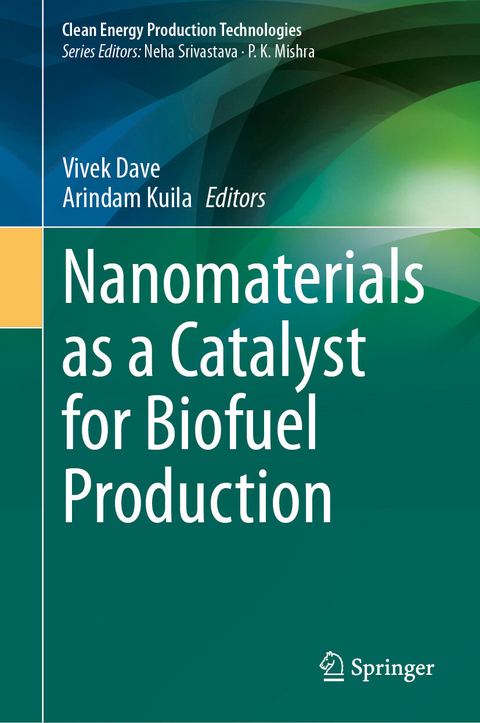
Nanomaterials as a Catalyst for Biofuel Production (eBook)
366 Seiten
Springer Nature Singapore (Verlag)
978-981-96-1706-7 (ISBN)
This contributed volume addresses several environmental problems using nanoparticles/nanomaterials for renewable energy and biofuel production. It presents nanomaterials as catalysts that can enable better selectivity, yield, and quality in renewable energy and biofuel production.
The rapid expansion of industries and human population has resulted in a significant increase in the generation of waste and environmental pollution, posing a significant threat to the environment and human health. People are looking for safer and more eco-friendly fuels to meet energy demand and preserve the world for future generations. Renewable energy and biofuels are alternative techniques that reduce fossil fuel consumption. The advancement in the field of nanotechnology has led to the development of nanocomposites/nanomaterials, which are composed of nanoscale particles and polymers. Their application in the environment has shown great potential in addressing environmental issues such as pollution control and waste management. Nanocomposites are advanced materials with unique properties, such as improved mechanical strength, thermal stability, and flame resistance, making them attractive for a wide range of applications, including environmental applications. Nanomaterials show great potential for sustainable biofuel production with commercial feasibility. Nanotechnology-based various conversion routes effectively convert waste biomass into value-added biofuels, such as syngas, biodiesel, and HVO. This book discusses the green synthesis of nanocomposites/nanomaterials for biofuel production and renewable energy. Additionally, it covers techno-economic analysis of bioremediation using green-synthesized nanoparticles/nanomaterials.
This book will be helpful for researchers, engineers, and scientists working in the areas of environmental biotechnology, materials science, nanotechnology, environmental science, and engineering.
This contributed volume addresses several environmental problems using nanoparticles/nanomaterials for renewable energy and biofuel production. It presents nanomaterials as catalysts that can enable better selectivity, yield, and quality in renewable energy and biofuel production.The rapid expansion of industries and human population has resulted in a significant increase in the generation of waste and environmental pollution, posing a significant threat to the environment and human health. People are looking for safer and more eco-friendly fuels to meet energy demand and preserve the world for future generations. Renewable energy and biofuels are alternative techniques that reduce fossil fuel consumption. The advancement in the field of nanotechnology has led to the development of nanocomposites/nanomaterials, which are composed of nanoscale particles and polymers. Their application in the environment has shown great potential in addressing environmental issues such as pollution control and waste management. Nanocomposites are advanced materials with unique properties, such as improved mechanical strength, thermal stability, and flame resistance, making them attractive for a wide range of applications, including environmental applications. Nanomaterials show great potential for sustainable biofuel production with commercial feasibility. Nanotechnology-based various conversion routes effectively convert waste biomass into value-added biofuels, such as syngas, biodiesel, and HVO. This book discusses the green synthesis of nanocomposites/nanomaterials for biofuel production and renewable energy. Additionally, it covers techno-economic analysis of bioremediation using green-synthesized nanoparticles/nanomaterials.This book will be helpful for researchers, engineers, and scientists working in the areas of environmental biotechnology, materials science, nanotechnology, environmental science, and engineering.
| Erscheint lt. Verlag | 28.2.2025 |
|---|---|
| Reihe/Serie | Clean Energy Production Technologies |
| Zusatzinfo | XV, 366 p. 31 illus., 24 illus. in color. |
| Sprache | englisch |
| Themenwelt | Naturwissenschaften ► Biologie ► Ökologie / Naturschutz |
| Naturwissenschaften ► Geowissenschaften | |
| Technik ► Bauwesen | |
| Technik ► Elektrotechnik / Energietechnik | |
| Technik ► Umwelttechnik / Biotechnologie | |
| Schlagworte | biodiesel • Biofuel production • Biohydrogen production • Environmental remediation • Green Synthesis of Nanomaterials • Nanocomposite Applications • renewable energy • sustainability |
| ISBN-10 | 981-96-1706-5 / 9819617065 |
| ISBN-13 | 978-981-96-1706-7 / 9789819617067 |
| Informationen gemäß Produktsicherheitsverordnung (GPSR) | |
| Haben Sie eine Frage zum Produkt? |
 PDF (Wasserzeichen)
DRM: Digitales Wasserzeichen
Dieses eBook enthält ein digitales Wasserzeichen und ist damit für Sie personalisiert. Bei einer missbräuchlichen Weitergabe des eBooks an Dritte ist eine Rückverfolgung an die Quelle möglich.
Dateiformat: PDF (Portable Document Format)
Mit einem festen Seitenlayout eignet sich die PDF besonders für Fachbücher mit Spalten, Tabellen und Abbildungen. Eine PDF kann auf fast allen Geräten angezeigt werden, ist aber für kleine Displays (Smartphone, eReader) nur eingeschränkt geeignet.
Systemvoraussetzungen:
PC/Mac: Mit einem PC oder Mac können Sie dieses eBook lesen. Sie benötigen dafür einen PDF-Viewer - z.B. den Adobe Reader oder Adobe Digital Editions.
eReader: Dieses eBook kann mit (fast) allen eBook-Readern gelesen werden. Mit dem amazon-Kindle ist es aber nicht kompatibel.
Smartphone/Tablet: Egal ob Apple oder Android, dieses eBook können Sie lesen. Sie benötigen dafür einen PDF-Viewer - z.B. die kostenlose Adobe Digital Editions-App.
Buying eBooks from abroad
For tax law reasons we can sell eBooks just within Germany and Switzerland. Regrettably we cannot fulfill eBook-orders from other countries.
aus dem Bereich