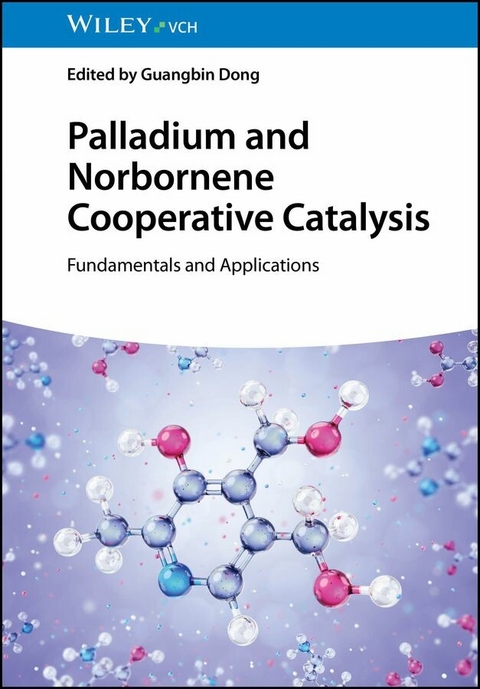
Palladium and Norbornene Cooperative Catalysis (eBook)
530 Seiten
Wiley-VCH (Verlag)
978-3-527-84296-4 (ISBN)
A comprehensive exploration of Pd/Norbornene (NBE) catalysis
In Palladium and Norbornene Cooperative Catalysis: Fundamentals and Applications, renowned researcher Professor Guangbin Dong delivers a systematic and comprehensive discussion of Pd/NBE catalysis, including its mechanisms, scopes, applications, and current limitations. The book provides readers with the fundamental knowledge they will need to use this type of catalysis in their own research, as well as how to choose the best reaction conditions and catalyst combinations.
Each of the eight chapters are written by leading experts in the Pd/NBE catalysis field. They cover topics ranging from the mechanistic foundation of Pd/NBE catalysis to the scope of the ipso and ortho functionalization, asymmetric development, a review of the Pd/NBE-catalyzed heteroarene functionalization, and more.
Readers will also find:
- A thorough introduction to intramolecular and intermolecular cyclizations
- Comprehensive explorations of the annulation chemistry
- Practical discussions of Pd(II)-initiated reactions
- A complete summary of a variety of applications in the synthesis of complex molecules and organic materials using Pd/NBE catalysis
Perfect for chemistry students with an interest in transition-metal catalysis and organic synthesis. This book will also benefit academic researchers and practicing chemists.
Guangbin Dong, PhD, is Professor of Chemistry at University of Chicago, USA. His current research interests include transition-metal-catalyzed C?H and C?C bonds activation, total synthesis of bioactive natural products, boron chemistry, and development of new materials. Professor Dong has received numerous scientific awards, including Elias J. Corey Award for Outstanding Original Contribution in Organic Synthesis by a Young Investigator, Tetrahedron Young Investigator award and ACS Arthur C. Cope Scholar award.
1
The Palladium/Norbornene‐Catalyzed Annulation Chemistry: Rapid Access to Diverse Ring Structures
Mark Lautens and Xavier Abel‐Snape
Davenport Research Laboratories, Department of Chemistry, University of Toronto, Toronto, Ontario, M5S 3H6, Canada
1.1 Introduction
Palladium–norbornene (NBE) cooperative catalysis, commonly known as the Catellani reaction, constitutes a general and straightforward method to sequentially difunctionalize a haloarene at the ortho and ipso positions, with two different reagents [1–6]. These reagents are typically opposite in reactivity, as the first to react does so as an electrophile (E), which will functionalize the ortho site, while the second serves as a terminating reagent, which is often a nucleophile in character (Nu), which will add at the ipso position (Scheme 1.1). This sequence is made possible due to a unique combination of characteristics, including NBE's exceptional reactivity due to the strain, the resulting rigid framework that creates a transient directing group, and lack of accessible β‐hydrogens, that prevent side reactions.
Scheme 1.1 The general Catellani reaction.
The mechanism has been investigated in detail. Following oxidative addition into the C—X bond, the initial arylpalladium(II) species preferentially reacts with NBE via carbopalladation in order to release its ring strain rather than with the terminating reagent (Scheme 1.2). Every Catellani reaction subsequently generates a key intermediate, known as the arylnorbornyl palladacycle (ANP), which is typically formed after concerted metalation deprotonation (CMD) occurs at the ortho position in the presence of a base. The electrophile is then installed via one of two possible pathways: (i) oxidative addition to form a Pd(IV) intermediate followed by reductive elimination or (ii) dinuclear transmetalation [7–9]. Due to the steric congestion, NBE is then extruded via β–C elimination, giving rise to a new ortho‐functionalized arylpalladium(II) species that can now react with the terminating reagent.
Scheme 1.2 The general mechanism of the Catellani reaction.
In most cases, the aryl group bears one ortho‐substituent to avoid di‐ortho‐functionalization with the electrophile or NBE‐integrated side‐products and ultimately, a lower yield of desired product [9]. This requirement is known as the ortho constraint. To tackle this issue, various modified NBE scaffolds have been developed to successfully employ ortho‐unsubstituted aryl halides as substrates that give good to excellent yields [10–12].
Chapter 1 presents various cyclization methodologies harnessing Pd‐NBE cooperative catalysis. The first section describes the most common way of forming rings, i.e. intramolecular cyclization, where two or all three out of the aryl halide, electrophile or terminating reagent are tethered to one another. The second section reports annulations involving sequential intermolecular ortho‐functionalization and ring closure steps with external reagents. Three‐membered rings constitute the focus of section three, where their innate strain turns them into valuable electrophiles and terminating reagents upon ring opening, thereby forming five‐membered rings. Reactions where NBE and its analog norbornadiene find themselves incorporated in the final annulated product instead of solely being used as transient directing groups are included in section four. The final section is comprised of reactions where the annulation step occurs after the catalytic cycle.
1.2 Intramolecular Cyclizations
1.2.1 Electrophile Tethered to Terminating Reagent
1.2.1.1 Ortho Alkylation
Ipso Heck Termination The original 1997 report by Catellani described a reaction between an unsubstituted or para substituted aryl iodide, an alkyl halide, and a Heck acceptor [1]. The catalyst, known as the PNP complex, was a phenyl norbornyl palladium halide dimer prepared from phenyl mercuric chloride, NBE, and palladium chloride. In 1999, Pd(OAc)2 in DMF was shown to be a suitable combination for reacting ortho‐substituted aryl iodides [13]. In 2000, Lautens developed an annulative process and reported what have become the most widely used conditions, namely Pd(OAc)2, phosphines, acetonitrile, and cesium carbonate (Scheme 1.3). In this example, the electrophile, i.e. the alkyl bromide, is tethered to the Heck acceptor providing access to fused ring systems [14].
Scheme 1.3 First annulative Catellani methodology.
This set of conditions paved the way for subsequent ring‐forming processes, generating a variety of benzofused carbo‐ and heterocycles via ortho‐alkylation and ipso‐Heck termination under identical or modified conditions (Scheme 1.4) [15–19]. Some of these examples illustrate that heterocycles are tolerated, which was not possible until Lautens' report in 2006 [18].
Scheme 1.4 Examples of ortho‐alkylation/ipso‐Heck‐termination annulative methodologies.
Alkyl bromides were generally preferred over the analogous iodides likely due to potential side reactions, namely oxidative addition of Pd(0) into the C(sp3)–I bond followed by β–H elimination and reductive elimination to give the corresponding olefin and HI [13]. However, the iodides were ideal electrophiles in a β‐fluoroalkylation process [20]. Alkyl tosylates were also found to be compatible electrophiles in the Catellani reaction [21].
The Zhou group identified epoxides as alkylating reagents in a macrocyclization event using the potassium salt of 5‐NBE‐2‐carboxylic acid N1 (Scheme 1.5) [22].
Scheme 1.5 Macrocycle formation using an epoxide as an alkylating reagent.
(Homo)allylic alcohols were suitable as the Heck acceptor, furnishing the corresponding carbonyl compounds via a redox‐relay Heck cyclization (Scheme 1.6) [23].
Scheme 1.6 First methodology using (homo)allylic alcohols as the Heck acceptor.
Zhou was able to generate ring sizes ranging from five to seven [19, 24, 25]. Dong was also able to provide aldehyde‐tethered rings using modified procedures (Scheme 1.7) [26, 27].
Scheme 1.7 Examples of ortho‐alkylation/ipso‐redox‐relay Heck annulative methodologies.
Ipso C–H Arylation The first examples of annulative C–H arylation were reported by Lautens in 2005. The use of an unfunctionalized arene offers an attractive alternative to cross‐coupling reactions where both arenes typically need a compatible functional group. Lautens showcased the power of C–H arylation by generating annulated indoles (Scheme 1.8) [28].
Scheme 1.8 Synthesis of annulated indoles via ipso C–H arylation.
This concept was generalized to include the synthesis of related hetero‐ and carbocycles (Scheme 1.9) [29–36].
Scheme 1.9 Examples of ortho‐alkylation/ipso‐C–H arylation annulative methodologies.
Ipso Alkyne Insertion Following ortho‐alkylation and NBE extrusion, the resulting arylpalladium(II) species may undergo a migratory insertion relay step, followed by subsequent annulation reactions that increase molecular complexity.
Lautens reported reactions of alkyne‐substituted alkyl halides that lead to ipso‐alkyne insertion and C–H functionalization, leading to tetracyclic‐fused pyrrole and indole derivatives. Carbopalladation of the alkyne precedes the C–H activation (Scheme 1.10a,b) [37, 38]. A related approach was reported a few years later to furnish tetrasubstituted helical alkenes (Scheme 1.10c) [39].
Scheme 1.10 Ipso‐alkyne insertion followed by C–H activation to form (a) tetracyclic‐fused pyrrole derivatives (b) tetracyclic‐fused indole derivatives (c) tetrasubstituted helical alkenes.
The vinyl‐Pd(II) species can undergo an exo‐migratory insertion across NBE or norbornadiene followed by C–H activation to incorporate the bicycle in the final product. This method provided a different kind of tetrasubstituted helical alkenes as a single diastereomer (Scheme 1.11a) [40]. Interestingly, using chiral bromoalkyl aryl alkynes resulted in moderate diastereoselectivities (Scheme 1.11b) [41]. It was proposed the R4 substituent induces helical chirality upon ipso‐alkyne insertion and the resulting major vinylpalladium(II) species is favored over the minor due to 1,3‐allylic strain between the pseudoequatorial R4 substituent and...
| Erscheint lt. Verlag | 26.2.2025 |
|---|---|
| Sprache | englisch |
| Themenwelt | Naturwissenschaften ► Chemie |
| ISBN-10 | 3-527-84296-9 / 3527842969 |
| ISBN-13 | 978-3-527-84296-4 / 9783527842964 |
| Informationen gemäß Produktsicherheitsverordnung (GPSR) | |
| Haben Sie eine Frage zum Produkt? |
 EPUB (Adobe DRM)
Kopierschutz: Adobe-DRM
Adobe-DRM ist ein Kopierschutz, der das eBook vor Mißbrauch schützen soll. Dabei wird das eBook bereits beim Download auf Ihre persönliche Adobe-ID autorisiert. Lesen können Sie das eBook dann nur auf den Geräten, welche ebenfalls auf Ihre Adobe-ID registriert sind.
Details zum Adobe-DRM
Dateiformat: EPUB (Electronic Publication)
EPUB ist ein offener Standard für eBooks und eignet sich besonders zur Darstellung von Belletristik und Sachbüchern. Der Fließtext wird dynamisch an die Display- und Schriftgröße angepasst. Auch für mobile Lesegeräte ist EPUB daher gut geeignet.
Systemvoraussetzungen:
PC/Mac: Mit einem PC oder Mac können Sie dieses eBook lesen. Sie benötigen eine
eReader: Dieses eBook kann mit (fast) allen eBook-Readern gelesen werden. Mit dem amazon-Kindle ist es aber nicht kompatibel.
Smartphone/Tablet: Egal ob Apple oder Android, dieses eBook können Sie lesen. Sie benötigen eine
Geräteliste und zusätzliche Hinweise
Buying eBooks from abroad
For tax law reasons we can sell eBooks just within Germany and Switzerland. Regrettably we cannot fulfill eBook-orders from other countries.
aus dem Bereich