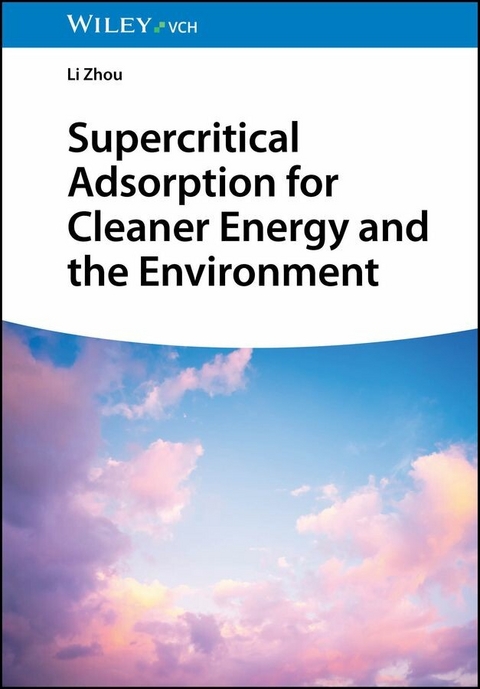
Supercritical Adsorption for Cleaner Energy and the Environment (eBook)
487 Seiten
Wiley-VCH (Verlag)
978-3-527-85164-5 (ISBN)
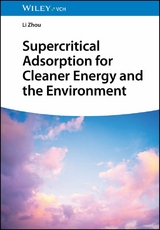
Comprehensive and technically detailed approach to addressing environmental and energy challenges through the advance of adsorption theory and techniques
Supercritical Adsorption for Cleaner Energy and the Environment delves into the novel theory of supercritical adsorption and its practical applications in energy and environmental management issues. The book addresses critical topics such as supercritical adsorption and sustainable energy solutions, provides a deep understanding of advanced theories and techniques of supercritical adsorption, and addresses innovative methods for fuel desulfurization, natural gas storage, hydrogen energy, and emission-free coal power generation in the energy industry.
The book is divided into two parts. The first part provides a comprehensive theory of supercritical adsorption, illustrated with examples that showcase significant progress in both applied and theoretical research due to recent advancements. Building on this theoretical foundation, the second part demonstrates how supercritical adsorption theory can address research questions in the fields of energy and environmental science.
Supercritical Adsorption for Cleaner Energy and the Environment includes information on:
- Solutions for theoretical problems of supercritical adsorption, such as determination of absolute adsorption and the volume or density of the adsorbed phase
- Adsorptive technology to enhance natural gas storage, and methane enrichment from low-quality gas
- Ideas, chemical reactions, and materials and adsorbents used in supercritical adsorption research with the potential to transform approaches in environmental challenges
- Efficient and feasible strategies for achieving carbon circulation within the energy consumption and generation cycle
Supercritical Adsorption for Cleaner Energy and the Environment is an essential forward-thinking reference for practitioners and researchers in the fields of chemistry, chemical engineering, energy, and environmental science.
Li Zhou was previously Professor working in the School of Chemical Engineering at Tianjin University, China. He retired from this University in 2009. He served as Director Board Member of the International Adsorption Society from 2004-2010.
Chapter 1
Classic Adsorption Theory
1.1 Adsorption Definition
Adsorption is a phenomenon that occurs at the interface between two phases. It might occur at the interface of gas/solid, gas/liquid, liquid/liquid, and liquid/solid, but only the adsorption that occurred at the gas/solid interface is of concern in this book. What is adsorption? It is the phenomenon that the concentration of gas at the interface is higher than that in the bulk phase. How it happens? There are two reasons. The first is due to the electrostatic attraction at the interface and yields so-called chemisorption; the second is due to the attraction of van der Waals force and yields physical adsorption. The former can only adsorb one layer of molecules because the chemical bond is no longer attractive once it is saturated, but each gas molecule can exert van der Waals force; therefore, physical adsorption is not limited to adsorbing just one layer of molecules, and the first layer of molecules adsorbed by chemical adsorption can still yield physical adsorption. The solid is named “adsorbent,” the substance to be adsorbed is named “adsorptive,” and it changes its name to “adsorbate” after being adsorbed. Either electrostatic force or van der Waals force will generate an adsorption potential field near the interface. As internal forces, their strength is limited, so the amount of adsorption is capped. The upper limit of the adsorption capacity is determined by the upper limit of gas phase pressure, which is the saturated vapor pressure, p0, when the adsorption occurs below the critical temperature because the vapor is liquefied when saturation pressure is reached. How about the situation of the adsorption occurring above the critical temperature when the gas cannot be liquefied? Is there not an upper limit for supercritical adsorption? The answer is Yes because there is an upper limit for the internal forces that yield adsorption. However, determining the upper limit is a problem for the adsorption at supercritical temperatures.
According to the Gibbs formalism, adsorption itself is an excess quantity. The situation at the gas/solid interface is schematically represented in Figure 1.1 [1]. The molecule’s density near the surface is higher than that in the bulk gas phase due to the adsorption, and a density profile is thus established between the solid surface and the ambient gas phase, but this density profile vanishes over quite a short range. As such, a layer on the solid surface, where adsorbate molecules are concentrated, is referred to the “adsorbed phase,” and a definite thickness (τ) is assumed for it.
Figure 1.1 Diagrammatic sketch for gas/solid adsorption [1]. The density profile (ρ) shown by a solid line curve indicates it is a function of distance (z) normal to the surface in the real system; the broken line shows the case without adsorption; and the chain-dotted line shows the boundary between phases. The shadowed area marks the adsorbed phase and the excess amount of adsorbed substance.
Based on the schematic representation, the adsorbed amount, n, can be determined by either way of the following: First, provided the density profile ρ(z) can be determined or assumed, then
where ρ is the density of the adsorbed phase at distance z to the solid surface, and ρg is the density of the bulk gas phase. The integral indicates that n is a density excess amount of the adsorbed substance, which is usually referred to as “surface excess adsorption” or simply “excess adsorption.”
The density profile perhaps may be determined by molecular simulation, it can hardly be measured experimentally. Therefore, the quantity n is often counted another way as is often cited in literature. Suppose the volume of the adsorbed phase in Figure 1.1 is Va, then the excess adsorption must be:
where nt is the total mass confined in the adsorbed phase, which is usually referred to as the “absolute adsorption.” The density of the adsorbed phase ρa is implicitly assumed to be uniform in Eq. (1.2), and it is usually esteemed as the density of liquid for vapor adsorption. Since gas cannot be liquefied above the critical temperature, the quantification of the values of ρa and Va is another big problem for the adsorption at the above-critical temperature.
The adsorption of gas on solid can be classified into three regions relative to the critical temperature according to the adsorption behavior:
- Subcritical region (T<Tc)
- Near-critical region (Tc<T<Tc+10)
- Supercritical region (T>Tc)
In the first region, isotherms show the feature of subcritical adsorption, and in the third region, isotherms will show the feature of supercritical adsorption. However, in the second region, the adsorption isotherms must show the feature of adsorption mechanism transition. The transition will occur more or less continuously if isotherms on both sides of the critical temperature belong to the same type; however, a discontinuous transition could happen on isotherms if there is a transformation of isotherm types. For all cases of T>Tc it belongs to “supercritical region.” The decisive factor of such classification is only temperature, but irrespective of pressure. This is because a fluid cannot undergo a transition from gaseous to liquid phase at above-critical temperatures regardless of the pressure exerted. This fundamental law of physics determines the different adsorption mechanism for the adsorption at sub- or supercritical temperature.
Progress in basic science is driven by practical requirements. The appearance of gas bombs in the First World War greatly promoted the research and progress of the subcritical adsorption, but less attention was paid to the adsorption above the critical temperature because the adsorption amount is generally very low. However, this kind of adsorption attracted the attention of researchers when the energy crisis occurred in the 1970s. However, the key problem, i.e., the adsorption mechanism, is still unknown, and its application research in practice is restricted. To explain the relation and difference between the adsorption phenomena above and below the critical temperature, the core knowledge of adsorption theory below the critical temperature must be quoted first, which is the basis of the study on supercritical adsorption, and it also helps to understand the characteristics and problems of the latter.
1.2 Type of Adsorption Isotherms
The adsorbed amount of gas on a given adsorbent is a function of temperature and gas phase pressure. Adsorption isotherm is the functional relation between the adsorbed amount and the gas phase pressure at a constant temperature. The gas phase density is certainly fixed when temperature and pressure are unchanged; therefore, the adsorption isotherm can be also expressed as a function of the adsorbed amount against the gas phase density. Adsorption isotherms are usually acquired experimentally. Isotherms were first divided into five types, as shown in Figure 1.2. If the surface of nonporous adsorbent is completely uniform or close to completely uniform, the isotherm shows the stepwise type, and the stepwise isotherm can also be counted as the sixth type, which is not here concerned because of its limited application. The Type-IV and Type-V isotherms have a hysteresis loop, the lower branch of which is the measured value when the system gradually increases pressure (adsorption line), while the upper branch is the measured value when the system gradually decreases pressure (desorption line).
Figure 1.2 Isotherm types of vapor adsorption [2] / with permission of Elsevier.
Type-I is the monolayer adsorption isotherm, and also known as Langmuir-type adsorption isotherm. Adsorption on microporous adsorbents often exhibits a Type-I isotherm because saturation is reached when microporous space is filled. On an open surface or a porous adsorbent with a larger pore size, the adsorption isotherm usually shows a Type-II or Type-III feature, and the adsorption amount increases with the increase of adsorption pressure. When the adsorption pressure approaches the saturation pressure of the adsorptive (P/P0→1), infinite multilayer adsorption can occur. When the molecular interaction force between the adsorptive and the adsorbent is greater than that among the adsorptive molecules, the adsorption isotherm appears as Type-II; if the interaction among the adsorptive molecules is greater than the interaction between adsorptive and adsorbent, it appears as Type-III. The Type-IV and Type-V isotherms correspond to the Type-II and Type-III isotherms, respectively, but the adsorption occurs on mesoporous adsorbents and the mesoporous space is gradually filled to achieve saturated adsorption at relative pressure P/P0→1. According to the International Association for Theoretical and Applied Chemistry [3], when the pore size is smaller than 2 nm it belongs to micropore; if the pore size is between 2 nm and 50 nm it belongs to mesopore; if the pore size is larger than 50 nm it belongs to macropore.
Quite a few adsorption theories were put forward to explain the mechanism of adsorption, based on which mathematical expressions describing different types of adsorption isotherms were established. Essential adsorption theories are introduced as that...
| Erscheint lt. Verlag | 26.2.2025 |
|---|---|
| Sprache | englisch |
| Themenwelt | Naturwissenschaften ► Chemie ► Physikalische Chemie |
| Schlagworte | boundary of supercritical adsorption • carbon circulation within the energy consumption and generation cycle <p class=MsoNormal> • carbon circulation within the energy consumption and generation cycle <p class=MsoNormal> • coal power with emission free • cryostat • determination of absolute adsorption • enrichment of methane • Hydrogen Energy • </p> <p class=MsoNormal>classic adsorption theory • </p> <p class=MsoNormal>classic adsorption theory • <span class=SpellE>desulfur</span> of oil fuels • measurement of adsorption isotherms • natural gas sweetening • storage of natural gas on wet adsorbent • theoretical basis of supercritical adsorption |
| ISBN-10 | 3-527-85164-X / 352785164X |
| ISBN-13 | 978-3-527-85164-5 / 9783527851645 |
| Informationen gemäß Produktsicherheitsverordnung (GPSR) | |
| Haben Sie eine Frage zum Produkt? |
 EPUB (Adobe DRM)
Kopierschutz: Adobe-DRM
Adobe-DRM ist ein Kopierschutz, der das eBook vor Mißbrauch schützen soll. Dabei wird das eBook bereits beim Download auf Ihre persönliche Adobe-ID autorisiert. Lesen können Sie das eBook dann nur auf den Geräten, welche ebenfalls auf Ihre Adobe-ID registriert sind.
Details zum Adobe-DRM
Dateiformat: EPUB (Electronic Publication)
EPUB ist ein offener Standard für eBooks und eignet sich besonders zur Darstellung von Belletristik und Sachbüchern. Der Fließtext wird dynamisch an die Display- und Schriftgröße angepasst. Auch für mobile Lesegeräte ist EPUB daher gut geeignet.
Systemvoraussetzungen:
PC/Mac: Mit einem PC oder Mac können Sie dieses eBook lesen. Sie benötigen eine
eReader: Dieses eBook kann mit (fast) allen eBook-Readern gelesen werden. Mit dem amazon-Kindle ist es aber nicht kompatibel.
Smartphone/Tablet: Egal ob Apple oder Android, dieses eBook können Sie lesen. Sie benötigen eine
Geräteliste und zusätzliche Hinweise
Buying eBooks from abroad
For tax law reasons we can sell eBooks just within Germany and Switzerland. Regrettably we cannot fulfill eBook-orders from other countries.
aus dem Bereich