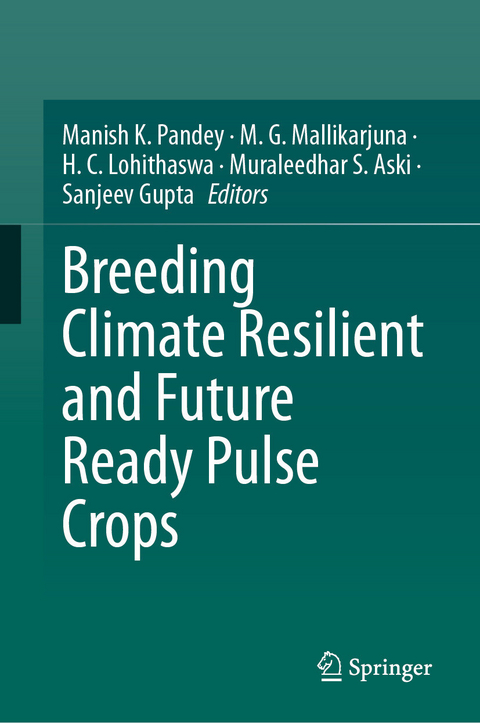
Breeding Climate Resilient and Future Ready Pulse Crops (eBook)
372 Seiten
Springer Nature Singapore (Verlag)
978-981-96-0483-8 (ISBN)
This edited volume covers the application of modern breeding tools for developing climate-smart pulse crop cultivars. The primary focus is on utilizing available genomic resources and next-generation breeding technologies such as genome-wide association mapping, genomic selection, genome editing, and accelerated breeding pipelines for the rapid development of stress-resilient, systems-specific pulse cultivars.
Pulses contribute to 10% of global daily protein intake and 5% of energy. Their ability to fix atmospheric nitrogen and serve as an alternative protein source to meat makes them crucial in combating global warming. With the global population expected to reach 9.8 billion by 2050, pulses production needs to increase by at least 70% to meet demand. However, pulses production is facing growing biotic and abiotic challenges, exacerbated by climate change. Thus, developing next-generation climate-smart cultivars is essential to ensure food and nutritional security. Recent efforts by global and national breeding communities have led to the discovery of new genomic resources, shifting breeding from phenotype-based to genome-based approaches. These advances integrate rapid generation advancement pipelines with genomic-assisted breeding, trait mapping, and genome editing tools.
This book is valuable for agricultural scientists, scholars, and graduate students involved in pulse crop improvement. It also serves as a reference for policymakers and research grant managers in formulating pulse research programs.
This edited volume covers the application of modern breeding tools for developing climate-smart pulse crop cultivars. The primary focus is on utilizing available genomic resources and next-generation breeding technologies such as genome-wide association mapping, genomic selection, genome editing, and accelerated breeding pipelines for the rapid development of stress-resilient, systems-specific pulse cultivars.Pulses contribute to 10% of global daily protein intake and 5% of energy. Their ability to fix atmospheric nitrogen and serve as an alternative protein source to meat makes them crucial in combating global warming. With the global population expected to reach 9.8 billion by 2050, pulses production needs to increase by at least 70% to meet demand. However, pulses production is facing growing biotic and abiotic challenges, exacerbated by climate change. Thus, developing next-generation climate-smart cultivars is essential to ensure food and nutritional security. Recent efforts by global and national breeding communities have led to the discovery of new genomic resources, shifting breeding from phenotype-based to genome-based approaches. These advances integrate rapid generation advancement pipelines with genomic-assisted breeding, trait mapping, and genome editing tools.This book is valuable for agricultural scientists, scholars, and graduate students involved in pulse crop improvement. It also serves as a reference for policymakers and research grant managers in formulating pulse research programs.
| Erscheint lt. Verlag | 20.2.2025 |
|---|---|
| Zusatzinfo | XVI, 372 p. 33 illus., 32 illus. in color. |
| Sprache | englisch |
| Themenwelt | Naturwissenschaften ► Biologie ► Botanik |
| Naturwissenschaften ► Biologie ► Ökologie / Naturschutz | |
| Weitere Fachgebiete ► Land- / Forstwirtschaft / Fischerei | |
| Schlagworte | climate change • Climate resilient • Crop improvement • Next- Generation Breeding • pulses • Stress |
| ISBN-10 | 981-96-0483-4 / 9819604834 |
| ISBN-13 | 978-981-96-0483-8 / 9789819604838 |
| Informationen gemäß Produktsicherheitsverordnung (GPSR) | |
| Haben Sie eine Frage zum Produkt? |
 PDF (Wasserzeichen)
DRM: Digitales Wasserzeichen
Dieses eBook enthält ein digitales Wasserzeichen und ist damit für Sie personalisiert. Bei einer missbräuchlichen Weitergabe des eBooks an Dritte ist eine Rückverfolgung an die Quelle möglich.
Dateiformat: PDF (Portable Document Format)
Mit einem festen Seitenlayout eignet sich die PDF besonders für Fachbücher mit Spalten, Tabellen und Abbildungen. Eine PDF kann auf fast allen Geräten angezeigt werden, ist aber für kleine Displays (Smartphone, eReader) nur eingeschränkt geeignet.
Systemvoraussetzungen:
PC/Mac: Mit einem PC oder Mac können Sie dieses eBook lesen. Sie benötigen dafür einen PDF-Viewer - z.B. den Adobe Reader oder Adobe Digital Editions.
eReader: Dieses eBook kann mit (fast) allen eBook-Readern gelesen werden. Mit dem amazon-Kindle ist es aber nicht kompatibel.
Smartphone/Tablet: Egal ob Apple oder Android, dieses eBook können Sie lesen. Sie benötigen dafür einen PDF-Viewer - z.B. die kostenlose Adobe Digital Editions-App.
Buying eBooks from abroad
For tax law reasons we can sell eBooks just within Germany and Switzerland. Regrettably we cannot fulfill eBook-orders from other countries.
aus dem Bereich