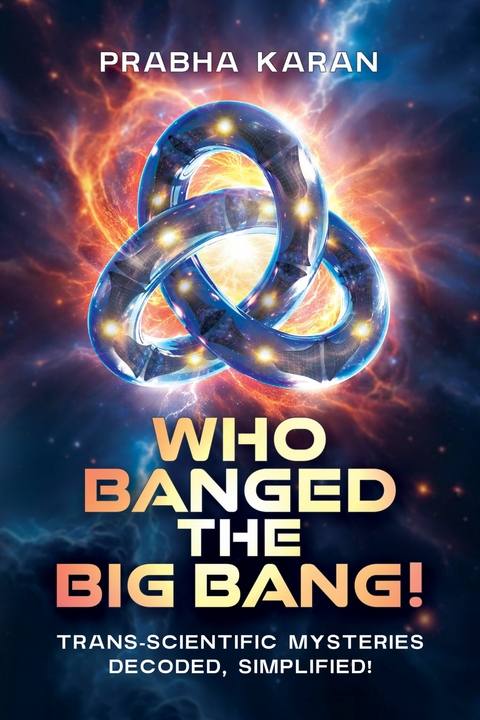
Who Banged the Big Bang! (eBook)
284 Seiten
Publishdrive (Verlag)
978-969-649-274-0 (ISBN)
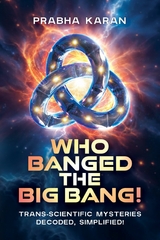
Scientists, physicists, mathematicians, theorists, and other thinkers have made significant contributions to advancements in medicine, technology, and philosophy. However, many of them grapple with even bigger questions: When and how did the universe begin? Why does it exist? What happened before the Big Bang? What is the purpose of human life? What occurs after death?
While these inquiries may seem cliché, they remain central to our quest for understanding. This book will explore these fundamental questions on both a macrocosmic and microcosmic scale. Our aim is to present established facts and methodically approach the unknown, particularly the mysteries surrounding the Big Bang, Infinity, and Consciousness. If you have considered the connection between your intellectual pursuits and these essential questions, this book is for you.
Chapter 1
Rarest of Humans Probe ‘The Infinite’
Though the Earth’s human population has now reached eight billion, the opportunity to be born as a human being is the rarest of the rare. Why? Consider the totality of living beings on this planet. The number runs into billions. This includes everything from great mammals to small insects and microbes. If plants are included as well, the number of individual living things becomes breathtakingly large. Compared to this, eight billion is an infinitesimally small number. This is why being born a human is exceedingly rare.
It’s even rarer to be born without any physical or mental defects that can prevent or interfere with a fully realized experience of life. And it’s rarer still to have the opportunity to get a proper education that introduces life’s higher values. Among this small group, how many will ever attempt to probe ‘the Infinite’? That type of person is the rarest of all beings on planet Earth.
Based on the number of tech universities and scientific institutions across the globe, it’s estimated that just about
10 million human beings are either actively or passively pursuing the Infinite through objective research and
scientific analysis. That’s 10 million out of eight billion. And those eight billion are part of an uncountably high number of living beings. To put this in perspective, consider another small group—the current number of millionaires worldwide. In 2024, it was estimated there were about
58 million millionaires globally. So those who pursue and probe the Infinite are rarer. Indeed, if you are among this rare 10 million, you are one of the luckiest people in the world.
Within this 10 million, different thinkers have adopted different strategies in their pursuit of the Infinite, ranging from the scientific to the spiritual. Some of their research has produced compelling results, but significant gaps remain in our understanding of Infinity and creation. When it comes to the Infinite, before the Big Bang, there was no consensus amongst the range of thinkers. The purpose of this book is to classify the spectrum of thinkers according to their domain and to explore their apparent pitfalls in the understanding of Infinity and the Big Bang. Our systematic approach will eventually narrow the continuously expanding gap between physicists, scientists, thinkers, researchers, and philosophers.
Before we begin that journey, however, let’s take a moment to discuss the spectrum of thinkers in the various fields of study and schools of thought that will come up throughout this book—our cast of characters, as it were. This will help us establish the hard evidence and postulated theories that have brought our collective understanding of the Infinite and the Big Bang to the point it’s at today.
Who pursues the Infinite?
So, who are these rare 10 million individuals? What do they do, and what are their thoughts?
First in line are the physicists, and these include the entire spectrum of astrophysicists and quantum physicists. They are the ones who deal with Infinity, in one way or another, directly and on a daily basis. They are the students and followers of scientists like Erwin Schrödinger, James Webb, Edwin Hubble, and others who came before or after them. The field of quantum physics is progressively evolving. In 2022, three physicists won a Nobel Prize for their work in entanglement, expanding our knowledge of the quantum relationship between particles and potentially enabling new advances.
Then come the theorists who focus on the more perplexing and extreme phenomena of our universe, the Big Bang, singularity, black holes, and wormholes. Those researching dark matter and dark energy fit in here, too. It is now believed that observable, ‘ordinary’ matter only represents 5% of all the energy in the universe, with dark matter representing 27% and dark energy 68%. No one knows what dark matter and dark energy actually are, but they do exist, and together they represent 95% of our universe.
Next are the scientists and researchers at SETI or the Search for Extra-Terrestrial Intelligence. This is the organization that probes outer space for signs of intelligent life. The discovery of and communication with extraterrestrial intelligence would represent a quantum leap forward in our understanding of infinity.
Another important organization is CERN, the European Organization for Nuclear Research. CERN houses the Large Hadron Collider (LHC), a 27-kilometer particle collider used to discover new subatomic particles. The LHC has enabled a number of important discoveries, including that of the Higgs boson. Still, a researcher there has indicated that the size of the LHC is not enough to enable the discovery of all subatomic particles. For that, we may need a collider with a diameter of the entire solar system.
Then there are the so-called ‘super scientists,’ those who seek to go beyond conventional physics with seemingly impossible materials, like super-fluids with zero viscosity or superconductors with zero resistance. The concept of super-consciousness has even been proposed, which would transcend ordinary Consciousness. It seems like every discipline has practitioners bold enough to push beyond the accepted boundaries of their field in an attempt to elevate our collective understanding of the rules that govern our existence.
But it’s not just the physicists who study the Infinite. Many in the scientific community also do so. Medical and biotech researchers, molecular chemists, and mathematicians—these scientists probe the Infinite passively. Developers of self-aware humanoids and artificial intelligence (AI) also belong to this group. With trillions of terra-bytes of data, the developers of AI apply themselves to the study of Consciousness/awareness and attempt to probe the Infinite within our Minds. To that end, psychologists who study the conscious, subconscious, and unconscious Minds also belong to this rare group.
Beyond the realm of real science, those who theorize about things like time travel and teleportation also have a place in this conversation. Though the science is unreal so
far, the desire to transcend time is a form of pursuing the Infinite. Similarly, readers and writers of science fiction engage in unreal but completely legitimate explorations of the Infinite.
Finally, we also need to include certain non-scientific individuals who fall on the spectrum between the spiritual and the intellectual. These include mystic power seekers, Kundaliners (kundalini practitioners), chakra healers, extreme Yoga practitioners, atheists, agnostics, and metaphysicians. This gives an idea of the entire spectrum of individuals who pursue the Infinite beyond scientific practice.
Now, let’s return to this rare 10 million. As we have seen, they belong to many different fields, practices, and traditions. What do they all have in common? Generally speaking, there are three aspects that they share. First, there is a focus on space, either universal, subatomic, or spiritual. Then, there is a focus on time and the rules that govern it. Third, there is a focus on causation and how it works in systems where cause and effect are cyclical. These three factors unite those who pursue Infinity.
Let’s now explore some of the answers that the rare
10 million have proposed.
What is Infinity?
Many disciplines of science and mathematics are centered on the idea of Infinity. But what is it? Is it a phenomenon? Is it numerical? Is it spatial? Is it temporal? Is it a quality? A quantity? Is it even real, or just a useful concept? These are some of the fundamental questions scientists and mathematicians have tried to answer. In some cases, they’ve come up with compelling explanations. Does this mean they’ve captured Infinity? We don’t know enough to say.
But let’s consider some of the theories they’ve presented
so far.
First, let’s see what math has to offer. Mathematics is full of different types of numbers: real numbers, rational and irrational numbers, and some numbers they call transcendental numbers. But beyond all the tangible numbers is the awareness that there is no numerical endpoint. Numbers exist within an infinity of numbers. Mathematicians have even proposed a system for categorizing distinct sets of Infinite numbers. These are known as the aleph numbers. So, mathematicians can describe and categorize Infinity, but does that mean they were able to capture what that it actually is?
Let’s next consider Hilbert’s paradox of the Grand Hotel. The paradox describes a hotel with Infinite rooms that is at full capacity and yet is still able to accommodate an infinite number of new guests. This illustrates how infinite numbers can interact, and yet, once again, is this insight the same as capturing Infinity?
Infinity doesn’t only exist on unimaginably large numerical scales, it can also be contained within a single number. For example, adding one-half, one-quarter, one-eighth, one-sixteenth, etc. will produce a number that comes infinitely close to one. But...
| Erscheint lt. Verlag | 19.2.2025 |
|---|---|
| Sprache | englisch |
| Themenwelt | Naturwissenschaften ► Physik / Astronomie ► Astronomie / Astrophysik |
| Schlagworte | Astronomy • astrophysics • Big Bang • Consciousness • Cosmology • Meditation • Spiritual • Yoga |
| ISBN-10 | 969-649-274-X / 969649274X |
| ISBN-13 | 978-969-649-274-0 / 9789696492740 |
| Informationen gemäß Produktsicherheitsverordnung (GPSR) | |
| Haben Sie eine Frage zum Produkt? |
 EPUB (Ohne DRM)
Digital Rights Management: ohne DRM
Dieses eBook enthält kein DRM oder Kopierschutz. Eine Weitergabe an Dritte ist jedoch rechtlich nicht zulässig, weil Sie beim Kauf nur die Rechte an der persönlichen Nutzung erwerben.
Dateiformat: EPUB (Electronic Publication)
EPUB ist ein offener Standard für eBooks und eignet sich besonders zur Darstellung von Belletristik und Sachbüchern. Der Fließtext wird dynamisch an die Display- und Schriftgröße angepasst. Auch für mobile Lesegeräte ist EPUB daher gut geeignet.
Systemvoraussetzungen:
PC/Mac: Mit einem PC oder Mac können Sie dieses eBook lesen. Sie benötigen dafür die kostenlose Software Adobe Digital Editions.
eReader: Dieses eBook kann mit (fast) allen eBook-Readern gelesen werden. Mit dem amazon-Kindle ist es aber nicht kompatibel.
Smartphone/Tablet: Egal ob Apple oder Android, dieses eBook können Sie lesen. Sie benötigen dafür eine kostenlose App.
Geräteliste und zusätzliche Hinweise
Buying eBooks from abroad
For tax law reasons we can sell eBooks just within Germany and Switzerland. Regrettably we cannot fulfill eBook-orders from other countries.
aus dem Bereich