


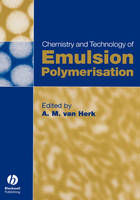
Chemistry and Technology of Emulsion Polymerisation
Seiten
2005
Blackwell Publishing Ltd (Verlag)
978-1-4051-2113-2 (ISBN)
Blackwell Publishing Ltd (Verlag)
978-1-4051-2113-2 (ISBN)
- Titel ist leider vergriffen;
keine Neuauflage - Artikel merken
Zu diesem Artikel existiert eine Nachauflage
A clear, comprehensive and straightforward discussion of emulsion polymerisation to illustrate how the underlying theory relates to practical application. Extensive use of schematic representations of principles Data tables containing important process characteristics.
Emulsion polymerisation produces high value polymers in a low cost, environmentally friendly process. The drive to develop environmentally benign production methods for polymers has resulted in widespread development and implementation of the emulsion polymerisation technique. In addition, when combined with novel polymerisation mechanisms the process can give rise to a range of polymer products with particularly useful properties. Emulsion polymerisation is a complex process, governed by the interplay of both chemical and physical properties including polymerisation kinetics and dispersion stability. Successful industrial application relies on understanding and controlling those properties. By carefully explaining the principles of the reaction, based on well-designed experimental investigation, "Chemistry and Technology of Emulsion Polymerisation" provides a practical and intuitive explanation of emulsion polymerisation.In the development of industrial processes, coupling that understanding with everyday practice can be a further difficult step, so the book emphasises a clear, comprehensive and straightforward discussion to illustrate how the principles relate to practical application.
Written for research chemists, technologists and engineers in the polymer, fine and specialty chemicals industries, and in university or government laboratories, this book will be particularly valuable to those early on in their careers. The comprehensive and straightforward coverage will also ensure it is an important resource for advanced courses in emulsion polymerisation.
Emulsion polymerisation produces high value polymers in a low cost, environmentally friendly process. The drive to develop environmentally benign production methods for polymers has resulted in widespread development and implementation of the emulsion polymerisation technique. In addition, when combined with novel polymerisation mechanisms the process can give rise to a range of polymer products with particularly useful properties. Emulsion polymerisation is a complex process, governed by the interplay of both chemical and physical properties including polymerisation kinetics and dispersion stability. Successful industrial application relies on understanding and controlling those properties. By carefully explaining the principles of the reaction, based on well-designed experimental investigation, "Chemistry and Technology of Emulsion Polymerisation" provides a practical and intuitive explanation of emulsion polymerisation.In the development of industrial processes, coupling that understanding with everyday practice can be a further difficult step, so the book emphasises a clear, comprehensive and straightforward discussion to illustrate how the principles relate to practical application.
Written for research chemists, technologists and engineers in the polymer, fine and specialty chemicals industries, and in university or government laboratories, this book will be particularly valuable to those early on in their careers. The comprehensive and straightforward coverage will also ensure it is an important resource for advanced courses in emulsion polymerisation.
Alex van Herk is Professor and Head of the emulsion polymerisation group in the Laboratory of Polymer Chemistry and Technology, Eindhoven University of Technology, Netherlands.
Contributors. List of Freqiuently Used Symbols. Abbreviations. Introduction. 1 Historic Overview. 2 Introduction to Radical (co)Polymerisation. 3 Emulsion Polymerisation. 4 Emulsion Copolymerisation, Process Strategies and Morphology. 5 Controlled Radical Polymerisation in Emulsion Polymerisation. 6 Colloidal Aspects of Emulsion Polymerisation. 7 Latex Polymer Characterization. 8 Particle Analysis. 9 Systematic Overview of Bulk Applications of Latex Polymers. 10 Specialty Applications of Latex Polymers. References. Index.
| Erscheint lt. Verlag | 2.9.2005 |
|---|---|
| Zusatzinfo | 100 illustrations |
| Verlagsort | Oxford |
| Sprache | englisch |
| Maße | 178 x 248 mm |
| Gewicht | 872 g |
| Themenwelt | Naturwissenschaften ► Chemie |
| ISBN-10 | 1-4051-2113-0 / 1405121130 |
| ISBN-13 | 978-1-4051-2113-2 / 9781405121132 |
| Zustand | Neuware |
| Informationen gemäß Produktsicherheitsverordnung (GPSR) | |
| Haben Sie eine Frage zum Produkt? |
Mehr entdecken
aus dem Bereich
aus dem Bereich
Gefüge von Metallen, Keramiken und Verbunden
Buch | Hardcover (2025)
Wiley-VCH (Verlag)
CHF 149,95


