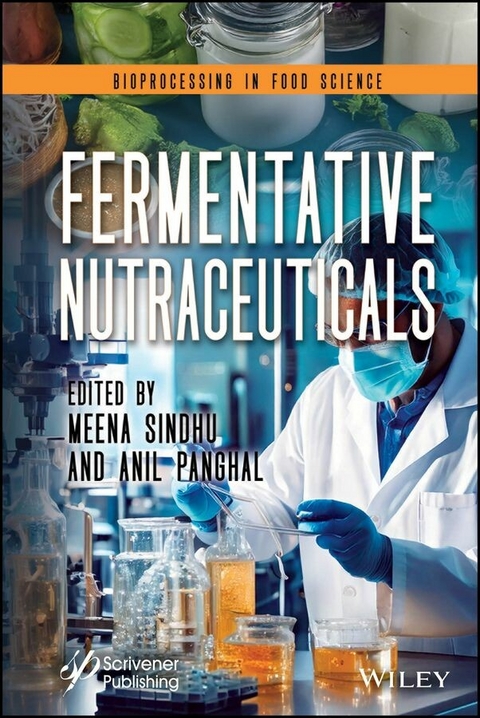
Fermentative Nutraceuticals (eBook)
518 Seiten
Wiley-Scrivener (Verlag)
978-1-119-77653-6 (ISBN)
Fermentative Nutraceuticals, the latest volume in the series Bioprocessing in Food Science, presents recent advances and breakthroughs in bioactive peptides derived from fermented foods, highlighting their applications as nutraceuticals. This volume explores opportunities for product design and innovation in food processing.
Bioprocessing in Food Science is a series of volumes that comprehensively covers unit operations in food processing. This latest installment addresses the advances, breakthroughs, and challenges associated with fermentative nutraceuticals.
The demand for food nutraceuticals and functional foods is growing among consumers worldwide. Academia, researchers, and the food industry are working in a fragmented manner, with technologies developed at each level often not compiled in a unified resource for stakeholders. Typically, the foods we consume are enriched with certain nutrients but deficient in others. Microbial fermentation can enhance the nutritional properties of food. Bioactive peptides produced through fermentation exhibit antioxidative, anticancer, and antidiabetic properties. Increased efforts from the food industry are needed to focus research on peptides and their applications as food-grade preservatives and functional food ingredients.
This groundbreaking volume provides a comprehensive compilation of existing research, practical applications, and future research prospects. The editors and contributing experts have made an earnest effort to include every possible detail, presenting an up-to-date repository of scientific literature and their own research findings. This volume is an invaluable resource for students, researchers, product developers, and industry professionals.
Meena Sindhu, PhD, is a scientist in the Department of Microbiology at CCS Haryana Agricultural University, Hisar, India. She has published numerous research papers in scientific journals and book chapters for international publishers. She has also authored two books focused on biotechnology. Her areas of expertise include microbial fermentation, enzyme technology, and biocontrol. Dr. Sindhu is currently researching the extraction of bioactive peptides and their physiological functions from cereals and pseudocereals.
Anil Panghal, PhD, is an assistant scientist in the Department of Processing and Food Engineering at CCS Haryana Agricultural University. Previously, he worked as a production manager at Nestlé for nine years. His areas of expertise include bioprocessing, manufacturing, food chemistry, food science and technology, food safety management systems (FSMS), and nutrition. He earned his PhD in food technology, focusing on the molecular and physicochemical quality aspects of commercial wheat varieties. Dr. Panghal has published numerous research papers in reputable journals and book chapters for international publishers.
Fermentative Nutraceuticals, the latest volume in the series Bioprocessing in Food Science, presents recent advances and breakthroughs in bioactive peptides derived from fermented foods, highlighting their applications as nutraceuticals. This volume explores opportunities for product design and innovation in food processing. Bioprocessing in Food Science is a series of volumes that comprehensively covers unit operations in food processing. This latest installment addresses the advances, breakthroughs, and challenges associated with fermentative nutraceuticals. The demand for food nutraceuticals and functional foods is growing among consumers worldwide. Academia, researchers, and the food industry are working in a fragmented manner, with technologies developed at each level often not compiled in a unified resource for stakeholders. Typically, the foods we consume are enriched with certain nutrients but deficient in others. Microbial fermentation can enhance the nutritional properties of food. Bioactive peptides produced through fermentation exhibit antioxidative, anticancer, and antidiabetic properties. Increased efforts from the food industry are needed to focus research on peptides and their applications as food-grade preservatives and functional food ingredients. This groundbreaking volume provides a comprehensive compilation of existing research, practical applications, and future research prospects. The editors and contributing experts have made an earnest effort to include every possible detail, presenting an up-to-date repository of scientific literature and their own research findings. This volume is an invaluable resource for students, researchers, product developers, and industry professionals.
1
Bioactive Compounds and Their Benefits
Love Singla1* and Smriti Batoye2
1Department of Microbiology, Maharaja Agrasen University, Baddi, Himachal Pradesh, India
2Department of Zoology, Maharaja Agrasen University, Baddi, Himachal Pradesh, India
Abstract
Bioactive compounds are one of human health's most critical and essential components. These are primarily released from various biological sources, including microorganisms (bacteria, fungi, and algae), animals, and endophytes. Their molecular diversity offers excellent support in possessing several therapeutic attributes and biological workings. Over the past few years, massive natural compounds have been extracted, identified, and applied as dietary or medicinal compounds. Because of this reason, various pharmaceutical and food industries have shown their interest in shifting to these kinds of bioactive compounds to uncover the secrets of disease treatments and enhancement of food nutritional components by these compounds of diverse biological origin. Several bacterial species help combat human diseases, including intestinal, liver, and kidney infections. In addition to bacteria, several algal and fungal species also help in the containment of these kinds of conditions. Moreover, some compounds are also procured from animals and endophytes. Let us detail the applications of these bioactive compounds in human health and disease protection.
Keywords: Bioactive compounds, bacterial origin, microalgal origin, animal origins, endophytic origins
1.1 Introduction
In this contemporary world, several reports have stated the dangerous effects of bad eating habits and the rapid pace of junk food intake compared to the past decade. Moreover, excess intake of antibiotics has increased the cases of antibiotic resistance, which has affected thousands of patients at present. This dissimilarity among the eating patterns has led to the enhancement of oxidative stress levels that, in turn, causes various chronic disorders like cardiovascular and neurodegenerative disorders and several types of cancer [1]. According to the WHO reports, most of the mortality rate has been because of cancer in the last decade globally [2]. Similar to cancer, diabetes mellitus is also one of the dangerous disorders in present times that are associated with several health problems like heart failure, kidney dysfunction, and blindness [3–5]. Due to the enhancement of antibiotic resistance, scientists look forward to newer approaches to combat this apocalypse. In addition, several other problems are also increasing with antibiotic resistance, like toxicity in cells and metabolic dysfunctioning [1]. Researchers use natural products/metabolites as alternative and safe options against pathogenic microbes [6]. Their presence in day-today diet or standardized formulation helps prevent the negative impact of oxidative stress on human health [7–10].
Natural compounds or metabolites are among the safest and eco-friendliest sources in various living entities like microorganisms, endophytes, plants, animals, and humans [11]. It comprises a large number of chemically diversified and is marked as one of the remarkable therapeutics capable of fighting against a wide variety of infectious entities. The first ever bioactive molecule beneficial for human health was found in ancient Mesopotamia near 2600 B.C. Over time, natural bioactive metabolites gain importance but at a slow rate compared to antibiotics growth in the pharmaceutical market. In today's world, more than 60% of pharmaceutical products are derived from compounds with bioactive properties, and around 50% of Food and Drug Administration (FDA)–approved drugs are related to bioactive metabolites [12, 13].
The application of natural metabolite for human benefit is seen from the discovery of the penicillin antibiotic. The accidental discovery of penicillin from a fungal species called Penicillium chrysogenum (earlier known as Penicillium notatum) in 1928 has led to the scientific interest shift from plants to microbes regarding the extraction of metabolites as a bioactive compound source [14]. From then, the secondary metabolites of microbes gain their application in various fields like pharmaceuticals, healthcare, the food industry, and scientific research [15]. With the advancement in technology, scientists gain the ability to discover newer beneficial effects of bioactive compounds on human health, including various discoveries of new methods that help in the development of novel therapies [16]. These bioactive compounds are further investigated for several properties that make them the best candidate for the fight against antibiotic resistance and attenuate the symptoms of several pathogenic infections, which are gaining power at an alarming rate [17].
Herein, we will summarize several bioactive compounds of various origins like plants, animals, endophytes, marine environment, and microorganisms and their biological applications in present-day pharmaceutical industries and discoveries of various newer therapies.
1.2 Bioactive Compounds of Microbial Origin
1.2.1 Bacterial Origin
The presence of dietary compounds in a contemporary diet provides an excellent way to enhance the nutritional value of public health [18]. The presence of various compounds having nutraceutical value and the addition of dietary compounds leads to the decrement of disease occurrence possibilities. This implies the importance of emerging innovative functional foods that help in providing physiological benefits and decreases the long-term risk of disease occurrence [19]. In these functional food groups, lactic acid is one of the most important examples that is further divided into three groups based on the availability in different formulations [20]:
1.2.1.1 Probiotics
These play a crucial role in enhancing the digesting mechanism in microbes, like most of the Lactobacillus and Bifidobacterium genera species. These benefit the host by maintaining the intestine–bacteria balance and growing in association with the intestinal mucosa by releasing several enzymes that help preserve osmoregulation and digestion. Due to so many benefits for human health, these are incorporated in various substances/products like yogurts, ice cream, and frozen dairy desserts [21, 22].
1.2.1.2 Prebiotics
These are a group of food supplements that are non-digestible and are extracted from the plants followed by the action of hydrolytic enzymes but have the ability to stimulate the multiplication/growth of specific natural microbiota/probiotic bacteria present in the colon region by providing various kinds of development promoting/enhancing derivatives or nutrients [23].
1.2.1.3 Biogenics
These are the bioactive compounds released by various bacterial species in favor of the host, i.e., they help the host in multiple types like its growth, immunostimulation, peroxidation, and intestinal putrefaction.
In addition to the growth enhancement of intestinal microbiota with the help of various growth-enhancing compounds produced by the different bacterial species, they also release various other biogenic compounds that function against other bacteria species, leading to the bactericidal effect and enhancing the immune system by acting as an immunostimulant [20]. Due to various health-beneficial effects (treatment of several human-associated intestinal dysfunctions) other than gut-specific (enhanced digestion) and immunological (cell-mediated immune response), it is believed that probiotics show beneficial effects at both levels (cellular and molecular levels) [24, 25]. Moreover, these probiotics can also act as a delivery system for different types of vaccines without being affected by intestinal microbiota. Recent reports also explain the beneficial properties of probiotics in cancer therapy and as a therapeutic agent in patients with high cholesterol levels [26]. Mainly, Lactobacillus and Bifidobacterium species are primarily associated with the functioning of probiotics due to their beneficial properties like non-pathogenic, safe to consume, metabolic stable, adherence to the walls of the intestine, and no antibiotic resistance.
In addition to benefits, there should be some properties that bacteria species should possess to be a part of the probiotic group. It includes the survival ability of bacilli along the upper digestive tract (resistance from hydrochloric acid, gastric juice including bile, various proteolytic enzymes, and several other reactive-oxidative radicles) and possesses the ability to aggregate along through the natural microbiota present in the lower digestive tract with the secretion of several beneficial compounds that have the capability to enhance the health status of the host after its adherence along the intestinal walls [20, 26]. However, during the delivery of probiotic bacteria to its site, we encounter various problems (biotic and abiotic) that resist its effect, leading to its loss of beneficial properties. Biotic conditions include a decrease in the viability of probiotic microbes in dairy food materials. Abiotic conditions include variations in pH, temperature, and the concentration of dissolved oxygen in the medium.
To overcome these conditions, several delivery systems/approaches are used to enhance probiotic resistance by selecting specific bacterial...
| Erscheint lt. Verlag | 13.2.2025 |
|---|---|
| Sprache | englisch |
| Themenwelt | Naturwissenschaften ► Biologie |
| Naturwissenschaften ► Chemie | |
| Weitere Fachgebiete ► Land- / Forstwirtschaft / Fischerei | |
| ISBN-10 | 1-119-77653-8 / 1119776538 |
| ISBN-13 | 978-1-119-77653-6 / 9781119776536 |
| Informationen gemäß Produktsicherheitsverordnung (GPSR) | |
| Haben Sie eine Frage zum Produkt? |
 EPUB (Adobe DRM)
Kopierschutz: Adobe-DRM
Adobe-DRM ist ein Kopierschutz, der das eBook vor Mißbrauch schützen soll. Dabei wird das eBook bereits beim Download auf Ihre persönliche Adobe-ID autorisiert. Lesen können Sie das eBook dann nur auf den Geräten, welche ebenfalls auf Ihre Adobe-ID registriert sind.
Details zum Adobe-DRM
Dateiformat: EPUB (Electronic Publication)
EPUB ist ein offener Standard für eBooks und eignet sich besonders zur Darstellung von Belletristik und Sachbüchern. Der Fließtext wird dynamisch an die Display- und Schriftgröße angepasst. Auch für mobile Lesegeräte ist EPUB daher gut geeignet.
Systemvoraussetzungen:
PC/Mac: Mit einem PC oder Mac können Sie dieses eBook lesen. Sie benötigen eine
eReader: Dieses eBook kann mit (fast) allen eBook-Readern gelesen werden. Mit dem amazon-Kindle ist es aber nicht kompatibel.
Smartphone/Tablet: Egal ob Apple oder Android, dieses eBook können Sie lesen. Sie benötigen eine
Geräteliste und zusätzliche Hinweise
Buying eBooks from abroad
For tax law reasons we can sell eBooks just within Germany and Switzerland. Regrettably we cannot fulfill eBook-orders from other countries.
aus dem Bereich