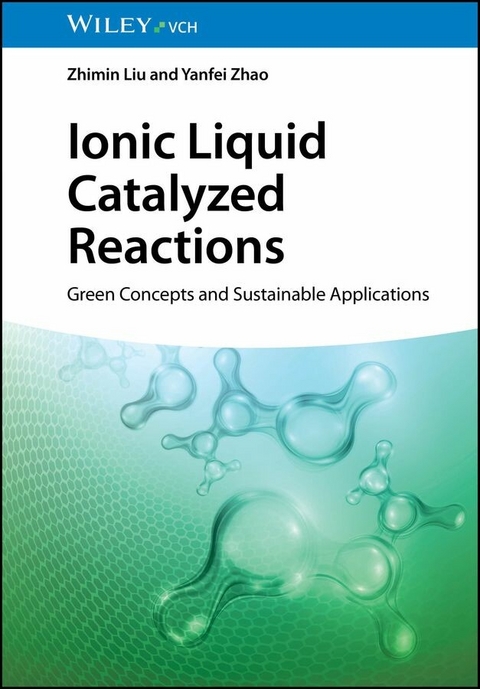
Ionic Liquid Catalyzed Reactions (eBook)
728 Seiten
Wiley-VCH (Verlag)
978-3-527-83895-0 (ISBN)
Understand the applications of ionic liquid catalysis with this cutting-edge overview
Ionic liquids have distinctive properties that have made them the subject of vigorous research in recent decades. They have primarily been seen as potential green alternatives to volatile organic solvents, and therefore as a vital tool in the development of sustainable industry. In fact, however, ionic liquids can also serve as catalysts, catalyst immobilizers, and initiators, with the result that they have been applied in over 100 known types of chemical reactions.
Ionic Liquid Catalyzed Reactions: Green Concepts and Sustainable Applications offers a detailed overview of these reactions and the catalytic mechanism of ionic liquids. It surveys cutting-edge research into ionic liquid catalysis and the concepts, perspectives, and skills needed for scientists to incorporate it into a range of experimental fields. It is a must-own for anyone looking to understand the range and variety of uses for ionic liquid catalysis.
Ionic Liquid Catalyzed Reactions readers will also find:
- Case studies throughout showing ionic liquid catalysis applications
- Information for scientists working in organic chemistry, electrochemistry, biotechnology, and many more
- Detailed coverage of reactions including CO2 conversion, biomass transformation, organic synthesis, and many others
Ionic Liquid Catalyzed Reactions is ideal for catalytic chemists, organic chemists, environmental chemists, electrochemists, and anyone else working with chemical catalysis in need of new experimental methods.
Zhimin Liu, PhD, is Professor at the Institute of Chemistry, Chinese Academy of Sciences (ICCAS), China. She has spent most of her career conducting research at ICCAS. She is the recipient of numerous scientific awards. She is an Editor-in-Chief of Current Opinion in Green and Sustainable Chemistry.
Yanfei Zhao, PhD, is Associate Professor at ICCAS, China. Her current research interest concentrates on the ionic liquid-promoted transformation of renewable carbon resources.
Chapter 1
Background and Overview
Contents
1.1 Introduction
With the development of science and technology, fossil fuel consumption has increased significantly. The emission of a huge amount of CO2 and accumulation of spent or discarded synthetic materials pose a huge threat to the current ecosystem and human health. As a result, we are facing the challenges of energy crisis and sustainable development. To tackle these issues, the carbon neutrality goal has been proposed and accepted worldwide. Green chemistry, especially, green carbon science, provides a chemical solution to achieve carbon neutrality, which mainly involves highly efficient utilization of fossil resources, the transformation of renewable carbon resources (e.g. CO2 and lignocellulose) into chemicals/fuels in a green way, and recycling of spent synthetic carbon-containing materials (e.g. spent plastics) [1–5]. In the past decades, great efforts have been dedicated to the chemical transformation of renewable and recyclable carbon resources into chemicals and fuels, and numerous achievements have been made that afford alternative strategies to access energy and chemicals, which is of great significance to achieve the carbon neutrality goal and sustainable development.
Catalysts are generally needed to achieve the chemical transformation of carbon resources. For example, CO2 is thermodynamically stable and kinetically inert, and thus its transformation usually needs high energy input and catalysts with high activity. To date, various catalysts have been developed for the transformation of CO2 into chemicals and fuels through different protocols including thermal catalysis, electroreduction, and photoreduction. Lignocellulose and its derivatives possess complicated structures, and thus catalysts are highly required to cleave the chemical bonds in lignocellulose and form the target products. Similarly, the recycling of spent plastics cannot be complemented in the absence of catalysts.
Ionic liquids (ILs) are a kind of molten salts composed of organic cations and inorganic/organic anions, remaining in a liquid state below 100 °C. Generally, ILs possess unique properties, such as negligible vapor pressure, good affinity with a wide range of chemicals, high thermal and chemical stability, easy recyclability, high conductivity, and a wide electrochemical window. In particular, they are highly designable and can be designed with specific functions through careful design and choice of task-specific component ions. To date, various kinds of ILs have been synthesized, such as acidic ILs, basic ILs, protic ILs, chiral ILs, and so on. There exist multiple interactions in IL systems, including Coulomb interaction, hydrogen bonding, halogen bonding, Van der Waals force, hydrophilic/hydrophobic interaction, and π–π interaction, which provide the ILs with unique properties and advantages over traditional molecular liquids. Therefore, they have shown wide applications in many fields, such as separation process, chemical reaction process, material synthesis and processing, battery electrolytes, etc.
Due to their designable and unique properties, ILs have emerged as green solvents and/or catalysts to be used in chemical reaction processes. Especially, different kinds of IL catalysts have been designed for the transformation of renewable and recyclable carbon resources into chemicals and fuels, and for green reactions such as oxidation, water-involved reactions (i.e. dehydration, hydration, and hydrolysis), alkylation, and other organic reactions. In particular, the unique properties of ILs endow them with the opportunity to serve as metal-free catalysts, and the combination with metal catalysts makes IL-based catalysts have wider applications.
This book focuses on the IL-catalyzed chemical transformation of renewable carbon resources into chemicals and fuels, together with green protocols relevant to IL catalysis.
1.2 Ionic Liquids
ILs are highly designable; they can be designed with an acidic site, basic site, or hydrogen bond (HB) donor and/or acceptor, and can be complexed with Lewis acids and bases to form Lewis acidic or basic ILs. To date, various ILs including acidic ILs, basic ILs, neutral ILs, and chiral ILs have been applied in different chemical reactions, showing promising application potential. In the following subsections, acidic ILs, basic ILs, neutral ILs, and chiral ILs are described, with their applications in catalyzing reactions.
1.2.1 Acidic ILs
Acidic ILs can be classified into Brønsted acidic ILs, Lewis acidic ILs, Brønsted–Lewis acidic ILs, and heteropolyacid-based ILs, which have their unique properties originating from their structures, and thus have been used as catalysts for different chemical reactions. Compared with acid catalysts (e.g. H2SO4), acidic IL catalysts generally display enhanced performance, and can alleviate or inhibit corrosion to the reaction equipment as well. Therefore, acidic ILs may be applied to replace the traditional acid catalysts, and various investigations have been made. Especially, acidic ILs as catalysts display high activity for catalyzing water-involved chemical reactions, including dehydration, hydration, and hydrolysis, and they are also effective for catalyzing the transformation of lignocellulose and its derivatives into chemicals, oxidation reactions, decomposition of polyesters, and so on.
Brønsted acidic ILs are generally a kind of ILs with acidic sites (e.g. ─SO3H, ─COOH, and ─H) at cations or with acidic anions (e.g. [HSO4]−), as shown in Scheme 1.1, which can provide protons and exhibit acidity in IL systems. Among the reported acidic ILs, the 1-(1-alkylsulfonic acid)-3-methylimidazolium-based ILs that possess ─SO3H at the alkyl group of cations have been widely investigated, serving as acidic catalysts for various chemical reactions, and they usually display enhanced activity compared with the traditional acid catalysts. For example, 1-(1-butylsulfonic acid)-3-methylimidazolium trifluoromethanesulfonate ([SO3H─BMIm][OTf]) has been reported to exhibit outstanding performance for catalyzing ring-closing metathesis of aliphatic ethers to O-heterocycles [6], and 2-phenyl-2-imidazoline-based SO3H-functionalized acidic ILs could effectively catalyze the hydrolysis of cellulose to glucose in 1-butyl-3-methylimidazolium chloride ([BMIm]Cl) [7]. Additionally, [SO3H─(CH2)3─py]2[TiF6] can effectively catalyze the oxidation of a wide range of sulfides, producing corresponding sulfoxides in high-to-good yields [8]. Compared with ─SO3H-functionalized acidic ILs, ─COOH-functionalized ILs possess weaker acidity, and they usually exhibit lower activity.
Scheme 1.1 Chemical structures of typical Brønsted acidic ILs.
The Brønsted acidic ILs with [HSO4]− anion and various cations, such as [BMIm][HSO4], [SO3H─BMIm][HSO4], [SO3H─(CH2)4─py][HSO4], [HOOC─CH2─py][HSO4], and [HOOC─CH2─MIm][HSO4], have been widely applied as acidic catalysts for different reactions. For example, [BMIm][HSO4] as both a reaction medium and a catalyst can efficiently realize dehydration of xylose to furfural at 120 °C [9]. The [HSO4]− anion-based ILs are found to be effective for oxidative desulfurization using H2O2 as the oxidant because the [HSO4]− anion as an acidic counterion can provide an acidic medium to enhance the oxidation ability of H2O2 [10].
Protic Brønsted acidic ILs refer to those derived from the neutralization of a Brønsted acid (e.g. H2SO4, HBF4, CF3COOH, HNO3, HCl, etc.) with an organic base (e.g. pyridine, imidazole, N,N-dimethylformamide, etc.) that is a proton acceptor, which show high acidity and related activity for catalyzing some reactions. For example, protic ILs with [HCPL]+ cation obtained from caprolactam (CPL) and Brønsted acids (e.g. CF3COOH, HNO3, and H2SO4) exhibit high catalytic activity for oxidative desulfurization of S-containing compounds using H2O2 [11]. [Hpy][HSO4] originated from pyridine and H2SO4 can achieve the direct conversion of hemicellulose to furfural [12]. The protic Brønsted acidic ILs with [TFA]− anion, such as [HBMIm][TFA] and [HTBD][TFA] (Scheme 1.1), are demonstrated to work well for various organic amine dehydration formylation reactions with formic acid under mild conditions, yielding a series of N-formylation products with high yields [13,14].
Lewis acidic ILs are generally derived from Lewis acids (e.g. metal halides) and ILs that have the same anion with the Lewis acids. For example, as AlCl3 is dissolved in [BMIm]Cl, the metal ion, Al3+, can coordinate with more Cl− ions to form metal-containing anions such as [AlCl4]−, [Al2Cl7]−, and so on, thus forming a series of Lewis acidic ILs based on the molar ratios of AlCl3 to [BMIm]Cl. To date, various Lewis acidic ILs have been developed by choosing Lewis acids and ILs. Among the Lewis acids, metal halides, such as AlCl3, CrCl2, FeCl3, CuBr2, SnCl2, have been widely applied to construct Lewis acidic ILs in combination with different ILs, especially 1-alkyl-3-methylimidazolium-based ILs. This kind of IL generally displays the liquid state at...
| Erscheint lt. Verlag | 11.2.2025 |
|---|---|
| Sprache | englisch |
| Themenwelt | Naturwissenschaften ► Chemie |
| Schlagworte | Alkylation • Biomass Transformation • catalyst immobilizers • CO2 conversion • Green Catalysis • green transformation • Hydrogenation • Hydrogenolysis • Hydrolysis • Organic Chemistry • organic synthesis • Oxidation |
| ISBN-10 | 3-527-83895-3 / 3527838953 |
| ISBN-13 | 978-3-527-83895-0 / 9783527838950 |
| Informationen gemäß Produktsicherheitsverordnung (GPSR) | |
| Haben Sie eine Frage zum Produkt? |
 EPUB (Adobe DRM)
Kopierschutz: Adobe-DRM
Adobe-DRM ist ein Kopierschutz, der das eBook vor Mißbrauch schützen soll. Dabei wird das eBook bereits beim Download auf Ihre persönliche Adobe-ID autorisiert. Lesen können Sie das eBook dann nur auf den Geräten, welche ebenfalls auf Ihre Adobe-ID registriert sind.
Details zum Adobe-DRM
Dateiformat: EPUB (Electronic Publication)
EPUB ist ein offener Standard für eBooks und eignet sich besonders zur Darstellung von Belletristik und Sachbüchern. Der Fließtext wird dynamisch an die Display- und Schriftgröße angepasst. Auch für mobile Lesegeräte ist EPUB daher gut geeignet.
Systemvoraussetzungen:
PC/Mac: Mit einem PC oder Mac können Sie dieses eBook lesen. Sie benötigen eine
eReader: Dieses eBook kann mit (fast) allen eBook-Readern gelesen werden. Mit dem amazon-Kindle ist es aber nicht kompatibel.
Smartphone/Tablet: Egal ob Apple oder Android, dieses eBook können Sie lesen. Sie benötigen eine
Geräteliste und zusätzliche Hinweise
Buying eBooks from abroad
For tax law reasons we can sell eBooks just within Germany and Switzerland. Regrettably we cannot fulfill eBook-orders from other countries.
aus dem Bereich