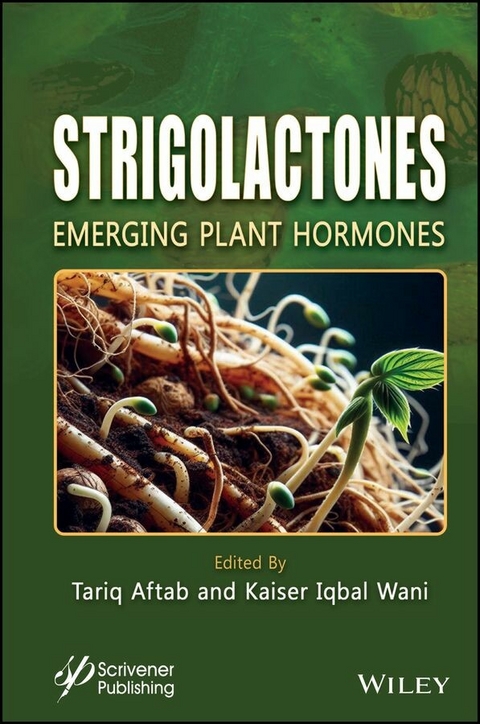
Strigolactones (eBook)
483 Seiten
Wiley-Scrivener (Verlag)
978-1-394-30280-2 (ISBN)
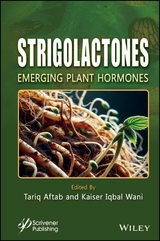
This book is a comprehensive guide to strigolactones' role in plant biology, growth, and sustainable agriculture.
Strigolactones, a fascinating and rapidly evolving class of plant hormones, have garnered significant attention in plant biology over the past decade. Initially discovered for stimulating the germination of parasitic plants, strigolactones are now recognized as key regulators of numerous plant processes, including growth, development, and response to environmental stresses. Their multifaceted nature and wide-ranging impact on plant physiology make strigolactones a critical study area for researchers aiming to enhance crop yield, resilience, and overall agricultural productivity.
This edited volume provides a comprehensive overview of the current state of knowledge on strigolactones, exploring their biosynthesis, signaling mechanisms, and practical applications in agriculture. The book collects contributions from leading experts in the field, offering a diverse and in-depth perspective on the various roles that strigolactones play in plant biology.
The chapters in this volume cover a broad spectrum of topics, from the molecular and genetic basis of strigolactone biosynthesis to their interactions with other phytohormones and environmental factors. The book examines the regulatory functions of strigolactones in plant architecture, including shoot branching, root development, and leaf senescence, as well as their involvement in stress responses such as drought, salinity, and pathogen attack. Also highlighted are recent advancements in understanding strigolactone signaling pathways and the potential for genetic engineering to manipulate these hormones for crop improvement.
Audience
Plant biologists, agronomists, horticulturists, and agriculture industry professionals studying plant development to address agricultural challenges.
Tariq Aftab, PhD, is an assistant professor at Aligarh Muslim University, Aligarh, Uttar Pradesh, India. He has published over 100 research articles and edited 20 books with international publishers. He is the recipient of a prestigious Leibniz-DAAD fellowship from Germany, Raman Fellowship from the Government of India, and Young Scientist Awards from the State Government of Uttar Pradesh (India) and the Government of India.
Kaiser Iqbal Wani, PhD, is a senior research fellow in the Department of Botany, Aligarh Muslim University, Aligarh, India. He is a recipient of a prestigious national fellowship CSIR/UGC JRF. He has several journal articles and book chapters to his name. His research focuses on molecular, proteomic, physiological, and biotechnological studies of medicinal plants under adverse environmental conditions.
This book is a comprehensive guide to strigolactones role in plant biology, growth, and sustainable agriculture. Strigolactones, a fascinating and rapidly evolving class of plant hormones, have garnered significant attention in plant biology over the past decade. Initially discovered for stimulating the germination of parasitic plants, strigolactones are now recognized as key regulators of numerous plant processes, including growth, development, and response to environmental stresses. Their multifaceted nature and wide-ranging impact on plant physiology make strigolactones a critical study area for researchers aiming to enhance crop yield, resilience, and overall agricultural productivity. This edited volume provides a comprehensive overview of the current state of knowledge on strigolactones, exploring their biosynthesis, signaling mechanisms, and practical applications in agriculture. The book collects contributions from leading experts in the field, offering a diverse and in-depth perspective on the various roles that strigolactones play in plant biology. The chapters in this volume cover a broad spectrum of topics, from the molecular and genetic basis of strigolactone biosynthesis to their interactions with other phytohormones and environmental factors. The book examines the regulatory functions of strigolactones in plant architecture, including shoot branching, root development, and leaf senescence, as well as their involvement in stress responses such as drought, salinity, and pathogen attack. Also highlighted are recent advancements in understanding strigolactone signaling pathways and the potential for genetic engineering to manipulate these hormones for crop improvement. Audience Plant biologists, agronomists, horticulturists, and agriculture industry professionals studying plant development to address agricultural challenges.
1
Strigolactones: Journey from Rhizospheric Chemoattractants to Plant Growth Regulators
Kaiser Iqbal Wani, M. Naeem and Tariq Aftab*
Department of Botany, Faculty of Life Sciences, Aligarh Muslim University, Aligarh, India
Abstract
Strigolactones are a broad class of plant hormones that have progressed from being identified solely as chemoattractants in the rhizosphere to becoming important regulators of plant growth and development. Originally identified by their ability to promote the germination of seeds from parasitic plants such as Striga, Orobanche, and Phelipanche, strigolactones are now widely recognized as a novel class of plant hormones that play an important role in plant growth regulation. They play an important role in developing symbiotic associations with microbes such as rhizobia and arbuscular mycorrhizal fungi (AMF), which facilitate nutrient absorption, especially under nutrient-scarce conditions. Their main influence on root development, shoot branching, and overall plant architecture has been demonstrated by numerous studies conducted in the last two decades. This novel group of hormones aids plants in integrating environmental cues for the regulation of many development processes by influencing the transport and signaling of other hormones, especially auxins. Their involvement in a wide range of growth and developmental processes in plants, under both normal and stressed conditions, highlights their potential for agricultural applications, including enhancing crop resilience and productivity in challenging conditions.
Keywords: Strigolactone, Striga, Orobanche, rhizospheric chemoattractant, agriculture
1.1 Introduction
In biology, hormones are a class of signaling molecules secreted by specific glands in organisms and transported to target organs via the circulatory system to regulate physiology and behavior. Traditionally associated with glands in animals, these molecules impart an action that is beyond simple chemical secretions either locally diffused to nearby cells or acting on the cells themselves that secrete them. Once these hormones reach their target cells, they bind with specific receptor proteins, and signal transduction pathways induce a cascade of cellular changes. Plants also have their version of such essential molecules; even though they lack dedicated hormone-secreting glands like animals, they are produced by the plant itself in trace amounts, the compounds being referred to as plant hormones. Plants are similarly dependent on the use of a varied array of natural factors that include, among others, water, oxygen, light, and a range of minerals and nutrients. The contribution of these exogenous factors to the growth of plants is considered essential. Alongside these exogenous factors, however, are intrinsic factors that help in their development. There exist factors intrinsic to the plants that are more specifically called plant hormones or phytohormones. They exercise their regulatory powers at very low concentrations either locally, in the cells adjacent to their origin, or upon distant tissues or organs. Darwin and Francis (1880) proposed the term plant hormones from the phenomenon of phototropism, which is the bending of a plant in the direction of light. Thiamann gave the term “phytohormones” to an organic substance of natural occurrence in plants.
Plant hormones play a crucial role in controlling different aspects of plant development and growth and reactions to environmental stimuli during different stages of the life cycle. The production of these signaling molecules occurs in specific tissues of plants and are then transported to other parts to exert their functions. The complex interactions between different hormones provide a framework necessary to coordinate plant physiological processes for optimal development in a changing environment. Of the many plant hormones, five are commonly regarded as “the big five”: auxins, gibberellins, cytokinins, ethylene, and abscisic acid (ABA). These hormones regulate a wide range of functions, frequently influencing several events at the same time. Auxins promote growth [1], cytokinins regulate cell division, which aids in the formation of new plant organs [2], gibberellins contribute to stem elongation [3], ethylene orchestrates processes such as ripening [4], and ABA regulates moisture levels by mediating stomatal behavior [5]. The intricate interplay of hormones constitutes a complex mechanism, many of which are still unidentified.
During the last 15 years or so, several classes of new chemical compounds that have hormone-like activity have been independently discovered. The name for this new class of phytohormones is strigolactones. In this intricate domain relating to plant–soil interactions, strigolactones are complex compounds with far-reaching consequences for plants and the environment surrounding them, particularly in rhizospheres. Initially identified as rhizospheric chemoattractants [6], these small chemical molecules came out to be versatile signaling molecules governing a wide array of activities integrally related to plant growth, development, and environmental adaptation [7]. This chapter briefly reviews the history of these multi-faceted novel phytohormones, from their detection in root exudates to key plant growth regulators.
1.2 Brief History of Strigolactones
This is the sixth decade since the first pivotal publication elucidating the isolation and characterization of strigol as an effective seed germination stimulant for Striga lutea [8]. Since then, a number of key discoveries have been made concerning strigolactones, as indicated in Figure 1.1 in the form of a timeline. The work by Cook et al. was seminal not only in aiding the discovery of a group of compounds known as strigolactones but also in establishing their activity in stimulating the germination of seeds belonging to parasitic plants such as Striga. More recently, their identification as key players in mediating the plant–arbuscular mycorrhizal fungi symbiosis [9] and their activity as shoot-derived endogenous plant hormones have driven new research opportunities [10, 11]. This structurally related group of compounds collectively called strigolactones occupies a prominent position in the scientific world today for their multifaceted involvement in rhizosphere signaling processes and their potential in parasitic weed management. This newfound understanding of their regulatory functions as plant hormones unraveled many intricacies of plant physiological responses.
Figure 1.1 Milestone discoveries in strigolactones.
Among various applications, strigolactones are most commonly used to control parasitic weeds. Parasitic weeds from the Striga, Phelipanche, and Orobanche genera pose significant agricultural threats in many regions around the world, necessitating immediate action [12]. The field has made significant progress, culminating in the organization of the inaugural international strigolactone congress in Wageningen in March 2015.
The first strigolactone, (+)-strigol, was discovered in 1966 and extracted from cotton root exudates as already discussed at the beginning. However, it was not until nearly two decades later that its structure was explained [13–15]. The ability of strigol to induce seed germination of the Striga and Orobanche species is significant. Initially, strigol was the only naturally occurring strigolactone known. After 1990, novel strigolactones were isolated from various root exudates, including sorgolactone from sorghum [16], orobanchol from red clover [17], and solanacol from tobacco [18].
Strigolactones are found in trace amounts in root exudates, making it challenging to determine their structures and assign stereochemistry [19]. All strigolactones have a fundamental structure consisting of an annulated system of three rings known as the ABC scaffold, which is connected to a butenolide ring via an enol ether bridge. Two families of strigolactones have been identified: one with (+)-strigol-like stereochemistry at the BC junction and the other with (-)-orobanchol-like BC stereochemistry. Across all natural strigolactones, the D-ring configuration at the C-2′ position is consistently R.
As the interest in strigolactones is growing day by day, new information about their biological properties is emerging. It has been discovered that strigolactones function as branching factors for arbuscular mycorrhizal (AM) fungi [9, 20] and as inhibitors of bud outgrowth and shoot branching, with the latter involving an interplay with auxins [10, 11]. Furthermore, they have a significant impact on plant architecture (both above- and below-ground), playing a key role in its regulation. These signaling molecules are now recognized as a new class of plant hormones with a promising future.
1.3 What is the Origin of the Name Strigolactone?
Strigolactones were first reported in root exudates because of their ability to induce the germination of seeds from the parasitic plant Striga. S. hermonthica, also known as purple or giant witchweed, is a notable species in this plant family. The name “Striga” originated from the observation of these witchweeds by subsistence farmers in Africa. These plants would germinate unexpectedly, destroying the crops. The term...
| Erscheint lt. Verlag | 11.2.2025 |
|---|---|
| Sprache | englisch |
| Themenwelt | Naturwissenschaften ► Biologie ► Botanik |
| ISBN-10 | 1-394-30280-0 / 1394302800 |
| ISBN-13 | 978-1-394-30280-2 / 9781394302802 |
| Informationen gemäß Produktsicherheitsverordnung (GPSR) | |
| Haben Sie eine Frage zum Produkt? |
 EPUB (Adobe DRM)
Kopierschutz: Adobe-DRM
Adobe-DRM ist ein Kopierschutz, der das eBook vor Mißbrauch schützen soll. Dabei wird das eBook bereits beim Download auf Ihre persönliche Adobe-ID autorisiert. Lesen können Sie das eBook dann nur auf den Geräten, welche ebenfalls auf Ihre Adobe-ID registriert sind.
Details zum Adobe-DRM
Dateiformat: EPUB (Electronic Publication)
EPUB ist ein offener Standard für eBooks und eignet sich besonders zur Darstellung von Belletristik und Sachbüchern. Der Fließtext wird dynamisch an die Display- und Schriftgröße angepasst. Auch für mobile Lesegeräte ist EPUB daher gut geeignet.
Systemvoraussetzungen:
PC/Mac: Mit einem PC oder Mac können Sie dieses eBook lesen. Sie benötigen eine
eReader: Dieses eBook kann mit (fast) allen eBook-Readern gelesen werden. Mit dem amazon-Kindle ist es aber nicht kompatibel.
Smartphone/Tablet: Egal ob Apple oder Android, dieses eBook können Sie lesen. Sie benötigen eine
Geräteliste und zusätzliche Hinweise
Buying eBooks from abroad
For tax law reasons we can sell eBooks just within Germany and Switzerland. Regrettably we cannot fulfill eBook-orders from other countries.
aus dem Bereich