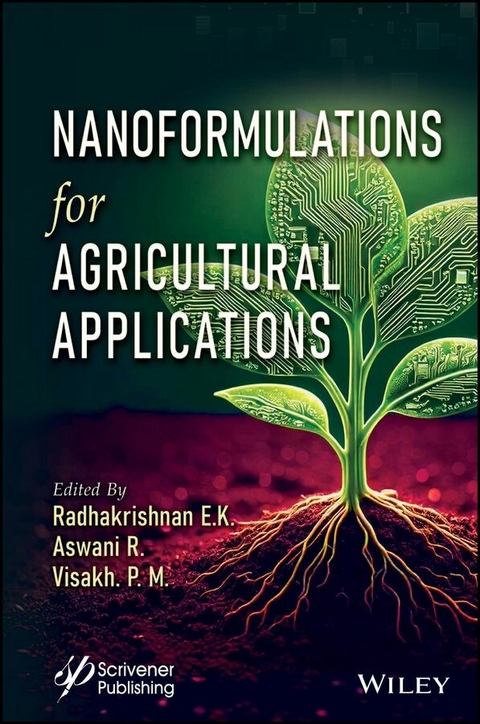
Nanoformulations for Agricultural Applications (eBook)
537 Seiten
Wiley-Scrivener (Verlag)
978-1-119-81910-3 (ISBN)
This book is a comprehensive guide to nanoformulations revolutionizing agriculture, enhancing sustainability, and advancing agrochemical applications.
This book examines state-of-the-art research, emerging challenges, and new opportunities in the field of nanoformulations for agriculture applications. Detailed discussions include the development and use of nanopesticides, nanoformulations for promoting plant growth, and nanotechnology for effective crop disease management. Furthermore, it covers recent trends in the design and production of nano-based formulations and nanocarriers for the efficient delivery of agrochemicals.
The book is divided into three sections. The first section introduces readers to agricultural applications and methods for nanoparticle synthesis, their applications, and types of biomasses. It examines the benefits of agriculture and the role of nanotechnology in the agriculture sector. The second section focuses on nanoformulations for plant growth promotion. It covers topics on types of nanoparticles, synthesis methods of nanoparticles, and applications of nanoparticles in the agricultural field. The third section discusses trends, various other applications, and the benefits of using nanocarriers in agriculture.
Audience
This book is aimed at researchers, engineers and scientists working in agrochemicals, crops, soil, biotechnology (chemistry), microbiology, nano-chemistry/technology/materials/formulations in agriculture applications.
Radhakrishnan E.K., PhD, is an associate professor at the School of Biosciences, Mahatma Gandhi University, Kottayam, India. During his 14 years of research, he has published over 150 research publications, 55 book chapters, and edited about 15 books. His research focuses on developing polymer-based nanocomposites with antimicrobial effects for food packaging and medical applications.
Aswani R. is currently pursuing a Ph.D. in microbiology at the School of Biosciences of Mahatma Gandhi University, Kottayam, India. Her areas of research is biocontrol mechanisms, the induction of plant defense responses by endophytic microorganisms, and the applications of nanotechnology-based methods in post-harvest protection.
Visakh. P. M., PhD, is a research associate in the Department of Chemical Oceanography, School of Marine Sciences, Cochin University of Science and Technology, Cochin, Kerala, India. He is a prolific editor with over 40 published books, 20 journal publications, 4 reviews, and more than 45 book chapters.
This book is a comprehensive guide to nanoformulations revolutionizing agriculture, enhancing sustainability, and advancing agrochemical applications. This book examines state-of-the-art research, emerging challenges, and new opportunities in the field of nanoformulations for agriculture applications. Detailed discussions include the development and use of nanopesticides, nanoformulations for promoting plant growth, and nanotechnology for effective crop disease management. Furthermore, it covers recent trends in the design and production of nano-based formulations and nanocarriers for the efficient delivery of agrochemicals. The book is divided into three sections. The first section introduces readers to agricultural applications and methods for nanoparticle synthesis, their applications, and types of biomasses. It examines the benefits of agriculture and the role of nanotechnology in the agriculture sector. The second section focuses on nanoformulations for plant growth promotion. It covers topics on types of nanoparticles, synthesis methods of nanoparticles, and applications of nanoparticles in the agricultural field. The third section discusses trends, various other applications, and the benefits of using nanocarriers in agriculture. Audience This book is aimed at researchers, engineers and scientists working in agrochemicals, crops, soil, biotechnology (chemistry), microbiology, nano-chemistry/technology/materials/formulations in agriculture applications.
1
Nanoformulations for Agricultural Applications: State-of-the-Art, New Challenges, and Opportunities
Aswani R.1, Radhakrishnan E.K.2 and Visakh P. M.3*
1Department of Molecular Biology and Biotechnology, College of Agriculture, Kerala Agricultural University, Thiruvananthapuram, Kerala, India
2Mahatma Gandhi University, Kottayam, Kerala, India
3Department of Chemical Oceanography School of Marine Sciences, Cochin University of Science and Technology Cochin, Kerala, India
Abstract
In this chapter providing and short version of all chapters, here we are writing about the different chapter topics such as synthesis and fabrication of green nanoparticles, biomass-derived nanoparticles and their applications: sensing, catalytic, biomedical and environmental, synthesis and application of nanopesticides, nanoformulations for plant growth promotion, nanotechnology in crop disease management, application of nano-fertilizers for sustainable agriculture: advantages and future prospects, biodegradable bionanocomposites in agriculture applications, advances and applications of nanotechnology in agriculture, recent trends in designing and production of nano based formulations, nanocarriers for the effective application of agrochemicals.
Keywords: Nanoformulations, agrochemicals, nanopesticides, green nanoparticles, biomass, nano-fertilizers, agriculture, nanotechnology, nanocarriers
1.1 Synthesis and Fabrication of Green Nanoparticles
The biological method involved in the synthesis of nanoparticles become cost-effective, easy to synthesize, reduces chemical output to the environment and free from unnecessary processing during synthesis [1]. Nanoparticles derived from biological materials are popularly known as biogenic nanoparticles and synthesis process involved is referred as green synthesis of nanoparticles. The concept of green chemistry has been applied for the biosynthesis of safe, cost-effective, and eco-friendly nanoparticles. The biosynthesis of nanoparticles using the plant and microbial organism epitomizes a green substitute for the invention of nanoparticles with innovative properties. The synthesis of nanoparticles is broadly divided in to two categories: top-down and bottom up strategies. Any synthesis approaches for the nanoparticles are belongs to either one of these approaches. In top-down synthesis, nanoparticles are generated from their bulk materials by breaking down them to the finest through mechanical grinding, milling, chemical etching, laser ablation, and sputtering [2]. A wide verity of nanoparticles such as metallic, metal oxide type, alloy-based, magnetic, and other inorganic ones are produced so far. Silver, gold, copper, palladium, and platinum nanoparticles are the important metallic nanoparticles that are established for biomedical applications, catalysis, and environmental applications. Magnetic nanoparticles hold a magnetic counterpart like iron, nickel, cobalt, etc. in combination with a definite functionality [3]. These are widely employed for the applications including catalysis and biomedical applications. The nanoparticles are synthesized using different physicochemical and biological methods.
Green nanotechnology is the only potential solution to overcome the disadvantageous and applications of nanoparticles compared with other physicochemical methods. Thus, the practice of green nanotechnology and safe production of nanoparticles have great research interest. Various biological methods are frequently conducted in sense of this green aspects. Green nanotechnology is simple, cost-effective, and eco-friendly, and this technology received great importance in recent years. Green nanotechnology can be defined, in general, as the use of biological routes like bacteria, fungi, or plants for the synthesis of nanomaterials (or nanoparticles) with the aid of various biotechnological techniques. Various microorganisms including bacteria, fungi, yeasts, viruses, and actinomycetes are being employed for the synthesis of different nanoparticles. There are reports on Au, Ag, ZnO, Se, Pt, SiO2, ZrO2 nanoparticles prepared using microorganisms mediated green strategies having different type of morphologies such as nanotubes, nanoconjugates, nanorods, nanowires, etc. Bacteria contains reductase enzyme inside the cell that catalyze the reduction of metal ions into metal nanoparticles. Various species of gram-positive and gram-negative bacteria have been reported to adsorb and take up heavy metal ions [4]. The significant advantages of using bacterial systems for nanoparticles synthesis are easy handling and genetic manipulation [5–7]. Bacteria play a significant role in the synthesis of metallic nanoparticles of silver and gold. Silver nanoparticle is well known for its biocidal properties which make it quite unique. It has been reported that some bacteria are resistant to silver [8], and they can accumulate silver on their cell wall to around 25% of their dry weight biomass indicating their potential use in the industrial recovery of silver from ore materials [9].
Gold nanoparticles prepared using a novel extremophilic actinomycete, Thermomonospora sp resulted in ∼8 nm sized particles that were capped and stabilized (the nanoparticles were stable for 6 months) with some extracellular proteins [10, 11]. In contrast gold nanoparticles of dimension 5 to 15 nm synthesized using alkali-tolerant actinomycete, Rhodococcus sp have shown the presence of reductase on the cell wall and cytoplasmic membrane which accounts for the metal ion reduction [12]. The biosynthetic route is a safe, biocompatible, and environment-friendly strategy adopted to synthesize nanoparticles using plants and microorganisms. The plant parts, such as leaves, fruits, roots, stem, seeds, are also used for the synthesis of various nanoparticles as these plant parts are rich in phytochemicals which acts like stabilization and reducing agents [13]. Various biological membranes are used for the synthesis of nanoparticles with the effective utilization of their ultrafine pores. For instance, gold nanoparticles were prepared using the rubber membrane prepared from Hevea brasiliensis that plays the role as preservative in the reduction of metal ions in solution [14]. Viruses are effective biomolecular templates for the synthesis of two-dimensional and three-dimensional nanoparticles. These nanoparticles are used for biomedical and agricultural applications owing to their controlled modification of surface functionality, less toxicity, good stability, biocompatibility, monodispersed natura and biodegradability [15].
Also, nanoparticles have been prepared using plant viruses that are biodegradable, noninfectious, biocompatible and stable. Amino acids are proven to be efficient reducing and capping agents for the synthesis of metals and metal oxide nanoparticles. In a typical study, the synthesis of gold nanoparticles was carried out with 20 amino acids and L-histidine was found to be the most effective reducing agent for the synthesis which significantly affected the morphology, dimension, and yield of nanoparticles [16].
Current agricultural practises, as a result of the Green Revolution, have made a significant contribution to the global food supply. The green revolution has unintentionally had a negative impact on the environment and ecosystem services, emphasizing the need for better scientific agricultural techniques to be developed. Nonjudicial application of fertilizers and pesticides has expanded significantly in the field due to a lack of understanding among common farmers, resulting in a rise in harmful agrichemicals in both ground and surface water. Nanotechnology has several applications in medicine, it increases drug delivery in many therapies especially in oncology field and provide new strategies in therapy especially against infectious diseases either through anti-microbial activity or inhibition of quorum sensing of bacteria especially Pseudomonas aeruginosa. Nanotechnology can be used in production of biomaterials such as medical implants or grafts. Nanotechnology is also used in food production to detect contaminants, or even in creation of laboratory vegetarian meat with taste and texture as that in the real meat to overcome food shortage in the world. The use of nanofertilizers enhances the accessibility and reach of nutrients to plant branches and leaves, resulting in increased growth. In data storage, a novel idea based on terabit capacity, ultra-high density, high data rate, and tiny form factor has just been introduced. Numerous nano-based technologies have the potential to be employed as sensors in agricultural activities. For pest control and live-stock health management, Carbon nanotube devices have the qualities of accurate sensing, diagnosis, and medicine administration.
The iron sulfate (FeSO4) nanoparticles sprayed on the leaves of sunflowers showed similar results in addition to increased utilization of carbon dioxide (CO2), iron content, and lower sodium contents [17]. The use of silicon nanoparticles (SiNPs) to relieve UV-B induced stress in wheat has been investigated [18]. Nanozeolite can boost long-term nutrient availability as well as plant germination and growth [19]. In Arabidopsis, for example, a microarray investigation revealed that the application of AgNPs up-regulated or down-regulated a number of genes [20]. Plant response to nanofertilizers, on the other hand, differs depending on plant species, growth phases, and nanomaterials utilised [21]. The coating of...
| Erscheint lt. Verlag | 11.2.2025 |
|---|---|
| Sprache | englisch |
| Themenwelt | Naturwissenschaften ► Biologie |
| Weitere Fachgebiete ► Land- / Forstwirtschaft / Fischerei | |
| ISBN-10 | 1-119-81910-5 / 1119819105 |
| ISBN-13 | 978-1-119-81910-3 / 9781119819103 |
| Informationen gemäß Produktsicherheitsverordnung (GPSR) | |
| Haben Sie eine Frage zum Produkt? |
 EPUB (Adobe DRM)
Kopierschutz: Adobe-DRM
Adobe-DRM ist ein Kopierschutz, der das eBook vor Mißbrauch schützen soll. Dabei wird das eBook bereits beim Download auf Ihre persönliche Adobe-ID autorisiert. Lesen können Sie das eBook dann nur auf den Geräten, welche ebenfalls auf Ihre Adobe-ID registriert sind.
Details zum Adobe-DRM
Dateiformat: EPUB (Electronic Publication)
EPUB ist ein offener Standard für eBooks und eignet sich besonders zur Darstellung von Belletristik und Sachbüchern. Der Fließtext wird dynamisch an die Display- und Schriftgröße angepasst. Auch für mobile Lesegeräte ist EPUB daher gut geeignet.
Systemvoraussetzungen:
PC/Mac: Mit einem PC oder Mac können Sie dieses eBook lesen. Sie benötigen eine
eReader: Dieses eBook kann mit (fast) allen eBook-Readern gelesen werden. Mit dem amazon-Kindle ist es aber nicht kompatibel.
Smartphone/Tablet: Egal ob Apple oder Android, dieses eBook können Sie lesen. Sie benötigen eine
Geräteliste und zusätzliche Hinweise
Buying eBooks from abroad
For tax law reasons we can sell eBooks just within Germany and Switzerland. Regrettably we cannot fulfill eBook-orders from other countries.
aus dem Bereich