Aedes Aegypti
Academic Press Inc (Verlag)
978-0-443-21461-5 (ISBN)
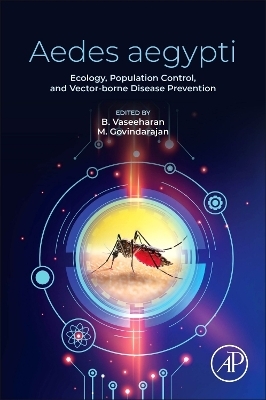
In addition to extensively discussing the mosquito’s role as a vector, the book emphasizes cutting-edge population control strategies, including genetic modifications, microbial interventions, and community-based efforts. It also addresses the global scale of vector-borne diseases, providing actionable insights into prevention methods, surveillance systems, and the urgent need for interdisciplinary collaboration.
Prof. B. Vaseeharan is Professor and Head of the Department of Animal Health and Management, Alagappa University, Tamil Nadu, India since 2008. Upon successful completion of Post-Doctoral Research (2003-2007), he joined as Senior Lecturer at School of Biotechnology, VIT University, Vellore (2007-2008), Tamil Nadu, India. He has been conferred with various prestigious awards notably the Young Scientist Award in 2009 by Department of Science and Technology, Dr. M. Swaminathan Best Fisheries Scientist Award 2019 by PFGF, ICAR-CIFRI, and TANSA-2019 Award by Tamil Nadu State Council for Science and Technology. He has more than 22 years of teaching and research experience and dedicated his time to teach Life Sciences. Currently, 7 research scholars are pursuing Ph.D. under his supervision and he serves as mentor for several post-Doctoral researchers. He has published more than 250 research articles (citations-9049) in National and International journals. He is a member of international scientific bodies such as The Zoological Society, Institute of Immunology and Immunotherapy, and The Indian Science Congress Association. Prof. M. Govindarajan is an Assistant Professor in the Department of Zoology at Annamalai University and an Assistant Professor of Zoology at the Government College for Women. His scientific interests include mycology, parasitology, vector control, nanotechnology, and natural products. He discovered nearly 20 pure molecules with significant mosquitocidal potential. He has published over 200 papers in Scopus and Web of Science-indexed journals and 11 books with international publishers. He mentors doctoral scholars and is a public viva-voce examiner for Ph.D. scholars at various universities. He serves on the editorial boards of several national and international journals. He obtained research projects from DST, UGC, and ICMR. He has received many international and national awards, including the Shiksha Rattan Puraskar from India International Friendship Society; Best Teacher Award from Government College for Women; and Shining star award for international education excellence. Stanford University has ranked him as one of the world's top 2% of scientists.
I. An Introduction to Mosquitos: Aedes aegypti
1. Epidemiological impact of Aedes aegypti
2. Behavior and Ecology of Aedes mosquitos
3. Microbiota and vector competence of Aedes mosquitos
II. Aedes aegypti: Mechanisms of Action in Vector-borne diseases
4. Dengue Virus and Aedes aegypti
5. Yellow Fever Virus and Aedes aegypti
6. Chikungunya, Zika virus and Aedes aegypti
III. Control Measures of Aedes aegypti
7. Chemical interventions and approaches and non-chemical larviciding: species of larvivorous fish used
8. Habitat Management: Existing endemicity
9. Microbial Secondary Metabolites in the Control of Aedes aegypti
IV. Advanced Control Strategies
10. Nano drug delivery approaches in the control of Aedes aegypti
11. Electrochemical biosensing for mosquito control
12. Machine learning techniques in the control of Aedes aegypti
V. Challenges in mosquito control
13. Development of Insecticide-resistant mosquitos and impact of environmental changes on ecological traits of mosquitos
14. Lack of insights into mosquito dispersal and mating behavior
15. Future Directions of Research and Surveillance for the Control of Aedes aegypti
| Erscheinungsdatum | 03.07.2025 |
|---|---|
| Verlagsort | San Diego |
| Sprache | englisch |
| Maße | 191 x 235 mm |
| Gewicht | 500 g |
| Themenwelt | Naturwissenschaften ► Biologie ► Zoologie |
| ISBN-10 | 0-443-21461-1 / 0443214611 |
| ISBN-13 | 978-0-443-21461-5 / 9780443214615 |
| Zustand | Neuware |
| Informationen gemäß Produktsicherheitsverordnung (GPSR) | |
| Haben Sie eine Frage zum Produkt? |
aus dem Bereich