


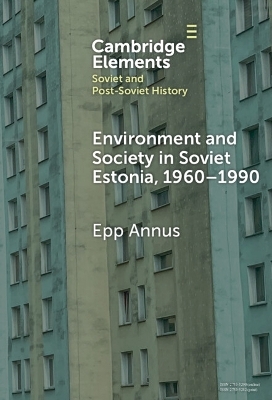
Environment and Society in Soviet Estonia, 1960–1990
An Intimate Cultural History
Seiten
2025
Cambridge University Press (Verlag)
978-1-009-53948-7 (ISBN)
Cambridge University Press (Verlag)
978-1-009-53948-7 (ISBN)
This Element investigates how natural environments and social ideas and circumstances were intertwined in fundamental ways. Various aspects of Estonian environmental thought and practices are analyzed as tied to local, intimate environments, while being at the same time connected to the global circulation of ideas.
Russia's twenty-first-century military aggression has inspired calls for rethinking the Soviet era and its aftermath – for drawing attention to decolonizing efforts within the (former) USSR and to Russia's colonial practices and imperial aspirations. At the same time, the present era of anthropogenic climate change urges us to consider the global and planetary implications of local actions. This Element combines these two scholarly impulses to consider Soviet-era Estonian society between the 1960s and the 1980s: it investigates how natural environments and social ideas and circumstances were intertwined in fundamental ways, and it emphasizes local agency over homogenizing strategies of Soviet rule. Estonians cared deeply about their local environments, but they also took inspiration from environmentalist works of global importance. Various aspects of Estonian environmental thought and practice are analyzed as tied to local, intimate environments, as impacted by Soviet/Russian colonial rule, and as connected to the global circulation of ideas.
Russia's twenty-first-century military aggression has inspired calls for rethinking the Soviet era and its aftermath – for drawing attention to decolonizing efforts within the (former) USSR and to Russia's colonial practices and imperial aspirations. At the same time, the present era of anthropogenic climate change urges us to consider the global and planetary implications of local actions. This Element combines these two scholarly impulses to consider Soviet-era Estonian society between the 1960s and the 1980s: it investigates how natural environments and social ideas and circumstances were intertwined in fundamental ways, and it emphasizes local agency over homogenizing strategies of Soviet rule. Estonians cared deeply about their local environments, but they also took inspiration from environmentalist works of global importance. Various aspects of Estonian environmental thought and practice are analyzed as tied to local, intimate environments, as impacted by Soviet/Russian colonial rule, and as connected to the global circulation of ideas.
1. Introduction; 2. 1965. Reverence for Life: bridging local and global environmental perspectives; 3. 1976. The forbidden sea and colonial violence; 4. 1969, 1869, 1988. The sound of the choir is the sound of the earth: the song, the land, the nation, and decolonization; 5. 1978. Urbanitis and limits to growth; 6. Conclusion. Thirty years later: bound to nature in a digital society.
| Erscheinungsdatum | 29.04.2025 |
|---|---|
| Reihe/Serie | Elements in Soviet and Post-Soviet History |
| Zusatzinfo | Worked examples or Exercises |
| Verlagsort | Cambridge |
| Sprache | englisch |
| Maße | 152 x 229 mm |
| Gewicht | 277 g |
| Themenwelt | Geisteswissenschaften ► Geschichte ► Regional- / Ländergeschichte |
| Naturwissenschaften ► Biologie ► Ökologie / Naturschutz | |
| Sozialwissenschaften ► Politik / Verwaltung ► Politische Systeme | |
| Sozialwissenschaften ► Politik / Verwaltung ► Politische Theorie | |
| ISBN-10 | 1-009-53948-5 / 1009539485 |
| ISBN-13 | 978-1-009-53948-7 / 9781009539487 |
| Zustand | Neuware |
| Informationen gemäß Produktsicherheitsverordnung (GPSR) | |
| Haben Sie eine Frage zum Produkt? |
Mehr entdecken
aus dem Bereich


aus dem Bereich
die Geschichte meiner Urgroßmutter
Buch | Hardcover (2025)
C.H.Beck (Verlag)
CHF 32,15
Träume und Macht : eine Biografie
Buch | Hardcover (2025)
C.H.Beck (Verlag)
CHF 61,60


