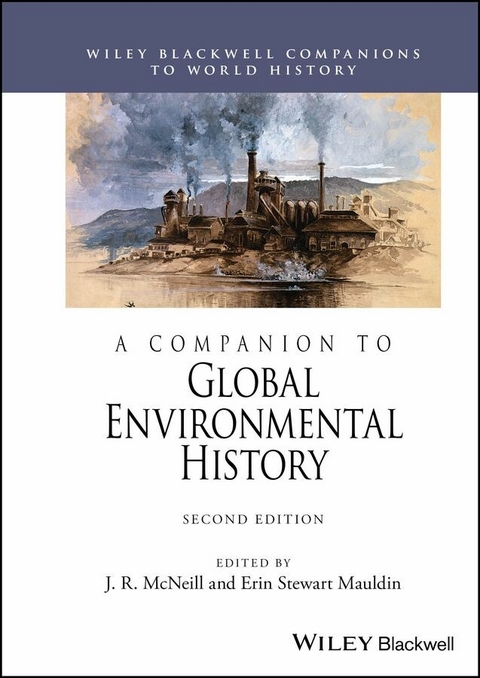
A Companion to Global Environmental History (eBook)
1264 Seiten
Wiley-Blackwell (Verlag)
9781119988212 (ISBN)
A COMPANION TO GLOBAL ENVIRONMENTAL HISTORY
Equips both specialists and newcomers with the historical, intellectual, and political context for engagement with the environment
Providing multiple points of entry into a dynamic, fast-growing field, A Companion to Global Environmental History explores the many contours of the relationship between human societies and the natural world on which they depend. Bringing together essays by an international roster of both established experts and emerging scholars, this volume covers a uniquely broad range of temporal, geographic, thematic, and contextual approaches to the practice of global environmental history.
Thirty-three detailed chapters describe how the relationship between society and nature has changed over time, examine the various drivers of change and environmental transformations, survey different types of environmental thought and action around the world, and more.
Now in its second edition, the Companion is fully revised to reflect major research developments and new trajectories within the field. Updated chapters that present new evidence for longstanding debates and innovative applications of environmental history are accompanied by six entirely new chapters on India, China, Africa, early modern cities, global environmental governance, and European environmentalism.
Offering fresh insights into environmental thought, culture, policy, and politics, A Companion to Global Environmental History, Second Edition, is an ideal textbook for undergraduate and graduate students and an invaluable reference for scholars, researchers, and environmental historians.
A COMPANION TO GLOBAL ENVIRONMENTAL HISTORY Equips both specialists and newcomers with the historical, intellectual, and political context for engagement with the environment Providing multiple points of entry into a dynamic, fast-growing field, A Companion to Global Environmental History explores the many contours of the relationship between human societies and the natural world on which they depend. Bringing together essays by an international roster of both established experts and emerging scholars, this volume covers a uniquely broad range of temporal, geographic, thematic, and contextual approaches to the practice of global environmental history. Thirty-three detailed chapters describe how the relationship between society and nature has changed over time, examine the various drivers of change and environmental transformations, survey different types of environmental thought and action around the world, and more. Now in its second edition, the Companion is fully revised to reflect major research developments and new trajectories within the field. Updated chapters that present new evidence for longstanding debates and innovative applications of environmental history are accompanied by six entirely new chapters on India, China, Africa, early modern cities, global environmental governance, and European environmentalism. Offering fresh insights into environmental thought, culture, policy, and politics, A Companion to Global Environmental History, Second Edition, is an ideal textbook for undergraduate and graduate students and an invaluable reference for scholars, researchers, and environmental historians.
Notes on Contributors
Michitake Aso is an associate professor of history at the University at Albany, SUNY, where he teaches courses on environmental, medical, and world history. He has published an award‐winning book, Rubber and the Making of Vietnam: An Ecological History (UNC, 2018), which has been translated into Vietnamese. He is co‐editor of Fighting for Health: Medicine in Cold War Southeast Asia (NUS, 2024) and author of several articles and book chapters. He has held fellowships at Kyoto University, the University of Texas at Austin, and the National University of Singapore, and participated in NEH‐ and Luce‐funded grants.
Peter Boomgaard, who died in 2017, was professor of economic and environmental history of Southeast Asia at the University of Amsterdam and former director of the Royal Netherlands Institute of Southeast Asian and Caribbean Studies at Leiden. His books include Frontiers of Fear: Tigers and People in the Malay World, 1600–1950 (2001), and Southeast Asia: An Environmental History (2007).
Iris Borowy is a distinguished professor at the University of Shanghai and director of the Center for the History of Global Development. She has worked at the University of Rostock, at the Centre Alexandre Koyré (Paris), and the University of Aachen (Germany). She has published widely on topics of global health, international organizations, and sustainable development, including a book on the Brundtland Commission (Routledge 2009) and the Routledge Handbook on the History of Development (2022). She is a founding co‐editor of the Yearbook for the History of Global Development.
Stephen Brain is an associate professor of history at Mississippi State University. He is the author of Song of the Forest: Russian Forestry and Stalinist Environmentalism, 1905–53 (2011). He is currently completing a manuscript about the environmental history of Soviet agricultural collectivization.
Yuan Julian Chen received her PhD in history from Yale University and is currently a postdoctoral Franklin Humanities Fellow at Duke University. She is an environmental historian of China specializing in the era of the Song Dynasty. Her work has appeared in a number of publications, including The Journal of Early Modern History and the Journal of Chinese History.
Janna Coomans is a university lecturer in medieval history at Utrecht University. She is the author of Community, Urban Health and Environment in the Late Medieval Low Countries (2021, Cambridge University Press). She was part of the ERC project “Healthscaping Urban Europe” and works on urban, social, and environmental history, including a research project on fire and risk in the Low Countries, 1250–1550.
Paul D’Arcy is a professor of Pacific history at the Australian National University. His research focuses on Asia Pacific resource conflict resolution, human interaction with the Pacific Ocean, Asia Pacific climate perturbation and natural hazard mitigation, and has been translated into four languages: Mandarin, French, German, and Spanish. He is the author of The People of the Sea (2006) and general editor of The Cambridge History of the Pacific Ocean in Two Volumes (2023).
Michael J. Dockry is an associate professor in the University of Minnesota’s Department of Forest Resources, as well as an associate faculty member of the American Indian Studies Department and an Institute on the Environment Fellow. He is a registered member of the Citizen Potawatomi Nation and works on tribal and Indigenous natural resource management and environmental history.
Michael H. Fisher is the Danforth Professor of history, Emeritus, Oberlin College, USA. Among his books are An Environmental History of India (Cambridge University Press, 2018), A Short History of the Mughal Empire (I.B. Tauris, 2015), Migration: A World History, (Oxford University Press, 2013), and (ed.) The Travels of Dean Mahomet: An Eighteenth Century Journey through India (University of California Press, 1997).
Yuan Gao is an assistant professor of Chinese History at Case Western Reserve University. She teaches courses on China, Central Eurasia, and environmental history. She is currently working on a book manuscript on the environmental history of Xinjiang under Qing rule.
Daniel Headrick is a professor emeritus of history and social science at Roosevelt University in Chicago. He is the author of several books, most recently, Humans Versus Nature: A Global Environmental History (2020), Power over Peoples: Technology, Environments, and Western Imperialism, 1400 to the Present (2010), and Technology: A World History (2009).
J. Donald Hughes, who died in 2019, was Evans Professor of history at the University of Denver and a former president of the American Society for Environmental History. He authored Pan's Travail: Environmental Problems of the Ancient Greeks and Romans (1993), What Is Environmental History (2006), and An Environmental History of the World (2009).
Faisal H. Husain is an environmental historian of the Ottoman Empire and an associate professor of history at Pennsylvania State University. He is the author of Rivers of the Sultan (2021) and serves on the editorial boards for journals including Marmara Türkiyat Araştırmaları Dergisi and Global Environment. He is currently working on an environmental history of Ottoman frontier expansion east of the Euphrates during the sixteenth century.
Iftekhar Iqbal is an associate professor at the Universiti Brunei Darussalam, and works in environmental history focusing on South and Southeast Asia. Previously, he taught at the University of Dhaka and received research fellowships from the British Academy and Humboldt Foundation. He is the author of The Bengal Delta: Ecology, State and Social Change 1840–1943 (Palgrave 2010) and The Range of the River: A Riverine History of Empire in South and Southeast Asia (Forthcoming with Stanford University Press).
Paul Josephson is a professor emeritus of history at Colby College, Waterville, Maine. A specialist in big science and technology in the twentieth century, he is the author of 15 books, most recently Hero Projects (2024), Nuclear Russia (2022), Chicken (2020), and Traffic (2017). He is completing a global environmental history of the nuclear age.
Jeremiah Kitunda is a distinguished professor of history at Appalachian State University. Born and schooled in Kenya before he moved to Miami University (Ohio) and the University of Wisconsin‐Madison for graduate studies, Kitunda focuses his research on African culture and environment. He has authored A History of the Water Hyacinth in Africa: The Flower of Life and Death (2017) and Kamba Proverbs from Eastern Kenya: Sources, Origins & History (2021). For a short stint, he was a lecturer at the University of Nairobi and a visiting scholar at the University of Oregon (Eugene).
Nancy Langston is a distinguished professor of environmental history at Michigan Technological University. Author of five books and recipient of the Distinguished Scholar Award from the American Society for Environmental History, she is currently working on a history of global reindeer translocations. www.nancylangston.net.
Bao Maohong is a professor of history at Peking University, China. He is the author of Forest and Development: Deforestation in the Philippines (2008), Environmental Governance in China and Environmental Cooperation in Northeast Asia (2009), and The Origins of Environmental History and Its Development (2012).
Robert B. Marks is Diehl professor of history emeritus at Whittier College. He is the author of Tigers, Rice, Silk and Silt: Environment and Economy in Late Imperial South China (1998), The Origins of the Modern World (2007), and China: Its Environment and History (2012). He is at work on a history of Mono Lake, California.
Joan Martinez‐Alier is emeritus professor of economics and economic history at the Autonomous University of Barcelona and a former president of the International Society for Ecological Economics. He is the author of The Environmentalism of the Poor (2002) and Land, Water, Air and Freedom: The Making of World Movements for Environmental Justice (2023).
Erin Stewart Mauldin is the John Hope Franklin Chair of Southern History at the University of South Florida. She is the author of Unredeemed Land: An Environmental History of Civil War and Emancipation in the Cotton South (2018), and the co‐editor of the book series, Environmental History and the American South, at the University of Georgia Press.
Meredith McKittrick is an associate professor in the Department of History at Georgetown University. Her most recent book is Green Lands for White Men: Desert Dystopias and the Environmental Origins of Apartheid (Chicago 2024). She is currently writing a book about riparian farming communities in southwestern Africa.
J. R. McNeill is distinguished university professor at Georgetown University and former president of the American Society for Environmental History and the American Historical Association. His environmental history books include Something New under the Sun (2000), Mosquito Empires (2010), and The Great Acceleration...
| Erscheint lt. Verlag | 6.2.2025 |
|---|---|
| Reihe/Serie | Wiley Blackwell Companions to World History |
| Sprache | englisch |
| Themenwelt | Geisteswissenschaften ► Geschichte |
| Naturwissenschaften ► Geowissenschaften ► Geografie / Kartografie | |
| Schlagworte | global environmental history • global environmental history approaches • global environmental history essays • global environmental history textbook • world environmental history • world environmental history essays • world environmental history textbook |
| ISBN-13 | 9781119988212 / 9781119988212 |
| Informationen gemäß Produktsicherheitsverordnung (GPSR) | |
| Haben Sie eine Frage zum Produkt? |
 EPUB (Adobe DRM)
Kopierschutz: Adobe-DRM
Adobe-DRM ist ein Kopierschutz, der das eBook vor Mißbrauch schützen soll. Dabei wird das eBook bereits beim Download auf Ihre persönliche Adobe-ID autorisiert. Lesen können Sie das eBook dann nur auf den Geräten, welche ebenfalls auf Ihre Adobe-ID registriert sind.
Details zum Adobe-DRM
Dateiformat: EPUB (Electronic Publication)
EPUB ist ein offener Standard für eBooks und eignet sich besonders zur Darstellung von Belletristik und Sachbüchern. Der Fließtext wird dynamisch an die Display- und Schriftgröße angepasst. Auch für mobile Lesegeräte ist EPUB daher gut geeignet.
Systemvoraussetzungen:
PC/Mac: Mit einem PC oder Mac können Sie dieses eBook lesen. Sie benötigen eine
eReader: Dieses eBook kann mit (fast) allen eBook-Readern gelesen werden. Mit dem amazon-Kindle ist es aber nicht kompatibel.
Smartphone/Tablet: Egal ob Apple oder Android, dieses eBook können Sie lesen. Sie benötigen eine
Geräteliste und zusätzliche Hinweise
Buying eBooks from abroad
For tax law reasons we can sell eBooks just within Germany and Switzerland. Regrettably we cannot fulfill eBook-orders from other countries.
aus dem Bereich