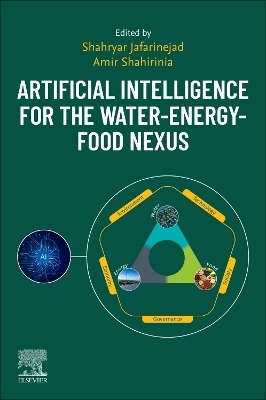
Artificial Intelligence for the Water-Energy-Food Nexus
Elsevier - Health Sciences Division (Verlag)
978-0-443-34019-2 (ISBN)
The first chapter introduces the WEF nexus concepts, assessment/analysis methodologies and tools, challenges, trends, and future perspectives. The second chapter summarizes AI applications to the water sector/industry with a focus on the importance, general applications and real-world applications, as well as challenges and future perspectives. The third chapter focuses on the application of AI techniques to the water and wastewater treatment systems including treatment processes, urban drinking water systems, and integrated urban drainage systems. The fourth chapter explores the application of AI techniques to the non-renewable and renewable energy systems, load monitoring, load demand forecasting, smart grids, energy optimization and process control, energy storage systems, and case studies and real-world applications as well as challenges in AI application to the energy industry and future directions. The application of AI techniques in the food industry in areas of organoleptic properties, nutrition, toxicology, and food chemistry, biotechnology processes and microbiology security, food processing and manufacturing, conservation and storage conditions, supply chain, markets, and distribution, and food industry environments (circular economy, water, and energy management) as well as challenges and opportunities are discussed in the fifth chapter. The final chapter reviews/presents the application of AI techniques to address problems associated with the WEF nexus.
This book can be of interest to all those who are looking to understand and utilize AI techniques in the context of water, energy, food, and WEF nexus, including researchers, advanced students, faculty, engineers, R&D, industry professionals, and policymakers.
Dr. Shahryar Jafarinejad is an Associate Professor of Chemical Engineering at Tuskegee University (TU), United States, where he has also served as a Faculty Senate Member from 2019 to 2024. Before joining TU in 2018 as an Assistant Professor, he completed his postdoctoral research at the University of California, Irvine. He has taught Chemical Engineering courses at TU, the University of Tehran, the College of Environment, and the Technical and Vocational University (Iran) and supervised undergraduate and graduate students. He has published three books, several book chapters, and numerous peer-reviewed journal and conference papers and has also served as an Editorial Board Member and Reviewer of engineering journals. His research group focuses on green technologies and sustainable materials, energy and the environment, and applying nanotechnology and modeling and simulation tools to solve problems in chemical and environmental engineering. He has served as the Principal Investigator (PI) or Co-PI on several funded projects. He received the Henry C. McBay Faculty Research Fellowship from UNCF in 2020 and 2024 and the Outstanding Faculty Performance Award for Research and Teaching/Learning at TU in 2020 and 2022, respectively. Dr. Amir Shahirinia is an Associate Professor of Electrical and Computer Engineering at the University of the District of Columbia (UDC), where he directs both the Applied Artificial Intelligence (AAI) Lab and the Center of Excellence for Renewable Energy (CERE). He received his PhD in Electrical and Computer Engineering from the University of Wisconsin in 2014 and has held research positions in academia and industry, including postdoctoral work with the Power Electronics Group at Rockwell Automation. Dr. Shahirinia's research focuses on artificial intelligence, smart grids, and power and energy systems. He is a Senior Member of IEEE and has served as the Principal Investigator (PI) or Co-PI on federally funded projects totaling over $12 million. He has authored numerous publications in peer-reviewed journals and international conferences. He has received both the Best Research Award and the Best Teaching Award during his tenure at UDC, reflecting his dual commitment to innovation and education.
1. Introduction to water-energy-food nexus: Concepts/ frameworks, assessment methods, challenges, trends, and future directions
2. Artificial intelligence for the water sector/industry
3. Artificial intelligence application to the water and wastewater treatment systems
4. Artificial intelligence for the energy sector/industry
5. Recent progress and future directions of artificial intelligence application to the food industry
6. Artificial intelligence application to the water-energy-food nexus
| Erscheinungsdatum | 11.11.2025 |
|---|---|
| Verlagsort | Philadelphia |
| Sprache | englisch |
| Maße | 152 x 229 mm |
| Gewicht | 450 g |
| Themenwelt | Informatik ► Theorie / Studium ► Künstliche Intelligenz / Robotik |
| Naturwissenschaften ► Biologie ► Ökologie / Naturschutz | |
| Technik ► Elektrotechnik / Energietechnik | |
| ISBN-10 | 0-443-34019-6 / 0443340196 |
| ISBN-13 | 978-0-443-34019-2 / 9780443340192 |
| Zustand | Neuware |
| Informationen gemäß Produktsicherheitsverordnung (GPSR) | |
| Haben Sie eine Frage zum Produkt? |
aus dem Bereich