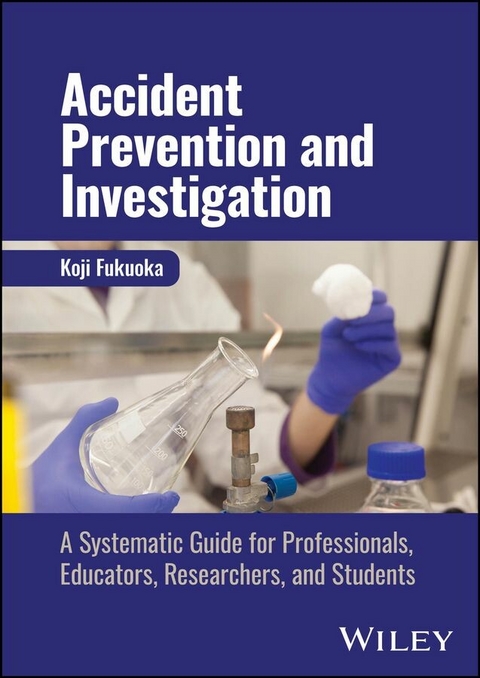
Accident Prevention and Investigation (eBook)
496 Seiten
Wiley (Verlag)
978-1-394-21675-8 (ISBN)
Practical reference on systematic accident prevention, investigative techniques, and contributing factors, derived from analysis of real accidents
Accident Prevention and Investigation enables readers to reduce the number of accidents and casualties during experiments at universities by using new approaches based on scientific knowledge and data. Demonstrated through case studies illustrating successful implementation, the book explores alternate perspectives on mechanisms and contributing factors of accidents, derived from investigation of real accidents.
Readers will first learn how accidents occur and understand how to prevent them. Next, they will learn how to use the discussed methods to conduct systematic accident prevention at universities, including fieldwork activities at sea.
In this book, readers will find:
- Tools to understand how to apply different accident prevention methods depending on the logistics of an experiment
- Guidelines to investigate and analyze accidents and near-misses
- Information on accident theory, risk management, and safety management systems
- Specific challenges at universities and how to systematically incorporate accident investigation and prevention when faced with factors from multiple industry types
- Helpful checklists to aid readers in the practical application of accident reduction
This book is an essential reference for faculty, researchers, and advanced students seeking to reduce the number of accidents on campus and in university-affiliated field work. It is also an ideal textbook for courses using a systematic approach to safety.
Koji Fukuoka is the President of BCP&BCM Consulting in Tokyo, Japan. Formerly, he was a professor at Kyushu University. He has spent most of his career as both a scientist and practitioner for safety systems in various fields including at the Okinawa Institute of Science and Technology Graduate University (OIST), Japan Transport Safety Board (JTSB), and Japan Coast Guard (JCG), as well as in various maritime industries.
Practical reference on systematic accident prevention, investigative techniques, and contributing factors, derived from analysis of real accidents Accident Prevention and Investigation enables readers to reduce the number of accidents and casualties during experiments at universities by using new approaches based on scientific knowledge and data. Demonstrated through case studies illustrating successful implementation, the book explores alternate perspectives on mechanisms and contributing factors of accidents, derived from investigation of real accidents. Readers will first learn how accidents occur and understand how to prevent them. Next, they will learn how to use the discussed methods to conduct systematic accident prevention at universities, including fieldwork activities at sea. In this book, readers will find: Tools to understand how to apply different accident prevention methods depending on the logistics of an experiment Guidelines to investigate and analyze accidents and near-misses Information on accident theory, risk management, and safety management systems Specific challenges at universities and how to systematically incorporate accident investigation and prevention when faced with factors from multiple industry types Helpful checklists to aid readers in the practical application of accident reduction This book is an essential reference for faculty, researchers, and advanced students seeking to reduce the number of accidents on campus and in university-affiliated field work. It is also an ideal textbook for courses using a systematic approach to safety.
Chapter 1
Current State of Accidents at Universities
1.1 Introduction
While rapid progress is being made in science and technology, many faculty members, researchers, graduate and undergraduate students have been killed in accidents involving chemical experiments in laboratories of universities and academic institutions (hereafter referred to as “universities, etc.”). However, the total number of accidents that have occurred in university laboratories worldwide remains unknown, and in many cases, similar accidents have been repeated several years later at other universities. This is because time has passed without a paradigm shift or fundamental change in laboratory safety measures, and universities around the world have not made progress in collaborating to prevent accidents.
According to a questionnaire survey conducted by the author, there are few established accident investigation and analysis methods or uniform rules for accident investigation and analysis in universities, and even when accident investigation and analysis is conducted, the 4Ms (man, machine, media, and method) analysis tool mainly applied in the manufacturing industry is used. In many cases, investigation reports and lessons learned from accidents that occur within universities are never published (Fukuoka 2022a).
In addition, there are no international organizations, such as the International Maritime Organization (IMO) or the International Civil Aviation Organization (ICAO), whose objectives mainly include accident prevention. It is essential for accident investigation and analysis to determine which accident models are applicable to the industry to which it belongs and to conduct the investigation and analysis using the methods associated with those accident models. If an inappropriate accident model is used in an accident investigation, the mechanism leading to the accident will be incorrectly analyzed and the resulting safety recommendations will be misdirected in terms of preventing accident recurrence. However, many chemical accident investigations in university laboratories have not been discussed based on accident models, although case studies have been carried out. Therefore, the lack of uniform methods for accident investigation and analysis raises doubts not only about the accident factors themselves derived as a result of the accident investigation but also about the derived data results, even if the accident factor data are statistically processed (Fukuoka and Furusho 2022).
For many universities to use the lessons learned from accident analyses to reduce accidents, accident investigations must be scientific, investigation and analysis methods must be standardized, and a large amount of accident data must be collected and analyzed. The approach to this is to bring together universities, etc. around the world to formulate investigation and analysis methods and rules, including the preparation of accident investigation reports, to provide education and training in investigation and analysis methods, and to establish a forum for sharing information to reduce accidents.
This book clarifies the problems that need to be solved to prevent the recurrence and prevention of accidents faced by universities, etc. in comparison with other industries, and describes approaches that can be adapted to universities, etc. First, as a prologue to the content discussed in Chapter 2 and below, issues related to accident prevention in universities, etc. obtained compared with other advanced industries are discussed.
In the subsequent chapters, the term “accident” refers to events involving injuries or fatalities occurring during educational and research activities within universities, etc., while “incident” refers to events threatening the safety of individuals other than accidents during educational and research activities, or events causing damage to facilities or equipment used during activities. Near misses are included within incidents.
1.2 Background
A wide variety of accidents occur in universities around the world, including explosions during chemical experiments in research laboratories. It is not possible to estimate how many accidents occur in university laboratories around the world, as the data itself are not published. The following is an excerpt from a review article by Ménard and Trant (2020) published in Nature Chemistry:
Over the past ten years, there have been several high-profile accidents in academic laboratories around the world, resulting in significant injuries and fatalities … However, the study of academic lab safety is still underdeveloped and necessary data about changes in safety attitudes and behaviours has not been gathered … More than ten years on from Sangji’s death, we can conclude that there is no evidence of sweeping, fundamental changes, nor of major paradigm shifts in how academic lab safety is approached within the discipline.
However, in the field of ship and aircraft accidents, a social transformation, a paradigm shift, took place in the second half of the twentieth century with regard to accident prevention. This involved the following multiple factors (Fukuoka 2023):
- Shift from human error to human factors
- Development of the software, hardware, environment, liveware (SHEL) model
- Development and global adoption of safety management systems (SMSs)
- Development of accident models, such as the Swiss cheese model, which can explain the mechanisms of organizational accidents
- Shift from Criminal Investigation to Safety Investigation
The trigger for these factors was a series of serious accidents in various industries in the 1970s and 1980s that affected society as a whole. In the chemical industry, 28 employees were killed in a chemical plant explosion in Flixborough, United Kingdom, in 1974, and thousands of citizens were killed by acute poisoning in Bhopal, India, in 1984 when a chemical plant released methyl isocyanate, while the exact number of victims was never determined.
In the maritime industry, 193 passengers and crew were killed in the 1987 capsizing of the ro-ro vessel Herald of Free Enterprise (HFE), which was traveling to and from the Strait of Dover. In the aviation industry, in 1985, Japan Air Lines (JAL) Flight 123 crashed into Mount Osutaka, killing 520 passengers and crew and leaving only 4 survivors, making it the worst single aircraft accident. In the space industry, in 1986, the US space shuttle Challenger exploded just 73 seconds after liftoff, killing all seven crew members on board.
1.3 Modes and Effects of Human Error
Human error was actively studied by Norman, Rasmussen, Reason, and others in the mid to late twentieth century, and findings were developed and established as follows.
1.3.1 Norman’s Theory
Norman (1988) emphasized that people make some errors in error-prone situations that are unrelated to specific personal characteristics. He distinguished between slips and mistakes. In other words, slips are errors of behavior, while mistakes are errors of thought.
1.3.2 Rasmussen’s Theory
Rasmussen, Duncan, and Leplat (1987) extended Norman’s theory and defined three types of performance and error. They are skill-based, rule-based, and knowledge-based. He states that people display different behavior at these three different levels.
At the skill-based level, it is an automatic method and is used when performing tasks that are routine and highly trained. The rule-based level is used when specific situations are encountered and there are already agreed rules for performing these actions. The knowledge-based level is used when a new situation is encountered that has not been experienced before. This is the highest performance level and involves people working very slowly, using all the resources imprinted in their memory through trial-and-error learning.
Rasmussen emphasizes that the process of people making decisions is not linear and that in real life people often shortcut the process. As a result, he states that the three levels outlined above can coexist at any time.
The three performance aspects of everyday life are explained, covering the process of learning to ride a bicycle. When riding a bicycle for the first time, children learn in detail from their parents and friends how to ride a bicycle, how to balance, when and how to brake, etc. When they actually ride a bicycle, they find it difficult to control it and keep going, so they try to learn to ride a bicycle through a process of repeated trial and error. This process is called knowledge-based performance. After a number of training sessions, the operating skills of riding a bicycle gradually improve and they are able to get out on the road. When they come across a traffic light, they stop, making sure that the rule is that they should not proceed at a red light. They also check that they are traveling on a particular side of the road, as they have learned from their parents. This process is called rule-based performance. They ride their bicycles every day, and after a few months, they become so familiar with it that they no longer need to pull out the bicycle maneuvering and traffic rules from their memory each time and apply them in practice. In particular, they can ride without having to think about how to maneuver it in their minds. When they encounter a red light, they are able to achieve their objectives by skipping rigid procedures experienced in the knowledge-based and rule-based performance, such as stopping reflexively. This process is called skill-based performance.
1.3.3 Reason’s...
| Erscheint lt. Verlag | 3.2.2025 |
|---|---|
| Sprache | englisch |
| Themenwelt | Naturwissenschaften ► Chemie |
| Schlagworte | accident contributing factors • accident mechanisms • Accident Prevention • accident reduction • accident theory • analyze accident • experiment accidents • experiment casualties • Safety Management Systems • sea fieldwork • university experiments |
| ISBN-10 | 1-394-21675-0 / 1394216750 |
| ISBN-13 | 978-1-394-21675-8 / 9781394216758 |
| Informationen gemäß Produktsicherheitsverordnung (GPSR) | |
| Haben Sie eine Frage zum Produkt? |
 EPUB (Adobe DRM)
Kopierschutz: Adobe-DRM
Adobe-DRM ist ein Kopierschutz, der das eBook vor Mißbrauch schützen soll. Dabei wird das eBook bereits beim Download auf Ihre persönliche Adobe-ID autorisiert. Lesen können Sie das eBook dann nur auf den Geräten, welche ebenfalls auf Ihre Adobe-ID registriert sind.
Details zum Adobe-DRM
Dateiformat: EPUB (Electronic Publication)
EPUB ist ein offener Standard für eBooks und eignet sich besonders zur Darstellung von Belletristik und Sachbüchern. Der Fließtext wird dynamisch an die Display- und Schriftgröße angepasst. Auch für mobile Lesegeräte ist EPUB daher gut geeignet.
Systemvoraussetzungen:
PC/Mac: Mit einem PC oder Mac können Sie dieses eBook lesen. Sie benötigen eine
eReader: Dieses eBook kann mit (fast) allen eBook-Readern gelesen werden. Mit dem amazon-Kindle ist es aber nicht kompatibel.
Smartphone/Tablet: Egal ob Apple oder Android, dieses eBook können Sie lesen. Sie benötigen eine
Geräteliste und zusätzliche Hinweise
Buying eBooks from abroad
For tax law reasons we can sell eBooks just within Germany and Switzerland. Regrettably we cannot fulfill eBook-orders from other countries.
aus dem Bereich