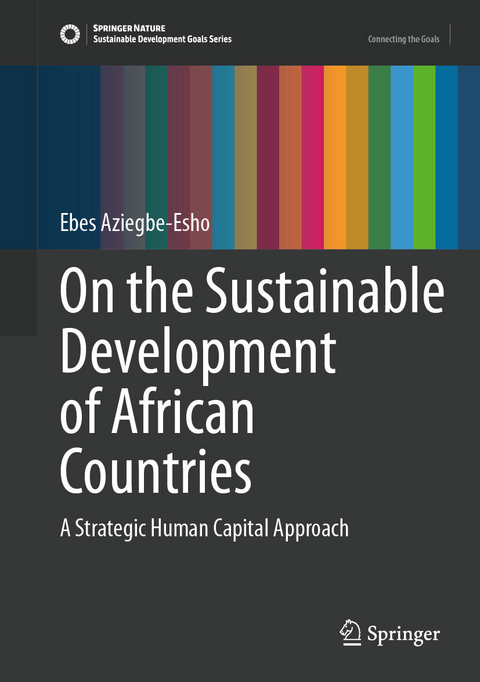
On the Sustainable Development of African Countries (eBook)
XIII, 156 Seiten
Springer-Verlag
978-3-031-81124-1 (ISBN)
Despite Africa’s vast and diverse natural resources, the developmental challenges plaguing the continent still remain. Indeed, a common factor that seems to bind all African countries together is developmental problems and challenges. From North Africa to Southern Africa, across West Africa through to Central and East Africa, African countries, especially those in Sub-Saharan Africa, are faced with the same or similar developmental challenges. Many reasons have been offered for Africa’s developmental challenges. Amongst developmental economists, the reasons range from geographical, historical, cultural, and tribal factors, to institutional factors. The unfavourable geographical landscape, its colonial and other peculiar histories, the huge diversity in culture and tribe that seem to hinder efforts at unity, and lack of good governance and the institutions of quality governance, have all been given as reasons for the inability of the continent to make good developmental progress.
This book offers a strategic human capital approach as a pathway to the sustainable development of African countries. The book synthesizes different knowledge domains on human capital, and presents ways on how human capital can be strategically developed and accumulated by African countries for sustainable development. The book highlights how the continent’s growing youthful population can be strategically harnessed into human capital for sustainable development. Unlike other books on human capital and Africa’s development that rely on a single disciplinary perspective, usually from economics, this book takes a multi-disciplinary and inter-disciplinary approach. The book draws from theories and studies of human capital in economics, the originating discipline of the concept, strategic management, entrepreneurship, and Strategic Human Resources Management. Thus, it is able to present the discuss and recommendations from a holistic integration of the concept of human capital. The book also presents case studies of three countries, Singapore, Finland, and Canada, that have successfully made strategic use of human capital in their national development in different ways; another unique feature of the book. Lessons on national human capital development are drawn from each case study.
Another unique feature of the book is its integration of the various global human capital indices available for a comprehensive understanding of the indices, their components, and utility for countries. Finally, the book is replete with many generic and specific recommendations on how human capital can be developed by various stake holders in Africa. A whole chapter is dedicated to generic strategic approaches to human capital development that can be adopted by African countries; and indeed, by all countries as they can be applied by other countries. The generic approaches are cumulatively drawn from resource-based theory (RBT), transaction cost economics, and human capital theory. Another chapter is also dedicated to more specific recommendations on human capital development and accumulation.
| Erscheint lt. Verlag | 3.2.2025 |
|---|---|
| Reihe/Serie | Sustainable Development Goals Series |
| Zusatzinfo | XIII, 156 p. 13 illus., 9 illus. in color. |
| Sprache | englisch |
| Themenwelt | Naturwissenschaften ► Geowissenschaften ► Geografie / Kartografie |
| Sozialwissenschaften ► Politik / Verwaltung ► Vergleichende Politikwissenschaften | |
| Wirtschaft ► Betriebswirtschaft / Management ► Personalwesen | |
| Wirtschaft ► Betriebswirtschaft / Management ► Unternehmensführung / Management | |
| Schlagworte | Global human capital indices • Human Capital • Human Capital Development • Strategic immigration • sustainable development |
| ISBN-10 | 3-031-81124-0 / 3031811240 |
| ISBN-13 | 978-3-031-81124-1 / 9783031811241 |
| Informationen gemäß Produktsicherheitsverordnung (GPSR) | |
| Haben Sie eine Frage zum Produkt? |
 PDF (Wasserzeichen)
DRM: Digitales Wasserzeichen
Dieses eBook enthält ein digitales Wasserzeichen und ist damit für Sie personalisiert. Bei einer missbräuchlichen Weitergabe des eBooks an Dritte ist eine Rückverfolgung an die Quelle möglich.
Dateiformat: PDF (Portable Document Format)
Mit einem festen Seitenlayout eignet sich die PDF besonders für Fachbücher mit Spalten, Tabellen und Abbildungen. Eine PDF kann auf fast allen Geräten angezeigt werden, ist aber für kleine Displays (Smartphone, eReader) nur eingeschränkt geeignet.
Systemvoraussetzungen:
PC/Mac: Mit einem PC oder Mac können Sie dieses eBook lesen. Sie benötigen dafür einen PDF-Viewer - z.B. den Adobe Reader oder Adobe Digital Editions.
eReader: Dieses eBook kann mit (fast) allen eBook-Readern gelesen werden. Mit dem amazon-Kindle ist es aber nicht kompatibel.
Smartphone/Tablet: Egal ob Apple oder Android, dieses eBook können Sie lesen. Sie benötigen dafür einen PDF-Viewer - z.B. die kostenlose Adobe Digital Editions-App.
Buying eBooks from abroad
For tax law reasons we can sell eBooks just within Germany and Switzerland. Regrettably we cannot fulfill eBook-orders from other countries.
aus dem Bereich