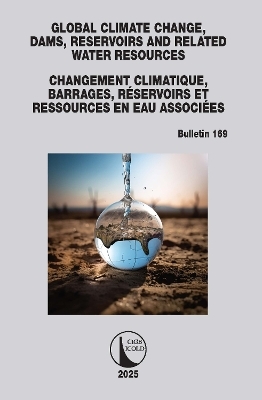
Global Climate Change, Dams, Reservoirs and Related Water Resources / Changement Climatique, Barrages, Réservoirs et Ressources en eau associées
CRC Press (Verlag)
978-1-032-98737-8 (ISBN)
The purpose of ICOLD Bulletin 169 is to assess the role of dams and reservoirs in adapting to the effects of global climate change, determine the threats, and potential opportunities, posed by global climate change to existing dams and reservoirs, and then recommend measures to mitigate against or adapt to the effects of global climate change. This bulletin is organized in chapters that include the following:
a description of what is at risk when considering dams, reservoirs and related water resources
facts and uncertainties with climate evolution, mainly based on past observations analysis
framework and method for assessing climate induced impacts and risk at watershed scale
other drivers besides climate change that can affect the balance between resources and needs: demography, technology, sedimentation
climate-driven opportunities for new storage
emissions of greenhouse gases associated to reservoirs and water resources
adaptation strategies and case studies from different regions of the world and illustrating different water resources systems situations
recommendations
ICOLD recommendations (chapter 10) address three broad themes:
Recommendation 1: Adopt a whole-of-system approach.
Recommendation 2: Apply an adaptive management process.
Recommendation 3: Collaborate with a wide range of disciplines, interest and stakeholders (including engineers alongside decision makers, politicians, natural resource scientists, social scientists, economists and the greater community) in the assessment of enduring and effective adaptation options.
L’objectif de ce ICOLD Bulletin 169 est d’évaluer le rôle des barrages et réservoirs dans l’adaptation face aux effets du réchauffement climatique, de déterminer les risques de même que les opportunités potentielles, imposées par le réchauffement climatique aux reservoirs et barrages, puis recommander des mesures d’atténuation ou d’adaptation aux effets du changement climatique mondial.
Le présent bulletin est structuré en plusieurs chapitres comprenant les éléments suivants:
la caractérisation des risques pour les barrages et réservoirs, et pour la gestion des ressources en eau associées
les constats et incertitudes liés à l’évolution du climat, principalement fondés sur l’analyse des observations antérieures
les principes méthodologiques des études d’évaluation des impacts et des risques induits par l’évolution du climat à l’échelle du bassin versant
d’autres facteurs que le changement climatique qui peuvent affecter l’équilibre entre les ressources et les besoins : démographie, évolution technologique, sedimentation
l’opportunité de créer de nouvelles réserves de stockage pour augmenter la résilience des systèmes aux effets climatiques
un point sur les émissions de gaz à effet de serre imputables aux réservoirs et aux ressources en eau
des principes de stratégie d’adaptation et des études de cas provenant de différentes régions du monde, illustrant différentes situations des systèmes de gestion des ressources en eau
des recommandations.
Les recommandations générales portent sur trois grands thèmes :
Recommandation 1: adopter une approche systémique d’ensemble
Recommandation 2: Appliquer un processus adaptatif de gestion
Recommandation 3: Collaborer avec un large éventail de disciplines, et de parties prenantes (ingénieurs, décideurs, élus, spécialistes des ressources naturelles, spécialistes des sciences sociales, économistes et la collectivité dans son ensemble) dans l’évaluation des options d’adaptation durables et efficaces.
The Commission Internationale des Grands Barrages (CIGB) / International Commission on Large Dams (ICOLD) is a non-governmental International Organization which provides a forum for the exchange of knowledge and experience in dam engineering. The Organization leads the profession in ensuring that dams are built safely, efficiently, economically, and without detrimental effects on the environment. Its original aim was to encourage advances in the planning, design, construction, operation, and maintenance of large dams and their associated civil works, by collecting and disseminating relevant information and by studying related technical questions. Since the late sixties, focus was put on subjects of current concern such as dam safety, monitoring of performance, reanalysis of older dams and spillways, effects of ageing and environmental impact. More recently, new subjects include cost studies at the planning and construction stages, harnessing international rivers, information for the public at large, and financing.
| Erscheinungsdatum | 31.07.2025 |
|---|---|
| Reihe/Serie | ICOLD Bulletins Series |
| Verlagsort | London |
| Sprache | englisch |
| Maße | 156 x 234 mm |
| Gewicht | 370 g |
| Themenwelt | Naturwissenschaften ► Biologie ► Ökologie / Naturschutz |
| Technik ► Bauwesen | |
| ISBN-10 | 1-032-98737-5 / 1032987375 |
| ISBN-13 | 978-1-032-98737-8 / 9781032987378 |
| Zustand | Neuware |
| Informationen gemäß Produktsicherheitsverordnung (GPSR) | |
| Haben Sie eine Frage zum Produkt? |
aus dem Bereich