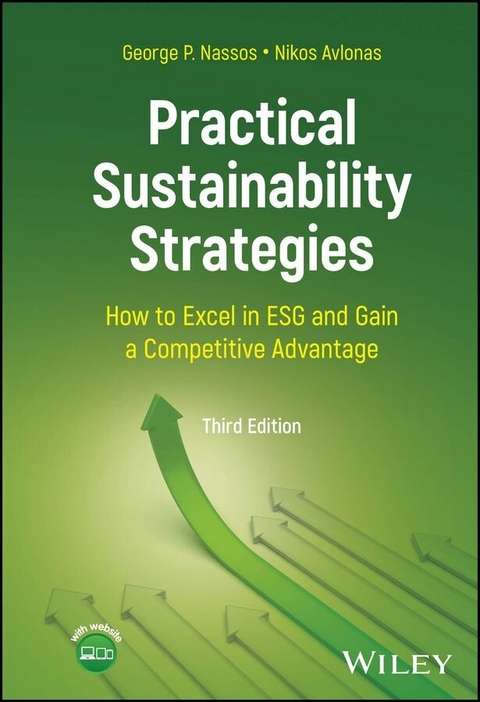
Practical Sustainability Strategies (eBook)
602 Seiten
Wiley (Verlag)
978-1-394-26377-6 (ISBN)
A comprehensive guide for developing and implementing ESG strategies that propel sustainable growth and enhance corporate responsibility
Practical Sustainability Strategies: How to Excel in ESG and Gain a Competitive Advantage provides the essential tools needed to implement ESG (Environmental, Social, and Governance) frameworks. With a strong focus on actionable strategies and practical applications, this real-world guide offers expert insights into how sustainability can drive corporate success while benefiting the environment and society.
In-depth yet accessible chapters bridge the gap between theory and practice, arming readers with proven frameworks to align organizational goals with global sustainability standards. The book covers the latest ESG trends and includes real-world case studies to help readers navigate the evolving landscape.
The updated and expanded third edition builds on previous insights by incorporating the latest trends, tools, and guidelines, including an entirely new chapter on ESG and circular economy, to ensure that businesses stay ahead of the curve. Laying out a clear path to building sustainable, competitive businesses, this book:
- Provides the tools and knowledge required to communicate, measure, and report ESG metrics
- Empowers organizations to lead with transparency and accountability, positively impacting both their bottom line and the wider world
- Includes PowerPoint slides for instructors and trainers to facilitate effective teaching and learning
- Addresses both advanced and specialist levels, suitable for professionals and students at various stages in their careers
- Contains numerous case studies and practical templates based on Global Reporting Initiative (GRI) Standards
Ideal for graduate-level students studying sustainability, corporate social responsibility, business strategy, and corporate governance, Practical Sustainability Strategies: How to Excel in ESG and Gain a Competitive Advantage, Third Edition is also a valuable resource for C-Suite executives and sustainability managers, including Chief Sustainability Officers looking to deepen their knowledge and improve their organization's ESG performance; as well as for government organizations and NGOs.
George P. Nassos has over 50 years of experience in sustainability and environmental management. He has held senior roles at International Minerals & Chemical, Chemical Waste Management, and in academia, where he directed MS programs in Sustainability Management at Illinois Institute of Technology and DePaul University. Currently, he is the co-founder and Dean of Environmental Sustainability at the Ariston Institute of Chicago and Vice President of Hydronergy. He holds a BS in Chemical Engineering from the University of Illinois and an MS and Ph.D. in Chemical Engineering and an MBA from Northwestern University.
Nikos Avlonas is the founder and President of the Centre for Sustainability & Excellence (CSE), a leading global advisory and training firm specializing in ESG. Recognized as a Top 100 Environmental Leader by the Environment+Energy Leader magazine, he has also received awards from Silicon Valley Community Foundation and PR News. An adjunct Professor at Athens University of Economics and Business and former Professor in UIC and DePaul University, Nikos is a renowned international speaker and educator on ESG and CSR, with extensive experience with FT 500 firms across North America, Europe, and the Middle East.
A comprehensive guide for developing and implementing ESG strategies that propel sustainable growth and enhance corporate responsibility Practical Sustainability Strategies: How to Excel in ESG and Gain a Competitive Advantage provides the essential tools needed to implement ESG (Environmental, Social, and Governance) frameworks. With a strong focus on actionable strategies and practical applications, this real-world guide offers expert insights into how sustainability can drive corporate success while benefiting the environment and society. In-depth yet accessible chapters bridge the gap between theory and practice, arming readers with proven frameworks to align organizational goals with global sustainability standards. The book covers the latest ESG trends and includes real-world case studies to help readers navigate the evolving landscape. The updated and expanded third edition builds on previous insights by incorporating the latest trends, tools, and guidelines, including an entirely new chapter on ESG and circular economy, to ensure that businesses stay ahead of the curve. Laying out a clear path to building sustainable, competitive businesses, this book: Provides the tools and knowledge required to communicate, measure, and report ESG metricsEmpowers organizations to lead with transparency and accountability, positively impacting both their bottom line and the wider worldIncludes PowerPoint slides for instructors and trainers to facilitate effective teaching and learningAddresses both advanced and specialist levels, suitable for professionals and students at various stages in their careersContains numerous case studies and practical templates based on Global Reporting Initiative (GRI) Standards Ideal for graduate-level students studying sustainability, corporate social responsibility, business strategy, and corporate governance, Practical Sustainability Strategies: How to Excel in ESG and Gain a Competitive Advantage, Third Edition is also a valuable resource for C-Suite executives and sustainability managers, including Chief Sustainability Officers looking to deepen their knowledge and improve their organization s ESG performance; as well as for government organizations and NGOs.
1
Urgency to Adopt Sustainability
It has been over 60 years since we started reading books or articles about the environment with Silent Spring by Rachel Carson being one of the first important books published in 1962. Many other outstanding books have been written about the environment since then such as The Ecology of Commerce by Paul Hawken in 1993, Natural Capitalism by Paul Hawken, Amory Lovins, and L. Hunter Lovins in 2008, and Hot, Flat and Crowded by Thomas L. Friedman, in 2008. The number and frequency of new books have increased as more and more people are concerned about the state of the environment.
Very few people question the decline in the state of our environment, only the degree to which it has deteriorated or the rate at which it is continuing to deteriorate. Regardless of the current status of our environment, it is important to put in perspective what has happened to our earth since its creation. Historians estimate that the earth is about 4.5 billion years old, but it is difficult to understand exactly what this means. What does one billion really mean? Let's consider a situation where a 21‐year‐old girl is given US$1 billion as a gift, and she places the money in a non‐interest‐bearing account. She will be able to spend US$60,000 every day of her life until she retires at the age of, say, 65 and still have US$36 million left over for retirement. This gives someone a better understanding of what one billion really means.
So how can we put 4.5 billion years in perspective so that we can understand what has happened to the earth since its creation? As suggested by David Brower [1], former Executive Director of the Sierra Club, let us compress the geologic time, from the initial formation of the earth until now, into the six days of biblical creation [2], from Monday to Saturday.
Creation of the Environment
Using the compressed time scale, the earth was formed at midnight, the beginning of the first day, Monday. There is no life until Tuesday at about 8:00 a.m., and millions of species begin to appear and disappear throughout the week. Photosynthesis begins and it gets into high gear by Thursday morning, just after midnight. By Saturday, the sixth and last day of creation, there is sufficient oxygen in the atmosphere that amphibians can come onto land, and enough chlorophyll manufactured for the vegetation to begin to form coal deposits. The giant reptiles appear around 4:00 p.m. and primates show up at 10:00 p.m. on this last day, but Homo sapiens don't appear until 11:59:54—just six seconds ago. In other words, if we compress the age of the earth to six days, or 144 hours, “man” is not created until the last six seconds. A quarter of a second to midnight, Jesus Christ appears. One‐fortieth of a second ago is the beginning of the industrial age, and one‐eightieth of a second ago, we discover oil, thus accelerating the carbon blowout started by the industrial revolution.
Scientists have predicted that this 4.5‐billion‐year‐old earth will be around for another “week.” But look at the damage that has been done in just the past one‐fortieth of a second. Almost 90% of the major fisheries have been depleted or are at their biological limit [3]. It is estimated that the forest cover has been reduced by as much as 40% worldwide [4], 50% of the wetlands [5], and more than 95% of the US grasslands have been lost [6]. By 2025, two‐thirds of the world's population may face water shortages [7]. The big question now is how long will we last, another one‐fortieth of a second—about five generations? Or will we be able to survive for another quarter of a second—about 2000 years? Or can we make a difference to extend a healthy world to some indefinite period of time? Or is it too late, and are we during a period of overshooting the carrying capacity of the earth, followed by a rapid collapse?
God did not create the natural environment for the benefit of the people so they can use and misuse it. The environment can be used indefinitely if it is replenished. It has the capacity to support the needs of living creatures—plants and animals, including humans—but only a finite number. Think about what happened when God created this earth. It consisted of trees, flowers, vegetables, birds, animals, fish, soil, and water. The trees produced blossoms to bear fruits, and the blossoms fell to the ground to enrich the soil. Birds would eat the fruits and seeds would fall to the ground. Seed would produce more trees. Animals would eat the plants and eat even the smaller animals. When animals die, they become food for other animals or fertilize the soil. Nature was designed to sustain itself and produce no waste. This was an early example of the circular economy that will be discussed later.
If this carrying capacity is exceeded to the degree that it cannot be replenished, the population that it is supporting will decrease significantly. This can be demonstrated by a real experiment conducted by scientists several years ago.
Exceeding the Ecological Footprint
Near the end of World War II in 1944, the United States Coast Guard placed 29 reindeer on St. Matthew Island in the Bering Sea, just southwest of Alaska, as an emergency food supply for the US military. This island consisted primarily of vegetation and was void of any predators. Specialists had calculated that the island could support between 13 and 18 reindeer per square mile, or a total population of between 1600 and 2300 animals.
In 1957, the population was 1350; but just six years later in 1963, the population had exploded to 6000. Were the scientists wrong in their calculations of how many reindeer the island could support?
Eventually, it was determined that the original calculations had been correct. The 6000 reindeer vastly exceeded the carrying capacity of the island, and they were soon decimated by disease, starvation, and extreme weather conditions. Such a drastic overshoot, however, did not lead to restabilization at a lower level with some of the reindeer dying off. Instead, the entire habitat was so damaged by the overshot of reindeer that the number of animals fell far short of the original carrying capacity. In 1966, just three years later, there were only 42 reindeer living on St. Matthew Island rather than the expected 1600–2300. The reduction was primarily due to disease and starvation.
This is an example of what could happen to the earth. In the case of St. Matthew Island, the resources used by the reindeer were grasses, trees, and shrubs, all renewable resources that can be replenished. Many of the resources necessary for human survival, however, are not renewable. There is only a finite quantity of resources such as minerals, oil, and coal. We must be cognizant of the over‐utilization of both renewable and non‐renewable resources.
To examine this over‐utilization of the earth's resources, we must look at a concept called the ecological footprint. This is a tool for measuring and analyzing human natural resource consumption and waste output within the context of nature's renewable and regenerative capacity (or bio‐capacity). It represents a quantitative assessment of the biologically productive area required to produce the resources (food, energy, and materials) and to absorb the waste of an individual or region. In terms of resources, it includes cropland, grazing land, forest, fishing grounds, and built‐up land. The footprint to handle waste output includes the forests required to absorb all the carbon dioxide emissions resulting from the individual's energy consumption.
To be certain, we don't exceed the carrying capacity of the earth; the footprint for humanity must be within the annual regenerative capability of nature. Similarly, we must not exceed the absorptive capacity of the planet for the handling of the waste that is produced. A sustainable environment will exist if we live within the earth's regenerative and absorptive capacity. If we remove more from nature than can be provided indefinitely, we are on an unsustainable track.
An organization called Global Footprint Network [8] has been calculating and analyzing the ecological footprint of over 200 countries. The footprint refers to the amount of the earth's carrying capacity it takes to sustain humanity's consumption of goods and services, basically the need for food, clothing, shelter, energy, and disposal of waste. According to its calculations, in the late 1970s, humanity's collective ecological footprint breached the sustainability mark for the first time, and it has remained unsustainable ever since. In fact, the deficit for maintaining sustainability has grown every year since then, and it appears that this deficit is on a path to grow further in the foreseeable future. Currently, it is estimated that we need 1.7 earths to ensure that future generations are as well off as we are today.
It is interesting to note the variation in the ecological footprint by region or nation as seen in Table 1.1. Surprisingly, the largest footprint belongs to Qatar where it is 35.6 acres per capita. This means that for each individual living in Qatar, about 36 acres are necessary to provide the consumptive and disposal needs for that person. By comparison, the footprint of the United States is 20 acres. Two additional questions that might be asked are as follows: (i) Is the footprint...
| Erscheint lt. Verlag | 27.1.2025 |
|---|---|
| Sprache | englisch |
| Themenwelt | Naturwissenschaften ► Chemie |
| Schlagworte | Corporate Social Responsibility • Environmental Social Governance • ESG case studies • ESG climate change • ESG investing • ESG metrics • ESG Strategies • ESG textbook • sustainability guidelines • Sustainability Management • sustainability strategies guide |
| ISBN-10 | 1-394-26377-5 / 1394263775 |
| ISBN-13 | 978-1-394-26377-6 / 9781394263776 |
| Informationen gemäß Produktsicherheitsverordnung (GPSR) | |
| Haben Sie eine Frage zum Produkt? |
 EPUB (Adobe DRM)
Kopierschutz: Adobe-DRM
Adobe-DRM ist ein Kopierschutz, der das eBook vor Mißbrauch schützen soll. Dabei wird das eBook bereits beim Download auf Ihre persönliche Adobe-ID autorisiert. Lesen können Sie das eBook dann nur auf den Geräten, welche ebenfalls auf Ihre Adobe-ID registriert sind.
Details zum Adobe-DRM
Dateiformat: EPUB (Electronic Publication)
EPUB ist ein offener Standard für eBooks und eignet sich besonders zur Darstellung von Belletristik und Sachbüchern. Der Fließtext wird dynamisch an die Display- und Schriftgröße angepasst. Auch für mobile Lesegeräte ist EPUB daher gut geeignet.
Systemvoraussetzungen:
PC/Mac: Mit einem PC oder Mac können Sie dieses eBook lesen. Sie benötigen eine
eReader: Dieses eBook kann mit (fast) allen eBook-Readern gelesen werden. Mit dem amazon-Kindle ist es aber nicht kompatibel.
Smartphone/Tablet: Egal ob Apple oder Android, dieses eBook können Sie lesen. Sie benötigen eine
Geräteliste und zusätzliche Hinweise
Buying eBooks from abroad
For tax law reasons we can sell eBooks just within Germany and Switzerland. Regrettably we cannot fulfill eBook-orders from other countries.
aus dem Bereich