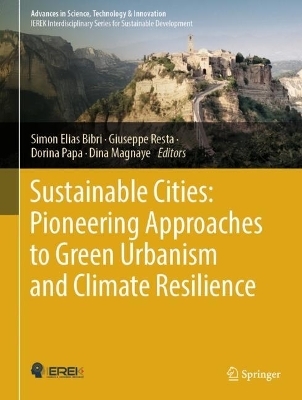
Sustainable Cities: Pioneering Approaches to Green Urbanism and Climate Resilience
Springer International Publishing (Verlag)
978-3-031-86094-2 (ISBN)
The book studies specific aspects of urban planning and environmental management, aiming to provide actionable insights and solutions. This book opens with an analysis of urban processes and the development of mass housing estates, using Famagusta, Cyprus, as a case study. It highlights how topographical factors influence urban growth and housing patterns, providing important implications for infrastructure planning. A significant focus is placed on the development of environmentally-friendly building materials. Several chapters explore the use of waste products, such as cork, in creating sustainable materials. Green and blue infrastructure also receive substantial attention. The book addresses strategies for integrating these elements into urban environments to combat climate change. Topics such as the retention capacity of green roofs and the role of vegetation in improving urban air quality underscore the importance of ecological infrastructure in creating resilient cities. The book further studies urban climate and pollution analysis, presenting advanced methods for monitoring and managing environmental conditions. Chapters on climate change monitoring, air pollution assessment through bryophytes, and VOCs monitoring provide tools for understanding and addressing urban environmental challenges. Human-centric design is another key theme, with discussions on pedestrian comfort and walkability in urban spaces. By focusing on outdoor promenades and thermal comfort, the book highlights the need for urban designs that enhance the quality of life for residents. Practical approaches to project management and planning are also covered. The book introduces methodologies such as PERT/CPM and Monte Carlo simulation techniques for improving project outcomes and developing criteria for climate-friendly planning competitions. Finally, the preservation of landscape heritage amidst urban expansion is explored. A methodology for creating a landscape catalog in Arequipa, Peru, is presented as a way to balance development with the conservation of cultural and natural landscapes.
Biography
Simon Elias Bibri, PhD, is a senior research scientist and project coordinator at the Swiss Federal Institute of Technology Lausanne (EPFL), Institute of Computer and Communication Sciences (IINFCOM), School of Architecture, Civil and Environmental Engineering (ENAC), and Media and Design Laboratory (LDM). He has a diverse professional background, having served as head of a computer department, software engineer, IT business engineer, green ICT and environmental sustainability strategist, research associate, assistant professor, and consultant. Currently, he serves as an expert in Artificial Intelligence and Applied Machine Learning for Climate Action for the United Nations Framework Convention on Climate Change (UNFCCC), an international expert in Sustainable Cities for the United Nations Industrial Development Organization (UNIDO), and an expert for Focus Group for Smart Sustainable Cities, Environmental Sustainability, and Digital Twin for the United Nations Agency of International Telecommunication Union (ITU). He also holds the position of Editor in Chief of the International Journal of Environmental Studies at Taylor & Francis Group.
Dr. Bibri s academic journey exemplifies both interdisciplinarity and transdisciplinarity, traversing and bridging the knowledge domains of science, technology, innovation, and society. His intellectual background encompasses computer science, computer engineering, systems science, innovation science, environmental science, social sciences, and humanities. He holds a bachelor s degree in computer engineering and an advanced management program (AMP) degree. Notably, he earned 9 master s degrees at esteemed Swedish universities, namely, Lund University, West University, Blekinge Institute of Technology, Stockholm University, Malmö University, and Mid Sweden University. Additionally, he earned a PhD in computer science at the Norwegian University of Science and Technology (NTNU), specializing in computational technology and urban informatics, with a focus on data driven smart sustainable cities.
Dr. Bibri is a prolific author with numerous highly cited journal articles, six authored books, two edited books, and 8 co edited books to his credit. His work has been cited over 10500 times, resulting in an h index of 48. His impact is further underscored by his recognition by Stanford and Elsevier as one of the top 2% of scientists globally for five consecutive years. He has also been listed by ScholarGPS in 2022 as the #1 highly ranked scholar in sustainable cities, #4 in big data, and #8 in sustainability in the world.
Dr. Bibri s research interests and expertise cover a broad spectrum of areas, including smart cities, sustainable cities, smarter eco cities, sustainable smart cities, urban artificial intelligence, urban artificial intelligence of things, urban digital twin, smart urban metabolism, urban circularity, cyber physical systems of systems, Internet of City Things, platform urbanism, environmental planning and governance, environmental sustainability, climate change mitigation and adaptation, smart sustainable energy, smart sustainable transportation, smart sustainable waste management, sustainability transitions, and technological innovation systems.
Resta has been architecture editor at Artwort Magazine and Artwort.com. His work has been published in architectural journals such as The Plan Journal, STUDIO, Lunch journal, FAM, Architecture and Urban Planning, CIDADE. His latest monographic books are Journey to Albania: Architectures, expeditions and landscapes of tourism (Accademia University Press, 2022) and Jean-Christophe Quinton. A few houses and shelters 2002-2021 (Libria, 2021).
Dorina Papa, Ph.D,Graduated in architecture in 2007 at Universita Degli Studi Gabrielle D'Annunzio, Italy,&rd
An investigation of urban process and mass housing estates development through topographical formations in urban peripheries a case study of famagusta cyprus.- Complexity in urban spatial analysis interdependence of climate change impacts and city morphology gabriele oneto maria canepa.- Test and evaluation of a developed criteria catalog for climate friendly planning competitions doris bechtel .- The green and blue infrastructures in carbon neutral urban district strategies and solutions towards the new urban and climatic challenges Marco.- Modelling the effects of vegetation on urban air quality based on multiple environmental data sources.- Ecological network analysis in urban areas through graph theory and remote sensing Costanza.- Integrating climate adaptation into green urban regeneration.- Valorization of cork waste within a plaster matrix for designing a new green material under axial compression: Experimental and Numerical approaches.- A new environmentally friendly plaster cork waste functionally graded building material thermal and physical characterization.- Valorization of natural materials in the composition of textile reinforced concrete Mechanical characterization.- Halfdecade green roof average retention capacity changes.- Application of pert cpm and monte carlo simulation techniques for scheduling in reinforced concrete pavement project.- Exploring influential Variables in Land Surface Temperature Prediction Using Remote Sensing.- Sensor stations for VOCs continuous monitoring: Validation of meteorological sensor data and evaluation of the meteorological conditions favouring vocs episodes.- Monitoring of climate change in uaeu campus.- Current condition and effective strategies evaluation thru advanced tools.- Assessment of air pollution by the contents of potentially toxic chemical elements in bryophytes.- Impact based project ideas for sustainable planning strategies in piura peru conversion of small illegal dumpsites as an opportunity to accelerate urban transformation towards climate action.- Comfort and walkability in outdoor promenades in Sharm egypt.- Multi agent simulation for dynamic prediction of pedestrians thermal comfort.- Review of latin american problems and perspectives according to the national reports of habitat.- Preserving landscape heritage in the face of urban expansion a methodology for developing a landscape catalog in arequipa peru.
| Erscheinungsdatum | 28.09.2025 |
|---|---|
| Reihe/Serie | Advances in Science, Technology & Innovation |
| Zusatzinfo | XVI, 240 p. 138 illus., 114 illus. in color. |
| Verlagsort | Cham |
| Sprache | englisch |
| Maße | 210 x 279 mm |
| Themenwelt | Naturwissenschaften ► Biologie ► Ökologie / Naturschutz |
| Naturwissenschaften ► Geowissenschaften | |
| Schlagworte | Axial Compression • climate adaptation • climate change • environmentally friendly • Landscape heritage • Mass Housing Estates Development • Meteorological conditions • Micro-dumpsites • reinforced concrete • textile-reinforced concrete • urban process • Vegetation |
| ISBN-10 | 3-031-86094-2 / 3031860942 |
| ISBN-13 | 978-3-031-86094-2 / 9783031860942 |
| Zustand | Neuware |
| Informationen gemäß Produktsicherheitsverordnung (GPSR) | |
| Haben Sie eine Frage zum Produkt? |
aus dem Bereich