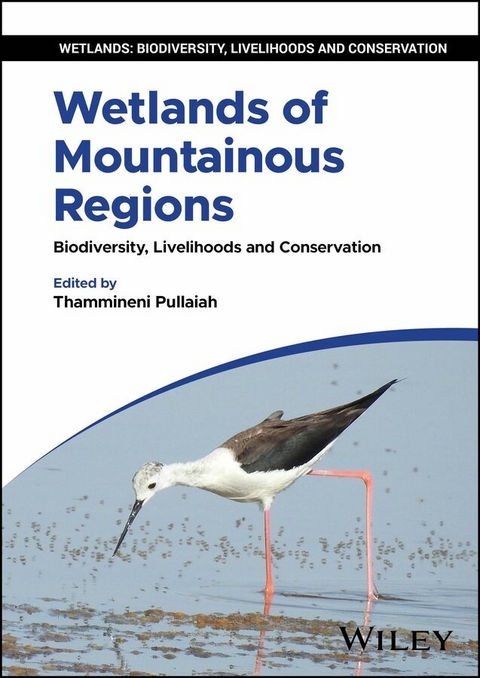
Wetlands of Mountainous Regions (eBook)
A comprehensive survey of exemplary wetlands that highlights their importance for local livelihoods as well as for global biodiversity
Covering 12 mountainous regions ranging from medium to high altitudes, Wetlands of Mountainous Regions provides detailed information on the world's most important wetlands and wetland types across Eurasia and the Americas as well as their current and potential biological resources. Each wetland is analyzed by a regional expert.
Written with UN sustainable development goals in mind, Wetlands of Mountainous Regions includes information on:
- Wetlands of Eastern Himalaya, Nepal, Pakistan, Armenia, Georgia, Slovakia, Bosnia, Herzegovina, Mexico, Costa Rica, Bolivia, Argentina, and Serbia
- The importance in sustaining local economic livelihoods of each wetland region by providing food resources as well as recreational opportunities
- Wetland ecosystem services including carbon sequestration, water filtration, nutrient retention, and flood mitigation
- Threats to the integrity of each wetland region as well as management strategies and practical conservation and restoration measures
Wetlands of Mountainous Regions is an essential reference on the subject for ecologists, conservation scientists, hydrologists, and environmental and water resource managers. Governmental agencies and professionals in fisheries, agriculture, and rural development will also find value in the book.
Thammineni Pullaiah is Professor of Botany (Retired), Department of Botany, Sri Krishnadevaraya University, India. He was President of Indian Botanical Society, President of the Indian Association for Angiosperm Taxonomy, and a member of Species Survival Commission of the International Union for Conservation of Nature (IUCN). He has authored 65 books, edited 40 books, and published over 340 research papers.
A comprehensive survey of exemplary wetlands that highlights their importance for local livelihoods as well as for global biodiversity Covering 12 mountainous regions ranging from medium to high altitudes, Wetlands of Mountainous Regions provides detailed information on the world s most important wetlands and wetland types across Eurasia and the Americas as well as their current and potential biological resources. Each wetland is analyzed by a regional expert. Written with UN sustainable development goals in mind, Wetlands of Mountainous Regions includes information on: Wetlands of Eastern Himalaya, Nepal, Pakistan, Armenia, Georgia, Slovakia, Bosnia, Herzegovina, Mexico, Costa Rica, Bolivia, Argentina, and SerbiaThe importance in sustaining local economic livelihoods of each wetland region by providing food resources as well as recreational opportunitiesWetland ecosystem services including carbon sequestration, water filtration, nutrient retention, and flood mitigationThreats to the integrity of each wetland region as well as management strategies and practical conservation and restoration measures Wetlands of Mountainous Regions is an essential reference on the subject for ecologists, conservation scientists, hydrologists, and environmental and water resource managers. Governmental agencies and professionals in fisheries, agriculture, and rural development will also find value in the book.
List of Contributors
Elena Abraham
Instituto Argentino de Investigaciones en
Zonas Áridas (IADIZA‐CONICET)
Mendoza
Argentina
Víctor Acosta‐Chaves
Center for Ecological Resilience Studies
The School for Field Studies
Beverly
MA
USA
Sede del Atlántico
Universidad de Costa Rica
Recinto de Paraíso
30201 Paraíso
Cartago
Costa Rica
Rafael Acuña‐Castillo
School of Biology
University of Costa Rica
San Pedro
Costa Rica
and
Center for Research in Biodiversity and
Tropical Ecology (CIBET)
University of Costa Rica
San José
Costa Rica
Herbario Luis A. Fournier Origgi (USJ)
Centro de Investigación en Biodiversidad y
Ecología Tropical
Universidad de Costa Rica
San José
Costa Rica
Karen Aghababyan
BirdLinks Armenia NGO and Scientific Centre
of Zoology and Hydroecology of the National
Academy of Sciences of the Republic of
Armenia
Yerevan
Armenia
Levon Aghasyan
Scientific Centre of Zoology and Hydroecology
of the National Academy of Sciences of the
Republic of Armenia
Yerevan
Armenia
Janna Akopian
Takhtajan Institute of Botany of the National
Academy of Sciences of the Republic of
Armenia
Yerevan
Armenia
Guram Aleksidze
Georgian Academy of Agricultural Sciences
Tbilisi
Georgia
Macanović Armin
Univerzitet u Sarajevu
Prirodno‐matematiči fakultet
Sarajevo
Bosnia and Herzegovina
Yanina Arzamendia
Grupo de investigación VICAM
Instituto de Ecorregiones Andinas (INECOA
CONICET‐UNJu)
Facultad de Ciencias Agrarias e INBIAL
UNJu
San Salvador de Jujuy
Argentina
Gerardo Avalos
School of Biology
University of Costa Rica
San Pedro
Costa Rica
and
Center for Ecological Resilience Studies
The School for Field Studies
Beverly
MA
USA
Jorge L. Baldo
Grupo de investigación VICAM
Instituto de Ecorregiones Andinas (INECOA
CONICET‐UNJu)
Facultad de Ciencias Agrarias e INBIAL
UNJu
San Salvador de Jujuy
Argentina
Andleeb Batool
Department of Zoology
Government College University
Lahore
Pakistan
Paula Calderón‐Mesén
Research Center in Microscopy Structures
University of Costa Rica UCR
San Pedro
Costa Rica
Ján Černecký
Institute of Landscape Ecology of the Slovak
Academy of Sciences
Nitra
Slovakia
Prabina Dahal
Amrit Campus
Tribhuvan University
Lainchaur
Kathmandu
Nepal
Alejandra I. Domic
Herbario Nacional de Bolivia
La Paz
Bolivia
and
Department of Anthropology and Department
of Geosciences
Pennsylvania State University
University Park
PA
USA
Viktória Ďuricová
Institute of Botany of the Slovak Academy of
Sciences
Bratislava
Slovakia
Luis Epele
Centro de Investigacióon Esquel de Montaña y
Estepa Patagónica (CONICET‐UNPSJB)
Chubut
Argentina
Mašić Ermin
Univerzitet u Sarajevu
Prirodno‐matematiči fakultet
Sarajevo
Bosnia and Herzegovina
Astghik Ghazaryan
Biological Department
Yerevan State University
Yerevan
Armenia
Dragana Jenačković Gocić
Department of Biology and Ecology
Faculty of Sciences
University in Niš
Niš
Serbia
Susanna Hakobyan
Scientific Centre of Zoology and Hydroecology
of the National Academy of Sciences of the
Republic of Armenia
Yerevan
Armenia
Abdul Jabbar
Department of Zoology
University of the Punjab
Lahore
Pakistan
Givi Japaridze
Georgian Academy of Agricultural Sciences
Tbilisi
Georgia
Karen Jenderedjian
Ministry of Environment of the Republic of
Armenia
Yerevan
Armenia
José Esteban Jiménez
Florida Museum of Natural History and
Department of Biology
University of Florida Herbarium
Gainesville
FL
USA
Herbario Luis A. Fournier Origgi (USJ)
Centro de Investigación en Biodiversidad y
Ecología Tropical
Universidad de Costa Rica
San José,
Costa Rica
Jardín Botánico Lankester
Universidad de Costa Rica
Cartago
Costa Rica
Ján Kadlečík
State Nature Conservancy of the Slovak
Republic
Banská Bystrica
Slovakia
Mark Kalashian
Scientific Centre of Zoology and Hydroecology
of the National Academy of Sciences of the
Republic of Armenia
Yerevan
Armenia
Patricia Kandus
Instituto de Investigación e Ingeniería
Ambiental (3iA)
Escuela de Hábitat y Sostenibilidad (EHyS)
Universidad Nacional de San Martín
Buenos Aires
Argentina
Bert Kohlmann
BioAlfa Barcoding Project
Santo Domingo de Heredia
Costa Rica
Imre Krizmanić
Institute of Zoology
Faculty of Biology
University of Belgrade
Belgrade
Serbia
Rabindra Maharjan
Forest Research and Training Centre
MoFE
Babarmahal
Kathmandu
Nepal
Zurab Manvelidze
Batumi Shota Rustaveli State University
Batumi
Georgia
José Luis Marín‐Muñiz
Academy of Sustainable Regional
Development
El Colegio de Veracruz
Veracruz
Mexico
Mónica Moraes R.
Herbario Nacional de Bolivia
La Paz
Bolivia
Instituto de Ecología
Universidad Mayor de San Andrés
La Paz
Bolivia
Maryam Mukhtar
Department of Zoology
University of the Punjab
Lahore
Pakistan
Naseeba Mustafavi
Department of Zoology
Government College University
Lahore
Pakistan
Biljana Panjković
Institute for Nature Conservation of Vojvodina
Province
Novi Sad
Serbia
Asia Parveen
Department of Zoology
Government College University
Lahore
Pakistan
Sara Pavkov
Department of Biology and Ecology
Faculty of Sciences
University of Novi Sad
Novi Sad
Serbia
Ranko Perić
Institute for Nature Conservation of Vojvodina
Province
Novi Sad
Serbia
Samvel Pipoyan
Armenian Pedagogical State University after
Khachatur Abovyan
Yerevan
Armenia
Oscar Plata
Herbario Nacional de Bolivia
La Paz
Bolivia
and
Museo Nacional de Historia Natural
La Paz
Bolivia
Rubén D. Quintana
IIIA (CONICET UNSAM)
Instituto de Investigación e Ingeniería
Ambiental
Escuela de Hábitat y Sostenibilidad (EHyS)
Universidad Nacional de San Martín
Buenos Aires
Argentina
Dimitrije Radišić
Department of Biology and Ecology
Faculty of Sciences
University of Novi Sad
Novi Sad
Serbia
Sanjeev K. Rai
Department of Plant Resources
MoFE
Thapathali
Kathmandu
Nepal
Milica Rat
Department of Biology and Ecology
Faculty of Sciences
University of Novi Sad
Novi Sad
Serbia
Dania Razzaq
Department of Zoology
Government College University
Lahore
Pakistan
Verónica Rojo
Grupo de investigación VICAM
Instituto de Ecorregiones Andinas (INECOA
CONICET‐UNJu)
Facultad de Ciencias Agrarias e INBIAL
UNJu
San Salvador de Jujuy
Argentina
Cecilia Rubio
Instituto Argentino de Investigaciones en
Zonas Áridas (IADIZA‐CONICET)
Mendoza
Argentina
Clara Rubio
Instituto Argentino de Investigaciones en
Zonas Áridas (IADIZA‐CONICET)
Mendoza
Argentina
Ricardo Sánchez‐Calderón
Center for Ecological Resilience Studies
The School for Field Studies
Beverly
MA
USA
Nenad Sekulić
Institute for Nature Conservation of Serbia
New Belgrade
Serbia
Barudanović Senka
Univerzitet u Sarajevu
Prirodno‐matematiči fakultet
Sarajevo
Bosnia and Herzegovina
Krishna K. Shrestha
Central Department of Botany
Tribhuvan University
Kirtipur
Kathmandu
Nepal
Natalia Solís
Grupo de investigación VICAM
Instituto de Ecorregiones Andinas (INECOA
CONICET‐UNJu)
Facultad de Ciencias Agrarias e INBIAL
UNJu
San Salvador de Jujuy
Argentina
Jana Špulerová
Institute of Landscape Ecology of the Slovak
Academy of...
| Erscheint lt. Verlag | 13.1.2025 |
|---|---|
| Reihe/Serie | Wetlands: Biodiversity, Livelihoods and Conservation |
| Sprache | englisch |
| Themenwelt | Naturwissenschaften ► Biologie ► Ökologie / Naturschutz |
| Naturwissenschaften ► Geowissenschaften ► Geologie | |
| ISBN-13 | 9781394235223 / 9781394235223 |
| Informationen gemäß Produktsicherheitsverordnung (GPSR) | |
| Haben Sie eine Frage zum Produkt? |
 EPUB (Adobe DRM)
Kopierschutz: Adobe-DRM
Adobe-DRM ist ein Kopierschutz, der das eBook vor Mißbrauch schützen soll. Dabei wird das eBook bereits beim Download auf Ihre persönliche Adobe-ID autorisiert. Lesen können Sie das eBook dann nur auf den Geräten, welche ebenfalls auf Ihre Adobe-ID registriert sind.
Details zum Adobe-DRM
Dateiformat: EPUB (Electronic Publication)
EPUB ist ein offener Standard für eBooks und eignet sich besonders zur Darstellung von Belletristik und Sachbüchern. Der Fließtext wird dynamisch an die Display- und Schriftgröße angepasst. Auch für mobile Lesegeräte ist EPUB daher gut geeignet.
Systemvoraussetzungen:
PC/Mac: Mit einem PC oder Mac können Sie dieses eBook lesen. Sie benötigen eine
eReader: Dieses eBook kann mit (fast) allen eBook-Readern gelesen werden. Mit dem amazon-Kindle ist es aber nicht kompatibel.
Smartphone/Tablet: Egal ob Apple oder Android, dieses eBook können Sie lesen. Sie benötigen eine
Geräteliste und zusätzliche Hinweise
Buying eBooks from abroad
For tax law reasons we can sell eBooks just within Germany and Switzerland. Regrettably we cannot fulfill eBook-orders from other countries.
aus dem Bereich