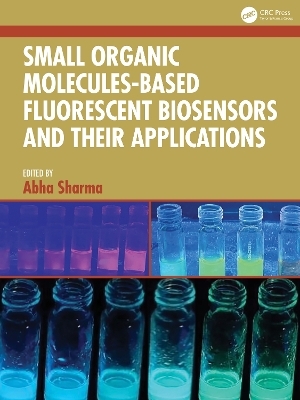
Small Organic Molecules-Based Fluorescent Biosensors and their Applications
CRC Press (Verlag)
978-1-032-70616-0 (ISBN)
This book provides an overview of organic molecule-based fluorescent compounds and their applications as sensors and biosensors. The initial chapter introduces fundamental fluorescence concepts and their significance in biosensing. The book, in turn, details the synthesis of various scaffolds including xanthene, BODIPY, julolidine, cyanine, quinoline, phenanthiridine, acridine, rhodamine, benzothiazole, coumarin, perylene, and carbazole. The subsequent section covers the use of these organic fluorescent molecules in sensing proteins and DNA through selective binding, ion indicators for real-time tracking, and receptor-specific ligands for interaction studies. It also explores cellular component visualization using organelle markers and membrane probes. Additionally, the book delves into the application of fluorescent organic molecules for sensing lipids, carbohydrates, and other biological molecules, fostering interdisciplinary understanding. Addressing environmental concerns, the book highlights the use of fluorescent probes for analyte analysis, providing insights into pollution monitoring and water quality assessment. This book is useful for researchers, students, and professionals seeking to understand and harness the potential of these innovative biosensing technologies.
Key features
Provides a comprehensive overview of the synthesis and development of organic molecule-based fluorescent compounds
Presents applications of organic molecule-based fluorescent compounds in various aspects of biological and environmental analysis
Discusses the applications of fluorescent compounds in sensing of lipids, carbohydrates, and other biological molecules
Reviews the role of fluorescent probes in monitoring pollution and assessment of water quality
Examines the role of biosensors as ion indicators for real-time tracking, and receptor-specific ligands for interaction studies
Explores cellular component visualization using organelle markers and membrane probes
Dr. Abha Sharma earned her Ph.D. from the Defence Research and Development Establishment (awarded by Jiwaji University), Gwalior, India, in 2006. She has worked at the Indian Institute of Toxicology Research (IITR), Lucknow as a Research Associate for more than three and a half years. Since 2010, she has been working as a faculty member in the Department of Medicinal Chemistry at the National Institute of Pharmaceutical Education and Research, Raebareli, India. Currently, she is serving as an Associate Professor in the same department. Her research area includes the design and synthesis of molecules for the treatment of Alzheimer's disease and the development of sensors/probes for the detection of analytes/biomarkers of various central nervous system diseases such as AD. Her publications include nearly 60 high-impact journal papers and book chapters, and she has been granted several patents. She has also served as a referee for some international journals and guided several students to the completion of their research projects.
Chapter 1. Photoluminescence and fluorescence mechanism. Chapter 2. Acridine-based fluorescent probes: Synthesis, biological and non-biological applications. Chapter 3. Rhodamine-based molecules: Design and applications. Chapter 4. BODIPY-based fluorescent probes and their applications. Chapter 5. Julolidine-based molecules: Design and applications. Chapter 6. Perylene-based molecules: Design and applications. Chapter 7. Cyanine-based molecules: Design and applications. Chapter 8. Fluorescein-based molecules: Design, Synthesis and their applications. Chapter 9. Quinoline-based fluorescent probes for various applications. Chapter 10. Phenanthiridine-based molecules: Design, synthesis and applications. Chapter 11. Benzothiazole-based fluorescent probes for various applications. Chapter 12. Coumarin-based molecules: Design and applications. Chapter 13. Carbazole-based fluorescent molecules: Design and applications.
| Erscheinungsdatum | 07.08.2025 |
|---|---|
| Zusatzinfo | 97 Line drawings, color; 61 Line drawings, black and white; 97 Illustrations, color; 61 Illustrations, black and white |
| Verlagsort | London |
| Sprache | englisch |
| Maße | 210 x 280 mm |
| Gewicht | 570 g |
| Themenwelt | Medizin / Pharmazie ► Physiotherapie / Ergotherapie ► Orthopädie |
| Naturwissenschaften ► Biologie ► Biochemie | |
| Technik ► Medizintechnik | |
| Technik ► Umwelttechnik / Biotechnologie | |
| ISBN-10 | 1-032-70616-3 / 1032706163 |
| ISBN-13 | 978-1-032-70616-0 / 9781032706160 |
| Zustand | Neuware |
| Informationen gemäß Produktsicherheitsverordnung (GPSR) | |
| Haben Sie eine Frage zum Produkt? |
aus dem Bereich