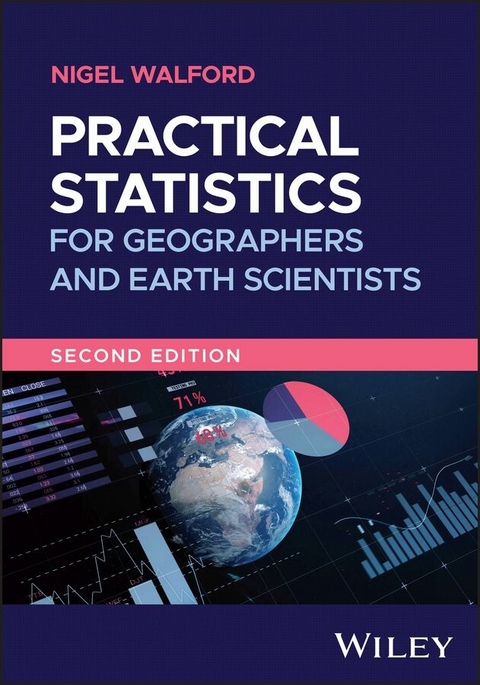
Practical Statistics for Geographers and Earth Scientists (eBook)
979 Seiten
Wiley (Verlag)
978-1-119-52698-8 (ISBN)
A practice-oriented and accessible introduction to geographical statistics
In the newly revised Second Edition of Practical Statistics for Geographers and Earth Scientists, distinguished researcher Nigel Walford delivers an authoritative and easy-to-follow introduction to the principles and applications of statistical analysis in a geographical context. The book assists students in the development of competence in the statistical procedures necessary to conduct independent investigations, field-work, and related geographical research projects.
The book explains statistical techniques relevant to geographical, geospatial, earth, and environmental data. It employs graphics and mathematical notation for maximum clarity. Guidance is provided on how to formulate research questions to ensure that the correct data is collected for the chosen analysis method.
This new edition incorporates a new section on exploratory spatial analysis and spatial statistics. It also offers:
- A thorough introduction to first principles in the statistical analysis of geographical data, including discussions of the quality, content, collection, and acquisition of geographical data
- In-depth treatments of geographical data exploration, including the taking of statistical measures or quantities, as well as frequency distributions, probability, and hypotheses
- Comprehensive explorations of testing times, including parametric and nonparametric tests
- Insightful discussions of relationship investigation, including correlation and regression, as well as the spatial aspects of geographical data
Perfect for undergraduates pursuing a degree in geography, Practical Statistics for Geographers and Earth Scientists will also be a valuable tool for students in other earth and environmental sciences.
Nigel Walford is Professor of Applied Geographical Information Systems at Kingston University in the United Kingdom.
A practice-oriented and accessible introduction to geographical statistics In the newly revised Second Edition of Practical Statistics for Geographers and Earth Scientists, distinguished researcher Nigel Walford delivers an authoritative and easy-to-follow introduction to the principles and applications of statistical analysis in a geographical context. The book assists students in the development of competence in the statistical procedures necessary to conduct independent investigations, field-work, and related geographical research projects. The book explains statistical techniques relevant to geographical, geospatial, earth, and environmental data. It employs graphics and mathematical notation for maximum clarity. Guidance is provided on how to formulate research questions to ensure that the correct data is collected for the chosen analysis method. This new edition incorporates a new section on exploratory spatial analysis and spatial statistics. It also offers: A thorough introduction to first principles in the statistical analysis of geographical data, including discussions of the quality, content, collection, and acquisition of geographical data In-depth treatments of geographical data exploration, including the taking of statistical measures or quantities, as well as frequency distributions, probability, and hypotheses Comprehensive explorations of testing times, including parametric and nonparametric tests Insightful discussions of relationship investigation, including correlation and regression, as well as the spatial aspects of geographical data Perfect for undergraduates pursuing a degree in geography, Practical Statistics for Geographers and Earth Scientists will also be a valuable tool for students in other earth and environmental sciences.
1
What's in a Number?
Chapter 1 provides a brief review of the development of quantitative analysis in Geography, Earth and Environmental Science and related disciplines. It also discusses the relative merits of using numerical data and how numbers can be used to represent qualitative characteristics. A brief introduction to mathematical notation and calculation is provided to a level that will help readers to understand subsequent chapters. Overall, this introductory chapter is intended to define terms and to provide a structure for the remainder of the book.
Learning Outcomes
This chapter will enable readers to:
- Outline the difference between quantitative and qualitative approaches and their relationship to statistical techniques;
- Describe the characteristics of numerical data and scales of measurement;
- Recognise forms of mathematical notation and calculation that underlie analytical procedures covered in subsequent chapters;
- Plan their reading of this text in relation to undertaking an independent research investigation in Geography and related disciplines.
1.1 Introduction to Quantitative Analysis
Quantitative analysis is one of the two main approaches to researching and understanding the world around us. In simple terms, it is the processing and interpretation of data about things, sometimes called phenomena, which are held in a numerical form. In other words, from the perspective of Geography and other Earth Sciences, it is about investigating the differences and similarities between people and places that can be expressed as numerical quantities rather than words. In contrast, qualitative analysis recognises the uniqueness of all phenomena and the important contribution towards understanding that is provided by unusual, idiosyncratic cases as much as by those conforming to some numerical pattern. Using the two approaches together has become popular in recent years to develop a more robust understanding of how processes work that lead to variations in the distribution of phenomena over the Earth's surface than by employing either methodology on its own.
If you are reading this book as a student on a university or college course, there will be differences and similarities between you and the other students taking the same course in terms of such things as your age, height, school level qualifications, home town, genetic make‐up, parental annual income and so on. You will also be different because each human being, and for that matter each place on the Earth, is unique. There is no one else exactly like you, even if you have an identical twin, nor is there any place precisely the same as where you are reading this book. You are different from other people because your upbringing, cultural background and physical characteristics have moulded your own attitudes, values and feelings and how you respond to new situations and events. In some ways, it is the old argument of nature versus nurture, but we are unique combinations of both sets of factors. You may be reading this book on a laptop in your room in a university hall of residence, and there are many such places in the various countries of the world and those in the same institution often seem identical, but the one where you are now is unique. Just as the uniqueness of individuals does not prevent analysis of people as members of various groups, so the individuality of places does not inhibit investigation of their distinctive and shared characteristics.
Quantitative analysis concentrates on those influences that are important in producing differences and similarities between individual phenomena and to disregard those producing unusual outcomes. Confusion between quantitative and qualitative analysis may arise because sometimes numbers are used to represent the qualitative characteristics of people and places. For example, areas in a city may be assigned to a series of qualitative categories, such as downtown, suburbs, shopping mall, commercial centre and housing estate, and these may be given numerical codes, or a person may agree or disagree with the UK's exit from the European Union with these opinions assigned numerical values such as 1 or 2. Just as qualitative characteristics can be turned into numerical codes, numerical measurements can be converted into descriptive labels. This could be simple, such as grouping household income values into low, medium and high ranges. In contrast, a selection of different socio‐economic and demographic numerical counts for various locations may have combined them in an ‘analytical melting pot’ to produce geodemographic descriptions or labels of what neighbourhoods are like, such as Old people, detached houses; Larger families, prosperous suburbs; Older rented terraces; and Council flats, single elderly.
The major focus of this book is on quantitative analysis in Geography and other Earth Sciences, although this emphasis does not imply that it is in some definitive sense ‘better’, or even more scientific, than qualitative analysis. Nor are they mutually exclusive since researchers from many disciplines now appreciate the advantages of combining both forms of analysis in a mixed methods approach. This book concentrates on quantitative analysis because many students, and perhaps researchers, find dealing with numbers and statistics difficult and are a barrier to understanding the ‘real’ Geography or Earth Science topics that interest them. Why should we bother with numbers and statistics, when what really interests us is why migrants are risking their lives crossing the English Channel to seek asylum in the UK, why we are experiencing a period of global temperature increase, or why people live in areas vulnerable to natural hazards?
We can justify working with numbers and statistics to answer such research questions in a few diverse ways. As with most research, when we try to explain things such as migration, global warming and exposure to natural hazards, the answers often seem like common sense and even rather obvious. Maybe this is a sign of ‘good’ research because it suggests the process of explaining such things is about building on what has become common knowledge and understanding. If this is true, then ongoing academic study both relies upon and questions the work of previous generations of researchers and puts across complex issues in ways that can be understood. Answers to research questions are commonly stated with a high degree of certainty, whereas they are often underlain by an analysis of numerical information that is anything but certain. The results of the research are likely to be correct, but they may be false. Using statistical techniques gives us a way of expressing this uncertainty and of hedging our bets against the possibility that our set of results has only arisen by chance. At some time in the future, another researcher might come along and contradict our findings.
But what do we really mean by the phrase ‘the results of the research’. For the ‘consumers’ of research, whether the public at large or professional groups, the results or outcomes of research are often some pieces of crucial information. The role of such information is to either confirm facts that are already known or believed or to fulfil the unquenchable need for new information. For the academic, these detailed factual results may be of less direct interest than the implications of the research findings, about some overarching theory. The student undertaking a research investigation as part of their course sits somewhere, perhaps uncomfortably, between these two positions. Realistically many students recognise that their research endeavours are unlikely to contribute significantly to theoretical advance, policy decisions or commercial product development, although obviously there are exceptions. Yet they also recognise that their tutors are unlikely to be impressed simply by the presentation of new information. Such research investigations (often called independent projects) are typically included in undergraduate degree programmes to provide students with training that prepares them for a career where such skills as collecting and assimilating information will prove useful, whether this be in academia or more typically in other professional fields. Students face a dilemma to which there is no simple answer. They need to demonstrate that they have carried out their research in a rigorous scientific manner using appropriate quantitative and qualitative techniques, but they do not want to overburden the assessors with an excess of detail that obscures the implications of their results.
In the 1950s and 1960s, several academic disciplines ‘discovered’ quantitative analysis and few geography students of the last 50 years will not have heard of the ‘quantitative revolution’. There was, and still is, a belief that the principles of rigour, replication and respectability enshrined in scientific endeavour sets it apart from, and superior to, other forms of more discursive academic enquiry. The adoption of the quantitative approach was seen implicitly, and in some cases explicitly, as providing the passport to recognition as a scientific discipline. Geography and other Earth Sciences were not alone, and perhaps were more sluggish than some disciplines, in seeking to establish their scientific credentials. The classical approach to geographical enquiry followed from the colonial and exploratory legacies of the 18th and 19th centuries that permeated regional geography into the early 20th century and concentrated...
| Erscheint lt. Verlag | 10.1.2025 |
|---|---|
| Sprache | englisch |
| Themenwelt | Naturwissenschaften ► Geowissenschaften ► Geografie / Kartografie |
| Schlagworte | Correlation • exploratory geographical data • Exploratory Spatial analysis • Frequency Distributions • geographical statistics • hypothesis testing • Probability • Regression • spatial statistics • statistics for earth science • statistics for geography |
| ISBN-10 | 1-119-52698-1 / 1119526981 |
| ISBN-13 | 978-1-119-52698-8 / 9781119526988 |
| Informationen gemäß Produktsicherheitsverordnung (GPSR) | |
| Haben Sie eine Frage zum Produkt? |
 EPUB (Adobe DRM)
Kopierschutz: Adobe-DRM
Adobe-DRM ist ein Kopierschutz, der das eBook vor Mißbrauch schützen soll. Dabei wird das eBook bereits beim Download auf Ihre persönliche Adobe-ID autorisiert. Lesen können Sie das eBook dann nur auf den Geräten, welche ebenfalls auf Ihre Adobe-ID registriert sind.
Details zum Adobe-DRM
Dateiformat: EPUB (Electronic Publication)
EPUB ist ein offener Standard für eBooks und eignet sich besonders zur Darstellung von Belletristik und Sachbüchern. Der Fließtext wird dynamisch an die Display- und Schriftgröße angepasst. Auch für mobile Lesegeräte ist EPUB daher gut geeignet.
Systemvoraussetzungen:
PC/Mac: Mit einem PC oder Mac können Sie dieses eBook lesen. Sie benötigen eine
eReader: Dieses eBook kann mit (fast) allen eBook-Readern gelesen werden. Mit dem amazon-Kindle ist es aber nicht kompatibel.
Smartphone/Tablet: Egal ob Apple oder Android, dieses eBook können Sie lesen. Sie benötigen eine
Geräteliste und zusätzliche Hinweise
Buying eBooks from abroad
For tax law reasons we can sell eBooks just within Germany and Switzerland. Regrettably we cannot fulfill eBook-orders from other countries.
aus dem Bereich