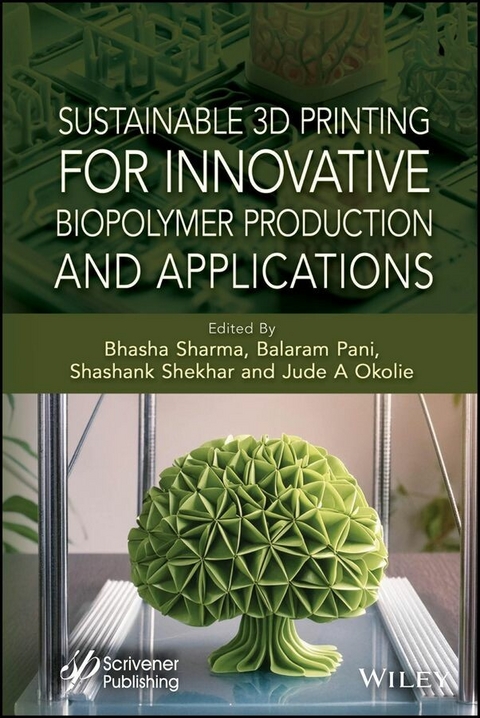
Sustainable 3D Printing for Innovative Biopolymer Production and Applications (eBook)
263 Seiten
Wiley-Scrivener (Verlag)
9781119792307 (ISBN)
This book highlights 3D-printed biopolymers' advancements and sustainability, exploring cutting-edge research and real-world applications.
Biopolymers have garnered global interest due to environmental concerns and are widely utilized in applications such as biomedicine, food, textiles, and cosmetics. Techniques like 3D printing have been extensively studied to fabricate reliable and efficient products, particularly in tissue engineering. These techniques enable the production of materials with complex structures and diverse functional groups.
The book provides a comprehensive account of contemporary advancements in 3D-printed biopolymers, emphasizing their role in promoting sustainability and supporting the circular economy. Featuring meticulously curated chapters by leading scientists, it integrates diverse disciplines, including green biopolymers, nanotechnology, functionalization techniques, and material synthesis, offering a holistic understanding of the field. Several chapters delve into 3D printing processing techniques and their applications in areas such as water purification, energy storage, and biomedical advancements. Additionally, the book addresses progress in biopolymer technology, exploring its challenges and future prospects.
Audience
This book is ideal for industrial manufacturers, environmental chemists, materials and biopolymer scientists, and researchers in industries such as biomedicine, food, textiles, packaging, and cosmetics.
Bhasha Sharma, PhD, is an assistant professor in the Department of Chemistry at the University of Delhi, India. Her research interests include sustainable polymers for packaging, environmentally friendly approaches to biodegrading plastic waste, fabricating bionanocomposites, and improving the electrochemical activity of biopolymers.
Balaram Pani, PhD, serves as Dean of Colleges and Director of the Campus on Open Learning at the University of Delhi, India. He has authored 20 books and published over 50 research articles in reputed journals. His research interests include polymer science, environmental chemistry, and thermodynamics.
Shashank Shekhar, PhD, is a visiting faculty member at Netaji Subhas University of Technology, Delhi, India, and is associated with the Department of Renewable Energy, Quantum Research Centre of Excellence in Delhi. His research focuses on biopolymers and Schiff base metal complexes.
Jude A Okolie, PhD, is a faculty member at St. Peter's College in Jersey City, New Jersey, an affiliate of the University of Saskatchewan, Canada. His research focuses on the thermochemical conversion of waste materials into green fuels and the use of hydrochar/biochar for environmental remediation.
This book highlights 3D-printed biopolymers' advancements and sustainability, exploring cutting-edge research and real-world applications. Biopolymers have garnered global interest due to environmental concerns and are widely utilized in applications such as biomedicine, food, textiles, and cosmetics. Techniques like 3D printing have been extensively studied to fabricate reliable and efficient products, particularly in tissue engineering. These techniques enable the production of materials with complex structures and diverse functional groups. The book provides a comprehensive account of contemporary advancements in 3D-printed biopolymers, emphasizing their role in promoting sustainability and supporting the circular economy. Featuring meticulously curated chapters by leading scientists, it integrates diverse disciplines, including green biopolymers, nanotechnology, functionalization techniques, and material synthesis, offering a holistic understanding of the field. Several chapters delve into 3D printing processing techniques and their applications in areas such as water purification, energy storage, and biomedical advancements. Additionally, the book addresses progress in biopolymer technology, exploring its challenges and future prospects. Audience This book is ideal for industrial manufacturers, environmental chemists, materials and biopolymer scientists, and researchers in industries such as biomedicine, food, textiles, packaging, and cosmetics.
| Erscheint lt. Verlag | 9.1.2025 |
|---|---|
| Sprache | englisch |
| Themenwelt | Naturwissenschaften ► Chemie ► Organische Chemie |
| Schlagworte | 3D Printing • Biodegradable Polymers • Biomedical Applications • biopolymers • Economical Considerations • Environmentally friendly polymers • Life Cycle Assessment • nanotechnology • Scaffolds • Structural applications • Sustainable Innovations • sustainable polymers • Thermoplastics • Tissue engineering • Water Purification Applications |
| ISBN-13 | 9781119792307 / 9781119792307 |
| Informationen gemäß Produktsicherheitsverordnung (GPSR) | |
| Haben Sie eine Frage zum Produkt? |
 PDF (Adobe DRM)
Kopierschutz: Adobe-DRM
Adobe-DRM ist ein Kopierschutz, der das eBook vor Mißbrauch schützen soll. Dabei wird das eBook bereits beim Download auf Ihre persönliche Adobe-ID autorisiert. Lesen können Sie das eBook dann nur auf den Geräten, welche ebenfalls auf Ihre Adobe-ID registriert sind.
Details zum Adobe-DRM
Dateiformat: PDF (Portable Document Format)
Mit einem festen Seitenlayout eignet sich die PDF besonders für Fachbücher mit Spalten, Tabellen und Abbildungen. Eine PDF kann auf fast allen Geräten angezeigt werden, ist aber für kleine Displays (Smartphone, eReader) nur eingeschränkt geeignet.
Systemvoraussetzungen:
PC/Mac: Mit einem PC oder Mac können Sie dieses eBook lesen. Sie benötigen eine
eReader: Dieses eBook kann mit (fast) allen eBook-Readern gelesen werden. Mit dem amazon-Kindle ist es aber nicht kompatibel.
Smartphone/Tablet: Egal ob Apple oder Android, dieses eBook können Sie lesen. Sie benötigen eine
Geräteliste und zusätzliche Hinweise
Buying eBooks from abroad
For tax law reasons we can sell eBooks just within Germany and Switzerland. Regrettably we cannot fulfill eBook-orders from other countries.
aus dem Bereich