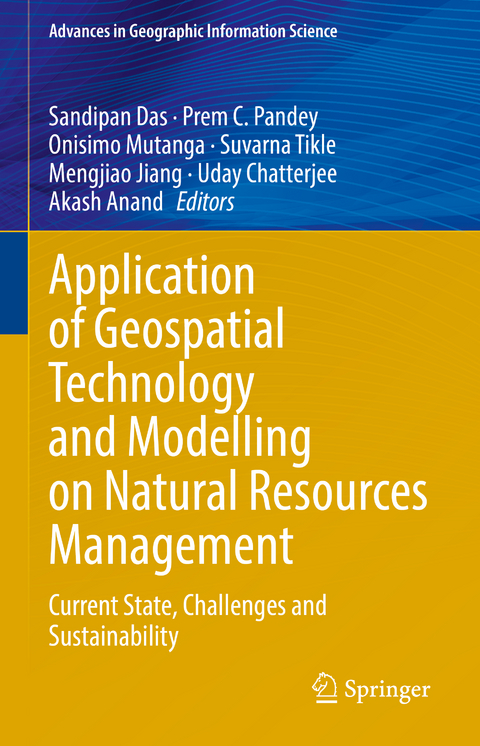
Application of Geospatial Technology and Modelling on Natural Resources Management
Springer International Publishing (Verlag)
978-3-031-84697-7 (ISBN)
This contributed volume provides coverage of geospatial technology and modelling techniques that are useful for natural resource assessment at various scales, from regional to global. This makes it a valuable resource for researchers, practitioners, scientists, faculties and students interested in understanding how geospatial tools can be used to assess natural resources. The book provides numerous examples of how geospatial technology and modeling can be applied to different natural resource management scenarios, including forest management, wildlife conservation, water resources management, and climate change adaptation. The book takes an interdisciplinary approach to natural resource management, bringing together perspectives from ecology, environment, geography, geology, and other fields.
Dr. Sandipan Das is an Assistant Professor at Symbiosis Institute of Geoinformatics, Symbiosis International (Deemed University), Pune, India. Dr. Das pursued his Master's degree in Geoinformatics from Pune University and Ph.D. in Geoinformatics from Symbiosis International (Deemed University). He has 9 years of teaching and 12 years of research experience. His areas of research interest include forest biomass and carbon assessment, water resources management, soil erosion, flood vulnerability, groundwater mapping, drought monitoring, and Geospatial Modelling of Environments. He has worked as a Principal Investigator, Co-Principal Investigator, and team member on several research projects funded by the Indian Space Research Organisation (ISRO), Department of Science and Technology (DST), and Ministry of Environment and Forest (MoEF). He has published 23 research papers, 4 edited books, 10 book chapters, and 5 conference proceedings. He has organized five capacity building geospatial training programs sponsored by DST and ISRO. Dr. Sandipan Das has completed the Special Issue (S.I) of Geophysical, Climatological and Anthropogenic Hazards and Disaster: Vulnerability, Risk Assessment, and Sustainability, Frontiers in Environmental Science Journal as a Lead Editor. He is a reviewer for the several scientific journals of international reputes. He is an Editorial board member of Springer Discover Geoscience Journal.
Dr. Prem Chandra Pandey received his PhD from University of Leicester, United Kingdom. He served as Research Scientist at Tel Aviv University, Israel. Currently, he is working as Assistant Professor at Department of Life Sciences, Shiv Nadar Institution of Eminence (deemed to be University) Greater Noida, India and also worked with the Center for Environmental Sciences and Engineering, Shiv Nadar University. Previously, he had been associated with Banaras Hindu University India. He received his M.Sc and M.Tech in Remote Sensing. He worked on remote sensing applications as Professional Research funded by NRSC Government of India. He has been a recipient of several awards including The Commonwealth award UK, INSPIRE fellowship, MHRD and UGC fellowships, and SERB-NPDF from GoI India. He has published more than 45 peer reviewed journal papers, has edited eight books, several book chapters, and presented his work in national and international conferences. Additionally, he is a life member of the Indian Society of Geomatics, and the Indian Society of Remote Sensing, as well as a IUCN CEM Member (2017-2021; 2022-2025), and the Society of Wetland Scientists (2021-2022). He is serving as Editorial member for the Journal-Geocarto International (Taylor & Francis), Sustainable Development (Wiley) and associated with Remote Sensing (MDPI) as topic Editor. Dr. Pandey is working in three projects related to Monitoring of wetlands/chilika lake mainly focusing on Ramsar sites along with other natural resources based research work funded by NGP and SERB Government of India. Dr. Pandey is also working with science-collaborators for real time Disaster monitoring at Himalayan region. He has expertise in remote sensing of environment and natural resources for their monitoring, mapping and modeling including forestry, agriculture, and land use land cover.
Onisimo Mutanga, is a Professor of Remote Sensing and South African Research Chair on Landuse Planning and Management. He received his PhD on Hyperspectral Remote Sensing of Tropical Grass quality and quantity from the ITC, Wageningen University, Netherlands in 2004. His expertise lies on resource modeling, pattern and condition analysis in the face of global and land use change. This includes the development of innovative remote sensing approaches for improved monitoring and management of various ecosystem traits. Focus areas include vegetation mapping, Ecosystem services quantification, for
1 Geospatial Technologies' Basic Concepts and Recent Applications in Natural Resources Management and Decision Support.- 2 Dam-Failure Induced Flood Simulation Modelling and Mapping using Space Technology.- 3 Assessing Drainage Characteristics Through Morphometric Evaluation in the Upper Wabe Shebelle Basin, Ethiopia.- 4 Changing Surface Water Scenario in Jhansi District of Bundelkhand Region.- 5 Hydro-Vegetation Dynamics in Godavari River Sub-Basins.- 6 Groundwater Potential Zoning in The Purulia District, West Bengal.- 7 Modelling and Predicting Forest Dynamics and Their Impacts on Ecosystem Services.- 8 Machine Learning-Based Algorithms for Mapping Mangrove Cover Changes in Mumbai Region Using Google Earth Engine.- 9 Geospatial Technologies' Concepts and Methods for Land-Use Land-Cover Dynamics Mapping.- 10 Mapping Soil Erosion Vulnerability in the Upper Blue Nile River Basin, Ethiopia.- 11 Advancements in Land Use Land Cover Classification.- 12 Assessment of Soil Erosion in Joshimath, Uttarakhand Using the Revised Universal Soil Loss Equation (RUSLE) and Machine Learning Approach.- 13 Comparison of Land Use Land Cover Classification Using Sentinel-2 Images with Different Deep Learning Approaches.- 14 Geospatial Techniques for Mapping and Monitoring Land Use Land Cover Change.- 15 Assessment of Salt-Affected Soil Using Remote Sensing-Based Salinity Indices.- 16 Estimating Soil Erosion in Surguja District, Chhattisgarh (India) Using the RUSLE Model and Geo-spatial Techniques.- 17 Benefits of Green and Blue Spaces (GBS) for Heat Mitigation and Emission Reduction in Urban Areas.- 18 Geospatial Techniques to Assess Green Equity in the City of Bhopal, India.- 19 Discriminating Maize and Soyabean in Mixed Cropping Systems Using Unmanned Aerial Systems Datasets and Random Forest.- 20 Chronology of Mangrove Destruction by Pond Expansion in the Mahakam Delta, Indonesia, Using Automatic Mangrove Map and Index (AMMI) and Automatic Shoreline Map (ASM) Index Through the Google Earth Engine Platform.- 21 Applications of Geospatial Technology in Wildfire Studies.- 22 Challenges and Future Opportunities of Geospatial Modelling for Natural Resource Assessment.
| Erscheinungsdatum | 05.06.2025 |
|---|---|
| Reihe/Serie | Advances in Geographic Information Science |
| Zusatzinfo | XXVIII, 543 p. 207 illus., 192 illus. in color. |
| Verlagsort | Cham |
| Sprache | englisch |
| Maße | 155 x 235 mm |
| Themenwelt | Naturwissenschaften ► Geowissenschaften ► Geografie / Kartografie |
| Schlagworte | GIS • machine learning • Modelling • natural resource management • Remote Sensing • scale • SDGs |
| ISBN-10 | 3-031-84697-4 / 3031846974 |
| ISBN-13 | 978-3-031-84697-7 / 9783031846977 |
| Zustand | Neuware |
| Informationen gemäß Produktsicherheitsverordnung (GPSR) | |
| Haben Sie eine Frage zum Produkt? |
aus dem Bereich