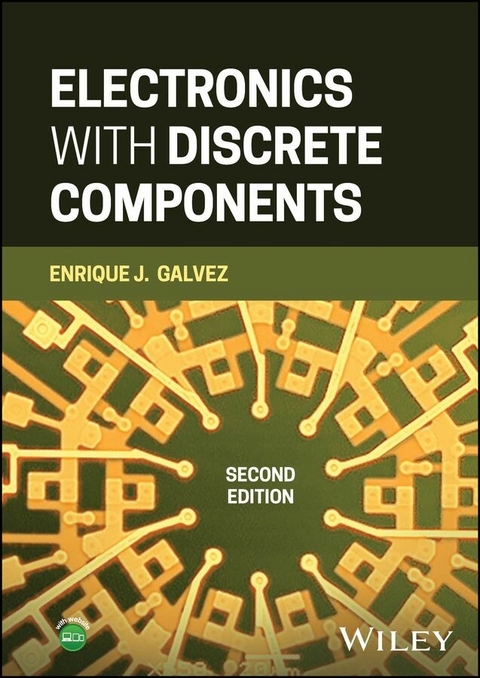
Electronics with Discrete Components (eBook)
435 Seiten
Wiley (Verlag)
978-1-119-91314-6 (ISBN)
Comprehensive textbook on electronics for physicists, now with more examples, exercises, hands-on electronics labs, troubleshooting tips, and practical exercises
Electronics with Discrete Components delivers a comprehensive overview of electronics from the perspective of a physicist. In the first part on digital components, after an introduction to digital electronics, the text covers fundamentals of combinational logic and its implementation in combinational logic devices, followed by sequential-logic devices such as flip-flops and memory components. The second part on analog components deals with the fundamentals of signal processing, filters, components such as diodes and transistors, and a lengthy coverage of operational amplifiers.
Each chapter ends with problem sets and 'lab projects' that have been proven to work well for instruction. Questions on simple aspects of the lab that students should know are also included, such as regarding powering components and diagnosing signals with the oscilloscope and providing 'troubleshooting tips' to help students find out why a particular circuit does not work.
The new edition of this textbook adds more worked examples, exercises with answers for the self-learner, and end-of-chapter problems. It adds new electronic components, covers the latest digital technologies plus adds a new section of Fourier transforms in electronics. In addition, it features labs with Arduino or Teensy boards which have become widespread in the community as inexpensive, easy-to-use electronics platforms.
Electronics with Discrete Components includes information on:
- Number systems, codes, signed numbers, binary functions, logic families, and IC wirings
- Filters and the frequency domain, covering RC, high- and low-pass, and cascading filters, FFTs, as well as important considerations for filter design
- Connecting digital to analog and to the world through TTL, CMOS, and LV gates and interfacing between the logic families
- Charge and potential, capacitors, electrical current, resistors, magnetic components, power, circuits, and abstractions and symbol jargon in the field
The Second Edition of Electronics with Discrete Components is an ideal textbook resource for a one-semester course on electronics for second-year physics students, as well as students from other disciplines or levels who understand elementary notions of circuits and complex numbers.
Professor Enrique J. Galvez is an atomic and optical physics experimentalist. His studies have focused on optics and quantum optics, including fundamental studies of the geometric phase in optics, complex light beams, singular optics, photon entanglement, and the development of instructional quantum optics laboratories. He is the recipient of the 2010 Award to Faculty Member for Research at an Undergraduate Institution and the 2020 Jonathan F. Reichert and Barbara Wolff-Reichert Award for Excellence in Advanced Laboratory Instruction from the American Physical Society.
Comprehensive textbook on electronics for physicists, now with more examples, exercises, hands-on electronics labs, troubleshooting tips, and practical exercises Electronics with Discrete Components delivers a comprehensive overview of electronics from the perspective of a physicist. In the first part on digital components, after an introduction to digital electronics, the text covers fundamentals of combinational logic and its implementation in combinational logic devices, followed by sequential-logic devices such as flip-flops and memory components. The second part on analog components deals with the fundamentals of signal processing, filters, components such as diodes and transistors, and a lengthy coverage of operational amplifiers. Each chapter ends with problem sets and lab projects that have been proven to work well for instruction. Questions on simple aspects of the lab that students should know are also included, such as regarding powering components and diagnosing signals with the oscilloscope and providing troubleshooting tips to help students find out why a particular circuit does not work. The new edition of this textbook adds more worked examples, exercises with answers for the self-learner, and end-of-chapter problems. It adds new electronic components, covers the latest digital technologies plus adds a new section of Fourier transforms in electronics. In addition, it features labs with Arduino or Teensy boards which have become widespread in the community as inexpensive, easy-to-use electronics platforms. Electronics with Discrete Components includes information on: Number systems, codes, signed numbers, binary functions, logic families, and IC wiringsFilters and the frequency domain, covering RC, high- and low-pass, and cascading filters, FFTs, as well as important considerations for filter designConnecting digital to analog and to the world through TTL, CMOS, and LV gates and interfacing between the logic familiesCharge and potential, capacitors, electrical current, resistors, magnetic components, power, circuits, and abstractions and symbol jargon in the field The Second Edition of Electronics with Discrete Components is an ideal textbook resource for a one-semester course on electronics for second-year physics students, as well as students from other disciplines or levels who understand elementary notions of circuits and complex numbers.
| Erscheint lt. Verlag | 30.12.2024 |
|---|---|
| Sprache | englisch |
| Themenwelt | Naturwissenschaften ► Physik / Astronomie ► Atom- / Kern- / Molekularphysik |
| Schlagworte | analog components • Combinational Logic • combinational logic devices • digital components • Digital electronics • diodes • Filters • flip-flops devices • Operational Amplifiers • sequential-logic devices • Signal Processing • Transistors |
| ISBN-10 | 1-119-91314-4 / 1119913144 |
| ISBN-13 | 978-1-119-91314-6 / 9781119913146 |
| Informationen gemäß Produktsicherheitsverordnung (GPSR) | |
| Haben Sie eine Frage zum Produkt? |
 PDF (Adobe DRM)
Kopierschutz: Adobe-DRM
Adobe-DRM ist ein Kopierschutz, der das eBook vor Mißbrauch schützen soll. Dabei wird das eBook bereits beim Download auf Ihre persönliche Adobe-ID autorisiert. Lesen können Sie das eBook dann nur auf den Geräten, welche ebenfalls auf Ihre Adobe-ID registriert sind.
Details zum Adobe-DRM
Dateiformat: PDF (Portable Document Format)
Mit einem festen Seitenlayout eignet sich die PDF besonders für Fachbücher mit Spalten, Tabellen und Abbildungen. Eine PDF kann auf fast allen Geräten angezeigt werden, ist aber für kleine Displays (Smartphone, eReader) nur eingeschränkt geeignet.
Systemvoraussetzungen:
PC/Mac: Mit einem PC oder Mac können Sie dieses eBook lesen. Sie benötigen eine
eReader: Dieses eBook kann mit (fast) allen eBook-Readern gelesen werden. Mit dem amazon-Kindle ist es aber nicht kompatibel.
Smartphone/Tablet: Egal ob Apple oder Android, dieses eBook können Sie lesen. Sie benötigen eine
Geräteliste und zusätzliche Hinweise
Buying eBooks from abroad
For tax law reasons we can sell eBooks just within Germany and Switzerland. Regrettably we cannot fulfill eBook-orders from other countries.
aus dem Bereich