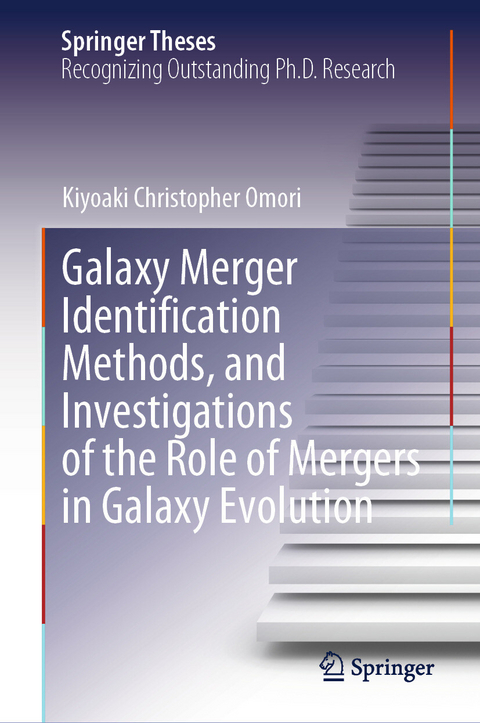
Galaxy Merger Identification Methods, and Investigations of the Role of Mergers in Galaxy Evolution (eBook)
XVI, 144 Seiten
Springer Nature Singapore (Verlag)
978-981-97-8735-7 (ISBN)
This book offers new findings on the impact of galaxy mergers on galaxy evolution and related processes. Galaxies are astronomical objects composed of stars, gas, and dark matter. The main pathway for galaxy evolution in the currently accepted model for structure growth is through interactions and mergers, or the process in which multiple galaxies interact, collide, and end up as one larger galaxy. Galaxy interactions and mergers are also considered to drive various processes pertaining to galaxy evolution, such as star formation, active galactic nuclei (AGN) activity, and chemical evolution. As such, not only are merging galaxy systems important to understand galaxy structure growth in a cosmological context, they are also unique laboratories to study evolutionary processes taking place in galaxies. However, despite their importance, the relative role of galaxy mergers on galaxy evolution is still heavily contested. One reason for this is difficulty in identifying merger galaxies in observational data. Many different methods have been adopted for merger galaxy identification, but none of them are perfect. Moreover, the use of differing selection methods can result in widely different samples, which can alter statistical results. As such, a novel, robust method for merger identification is required to deepen our understanding of galaxy mergers. In this book, we introduce new methods to identify galaxy mergers from observational data. The first method combines the use of visual identification-both of optical and kinematic images-with spectroscopic pair identification. The second is machine learning based, using a training method called fine-tuning, an application of transfer learning. A pre-trained model on galaxy images is further fine-tuned using a sample of synthetic galaxy images, to make a classifier for merger identification. Using samples identified by our methods, the author conducts three studies: the impact of mergers on galaxy chemical evolution, the effect of galaxy local environment on merging activity, and the connection between mergers and AGN activity. This book is mainly intended for astrophysicists, particularly those studying galaxies, however is open for all to read.
This book offers new findings on the impact of galaxy mergers on galaxy evolution and related processes. Galaxies are astronomical objects composed of stars, gas, and dark matter. The main pathway for galaxy evolution in the currently accepted model for structure growth is through interactions and mergers, or the process in which multiple galaxies interact, collide, and end up as one larger galaxy. Galaxy interactions and mergers are also considered to drive various processes pertaining to galaxy evolution, such as star formation, active galactic nuclei (AGN) activity, and chemical evolution. As such, not only are merging galaxy systems important to understand galaxy structure growth in a cosmological context, they are also unique laboratories to study evolutionary processes taking place in galaxies. However, despite their importance, the relative role of galaxy mergers on galaxy evolution is still heavily contested. One reason for this is difficulty in identifying merger galaxies in observational data. Many different methods have been adopted for merger galaxy identification, but none of them are perfect. Moreover, the use of differing selection methods can result in widely different samples, which can alter statistical results. As such, a novel, robust method for merger identification is required to deepen our understanding of galaxy mergers. In this book, we introduce new methods to identify galaxy mergers from observational data. The first method combines the use of visual identification-both of optical and kinematic images-with spectroscopic pair identification. The second is machine learning based, using a training method called fine-tuning, an application of transfer learning. A pre-trained model on galaxy images is further fine-tuned using a sample of synthetic galaxy images, to make a classifier for merger identification. Using samples identified by our methods, the author conducts three studies: the impact of mergers on galaxy chemical evolution, the effect of galaxy local environment on merging activity, and the connection between mergers and AGN activity. This book is mainly intended for astrophysicists, particularly those studying galaxies, however is open for all to read.
| Erscheint lt. Verlag | 26.12.2024 |
|---|---|
| Reihe/Serie | Springer Theses |
| Zusatzinfo | XVI, 144 p. 75 illus., 71 illus. in color. |
| Sprache | englisch |
| Themenwelt | Naturwissenschaften ► Physik / Astronomie ► Astronomie / Astrophysik |
| Schlagworte | active galactic nuclei • convolutional neural network • Galactic Interactions • Galaxy Evolution • Galaxy Morphological Classification • Hyper Suprime-Cam Subaru Strategic Program • Machine Learning Method • Mapping Nearby Galaxies at Apache Point Observatory (MaNGA) • Oxygen Abundance • Spatially Resolved Mass-Metallicity Relation in Mergers |
| ISBN-10 | 981-97-8735-1 / 9819787351 |
| ISBN-13 | 978-981-97-8735-7 / 9789819787357 |
| Informationen gemäß Produktsicherheitsverordnung (GPSR) | |
| Haben Sie eine Frage zum Produkt? |
 PDF (Wasserzeichen)
DRM: Digitales Wasserzeichen
Dieses eBook enthält ein digitales Wasserzeichen und ist damit für Sie personalisiert. Bei einer missbräuchlichen Weitergabe des eBooks an Dritte ist eine Rückverfolgung an die Quelle möglich.
Dateiformat: PDF (Portable Document Format)
Mit einem festen Seitenlayout eignet sich die PDF besonders für Fachbücher mit Spalten, Tabellen und Abbildungen. Eine PDF kann auf fast allen Geräten angezeigt werden, ist aber für kleine Displays (Smartphone, eReader) nur eingeschränkt geeignet.
Systemvoraussetzungen:
PC/Mac: Mit einem PC oder Mac können Sie dieses eBook lesen. Sie benötigen dafür einen PDF-Viewer - z.B. den Adobe Reader oder Adobe Digital Editions.
eReader: Dieses eBook kann mit (fast) allen eBook-Readern gelesen werden. Mit dem amazon-Kindle ist es aber nicht kompatibel.
Smartphone/Tablet: Egal ob Apple oder Android, dieses eBook können Sie lesen. Sie benötigen dafür einen PDF-Viewer - z.B. die kostenlose Adobe Digital Editions-App.
Buying eBooks from abroad
For tax law reasons we can sell eBooks just within Germany and Switzerland. Regrettably we cannot fulfill eBook-orders from other countries.
aus dem Bereich