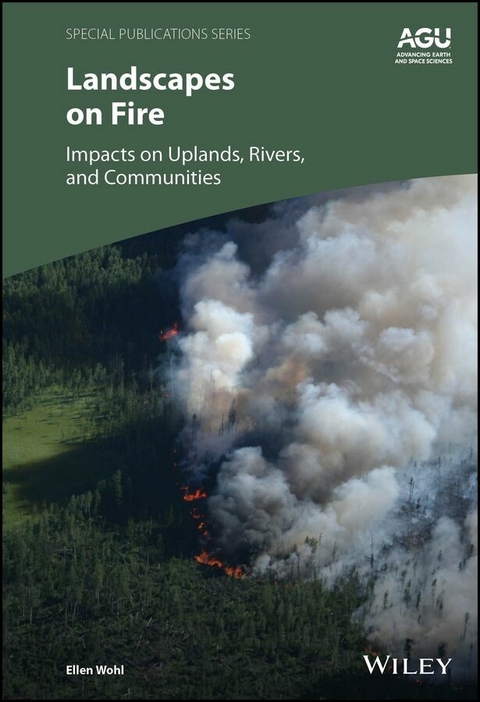
Landscapes on Fire (eBook)
477 Seiten
Wiley (Verlag)
978-1-394-23514-8 (ISBN)
Explores the effects of wildfires on land, water, vegetation, wildlife, and humans
Across the world, wildfires are increasing in frequency, extent, and severity, driven by changes in land use and climate. After the immediate hazards of fire and smoke have passed, landscapes and ecosystems can be left altered for decades.
Landscapes on Fire: Impacts on Uplands, Rivers, and Communities presents an overview of wildfires and their after-effects on different parts of the natural, biological, and human landscape, bringing together perspectives from different disciplines.
Volume highlights include:
- Causes, mechanics, and patterns of wildfire
- Effects of fire on uplands and river networks
- Predicting and mitigating fire-related hazards
- Projected trends in wildfire patterns and effects due to climate change
- Case studies from across the world
The American Geophysical Union promotes discovery in Earth and space science for the benefit of humanity. Its publications disseminate scientific knowledge and provide resources for researchers, students, and professionals.
Ellen Wohl, Colorado State University, USA
Explores the effects of wildfires on land, water, vegetation, wildlife, and humans Across the world, wildfires are increasing in frequency, extent, and severity, driven by changes in land use and climate. After the immediate hazards of fire and smoke have passed, landscapes and ecosystems can be left altered for decades. Landscapes on Fire: Impacts on Uplands, Rivers, and Communities presents an overview of wildfires and their after-effects on different parts of the natural, biological, and human landscape, bringing together perspectives from different disciplines. Volume highlights include: Causes, mechanics, and patterns of wildfire Effects of fire on uplands and river networks Predicting and mitigating fire-related hazards Projected trends in wildfire patterns and effects due to climate change Case studies from across the world The American Geophysical Union promotes discovery in Earth and space science for the benefit of humanity. Its publications disseminate scientific knowledge and provide resources for researchers, students, and professionals.
GLOSSARY
- active layer:
- within permafrost regions, describes the upper layer of the ground that thaws each summer and freezes in the winter
- aerosol:
- a colloidal suspension of particles dispersed in air
- albedo:
- the proportion of incident sunlight or solar radiation that is reflected by a surface
- alluvial fan:
- a fan‐shaped (in planform) alluvial deposit, typically at the junction of a smaller river with a larger river or at the exit of a river from a mountain front
- anthropogenic:
- human‐caused
- beaver meadow:
- a beaver‐modified portion of river corridor that includes multiple dams and ponds of varying age; despite the name, typically includes abundant woody vegetation such as willows (Salix spp.)
- benthic macroinvertebrates:
- live on or within the stream bed for at least some portion of their lifecycle and are visible to the naked eye (e.g., mussels, clams, worms, crayfish, snails, and a diverse array of insects)
- biofilm:
- a matrix‐enclosed and surface‐attached microbial community
- biomass:
- the total quantity or weight of living organisms in a given area or volume
- biome:
- a major ecological community type, such as desert or grassland
- bioturbation:
- the physical disturbance of sediment deposits by living organisms (e.g., by burrowing)
- boreal:
- an ecosystem or river catchment in the northern hemisphere, between approximately 50 and 70° N latitude
- channel head:
- the upstream boundary of concentrated water flow and sediment transport between definable banks
- coarse woody debris:
- downed, dead wood outside of stream corridors
- colluvial deposits:
- sediment deposited after transport by processes other than eolian or fluvial (e.g., rockfall, dry ravel, debris flow)
- colluvial hollows:
- concave or convergent areas of uplands
- conduction:
- transfer of heat via physical contact between a heat source and fuel or mineral body
- connectivity:
- the movement of materials and organisms between components in a system (e.g., between uplands and river corridor, between active channel and floodplain, or between surface and subsurface)
- convection:
- heat transfer by mixing of air masses
- crown fire:
- a wildfire that burns within the forest canopy
- debris flow:
- mass of poorly sorted, saturated sediment that moves downslope; typically has 40–77% sediment concentration by volume
- drylands:
- designated based on the scarcity of water; defined by the United Nations Environment Program (UNEP) as tropical and temperate areas with an aridity index of less than 0.65; numerous aridity indices have been proposed – UNEP uses an index equal to (100 × R/LP), where R is mean annual net radiation, P is mean annual precipitation, and L is latent heat of vaporization for water
- dry ravel:
- involves rapid, dry, particle‐to‐particle rolling, sliding, and bouncing of sediment and some organic matter under the force of gravity and without the presence of water
- dust:
- silt and clay‐sized particles transported by wind
- ecoregions:
- areas where ecosystems are generally similar
- ENSO atmospheric circulation pattern:
- the El Niño‐Southern Oscillation, a recurring climate pattern involving changes in the temperature of waters in the central and eastern tropical Pacific Ocean
- fallout radionuclides:
- residual radioactive material propelled into the upper atmosphere following a nuclear blast and subsequently deposited on Earth’s surface
- fire‐dependent ecosystems:
- those in which most species have evolved in the presence of fire
- fire‐independent ecosystems:
- naturally lack sufficient fuel or ignition sources to support fire as an evolutionary force; examples include desert and tundra
- fire‐sensitive ecosystems:
- those in which most species have not evolved in the presence of fire
- fire hazard:
- in the context of wildfire, hazard typically refers to the state of the fuel and is quantified with respect to the likelihood and intensity of wildfire
- fire intensity:
- rate of heat energy release
- fire risk:
- in the context of technical risk assessments, risk includes the probability of an event, as well as values and expected losses; i.e., the probability of an event with harmful consequences, which can be thought of as the combination of hazard and vulnerability; in the context of fire, however, risk may refer only to the probability of natural or human‐caused ignition, or it may be used to refer to hazard and the susceptibility of values‐at‐risk
- fire severity:
- the effects of the fire on plant communities, or the loss of or change in above‐ and below‐ground organic matter
- fire vulnerability:
- vulnerability typically describes exposure and susceptibility, which can be differentiated as asset vulnerability and human vulnerability
- flammability:
- reflects multiple metrics that quantify the ease of ignition and the behavior of the fire once ignited
- floodplain:
- a low‐relief sedimentary surface adjacent to the active channel that is constructed by fluvial processes and frequently inundated
- forest canopy:
- the upper layer of forest formed by mature tree crowns
- forest duff:
- the layer of organic soil below litter but above the mineral soil; composed of partly decomposed organic material
- forest litter:
- the upper, organic soil layer of dead, fallen plant material; includes recognizable plant parts
- forest understory:
- plant life growing beneath the forest canopy without penetrating the canopy to any great extent, but above the forest floor
- fuel bed:
- a generic description of the complex of fuels occupying a given area
- fuel component:
- subdivides the fuel type as a function of size (e.g., fine woody fuels) or physiological condition (e.g., dead wood)
- fuel layer:
- vertical stratification of the fuel bed into ground, surface, and canopy fuels
- fuel load:
- mass per unit area
- fuel moisture:
- measured as the ratio between the mass of water in the fuel and the mass of dry fuel
- fuel particle:
- individual fuel elements (e.g., twig, needle) that form the fuel complex at coarser scales
- fuel type:
- the dominant fuels in the fuel bed (e.g., forest litter or grass)
- gelisols:
- soils formed in very cold climates that contain permafrost within 2 m of the surface
- grassland:
- an area in which the vegetation is dominated by grasses
- ground cover:
- the lowest layer of aboveground vegetation (living and dead) and biological crusts that are in contact with the soil surface
- headcut:
- a vertical down‐step in the streambed that is migrating upstream over time
- headwaters:
- first‐ and second‐order streams
- heat‐induced spalling:
- wildfire heat results in lensoid‐shaped rock flakes up to a few mm in thickness detaching from the surface of boulders or bedrock outcrops
- herbaceous plants:
- vascular plants that have no persistent woody stem above ground
- histosols:
- soils that are dominantly organic, commonly associated with bogs, moors, or peatlands
- Hortonian overland flow:
- runoff that remains on the ground surface without infiltrating
- hydrophobic soils:
- water‐repellent soils that can form during wildfire
- hyperconcentrated flow:
- a flowing mixture of water and sediment in a channel, with properties intermediate between fluvial flow and debris flow
- hyporheic zone:
- subsurface areas in a river corridor containing water that originates from and returns to the channel
- ignition:
- the initiation of combustion
- indigenous:
- people inhabiting a region from the earliest times or before the arrival of European colonists
- infiltration capacity:
- the maximum rate at which soil or regolith is capable of absorbing water under given conditions
- landslide:
- mass movement with relatively rigid motion and deformation localized along persistent slip surfaces or shear zones
- large wood:
- downed, dead wood with dimensions ≥ 10 cm in diameter and 1 m in length
- machine learning:
- computer systems that are able to learn and adapt without following explicit instructions; these systems use algorithms and statistical models to analyze and draw inferences from patterns in data
- mass movements:
- downslope movements of multiple grains simultaneously; types include debris flow, landslide, and soil creep
- natural range of variability:
- the range of specified ecosystem or physical system properties (e.g., river discharge) over a particular time period in the absence of human alteration
- nutrients:
- substances used by organisms to survive, grow, and reproduce
- organic matter:
- remains of formerly living organisms, primarily plants; subdivided into fine particulate organic matter...
| Erscheint lt. Verlag | 16.12.2024 |
|---|---|
| Reihe/Serie | Special Publications |
| Sprache | englisch |
| Themenwelt | Naturwissenschaften ► Geowissenschaften ► Geologie |
| Schlagworte | carbon • climate change • Deposition • disturbance • Erosion • fisheries • Forest transition • Hazard • Lightning • Resilience • vulnerability • water quality • water supply • Wildfire |
| ISBN-10 | 1-394-23514-3 / 1394235143 |
| ISBN-13 | 978-1-394-23514-8 / 9781394235148 |
| Informationen gemäß Produktsicherheitsverordnung (GPSR) | |
| Haben Sie eine Frage zum Produkt? |
 EPUB (Adobe DRM)
Kopierschutz: Adobe-DRM
Adobe-DRM ist ein Kopierschutz, der das eBook vor Mißbrauch schützen soll. Dabei wird das eBook bereits beim Download auf Ihre persönliche Adobe-ID autorisiert. Lesen können Sie das eBook dann nur auf den Geräten, welche ebenfalls auf Ihre Adobe-ID registriert sind.
Details zum Adobe-DRM
Dateiformat: EPUB (Electronic Publication)
EPUB ist ein offener Standard für eBooks und eignet sich besonders zur Darstellung von Belletristik und Sachbüchern. Der Fließtext wird dynamisch an die Display- und Schriftgröße angepasst. Auch für mobile Lesegeräte ist EPUB daher gut geeignet.
Systemvoraussetzungen:
PC/Mac: Mit einem PC oder Mac können Sie dieses eBook lesen. Sie benötigen eine
eReader: Dieses eBook kann mit (fast) allen eBook-Readern gelesen werden. Mit dem amazon-Kindle ist es aber nicht kompatibel.
Smartphone/Tablet: Egal ob Apple oder Android, dieses eBook können Sie lesen. Sie benötigen eine
Geräteliste und zusätzliche Hinweise
Buying eBooks from abroad
For tax law reasons we can sell eBooks just within Germany and Switzerland. Regrettably we cannot fulfill eBook-orders from other countries.
aus dem Bereich