


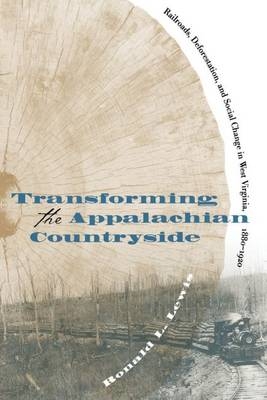
Transforming the Appalachian Countryside
Railroads, Deforestation, and Social Change in West Virginia, 1880-1920
Seiten
1998
|
New edition
The University of North Carolina Press (Verlag)
978-0-8078-4706-0 (ISBN)
The University of North Carolina Press (Verlag)
978-0-8078-4706-0 (ISBN)
In 1880, forest covered two-thirds of West Virginia, but by the 1920s lumbermen had denuded the entire region. This work explores the transformation in the mountain counties precipitated by deforestation. West Virginia provides a site for studying the broader social impact of deforestation.
In 1880, ancient-growth forest still covered two-thirds of West Virginia, but by the 1920s lumbermen had denuded the entire region. Ronald Lewis explores the transformation in these mountain counties precipitated by deforestation. As the only state that lies entirely within the Appalachian region, West Virginia provides an ideal site for studying the broader social impact of deforestation in Appalachia, the South, and the eastern United States. Most of West Virginia was still dominated by a backcountry economy when the industrial transition began. In short order, however, railroads linked remote mountain settlements directly to national markets, hauling away forest products and returning with manufactured goods and modern ideas. Workers from the countryside and abroad swelled new mill towns, and merchants ventured into the mountains to fulfill the needs of the growing population. To protect their massive investments, capitalists increasingly extended control over the state's legal and political systems. Eventually, though, even ardent supporters of industrialization had reason to contemplate the consequences of unregulated exploitation. Once the timber was gone, the mills closed and the railroads pulled up their tracks, leaving behind an environmental disaster and a new class of marginalized rural poor to confront the worst depression in American history. |Examines the impact of the rapid, unregulated deforestation of West Virginia between 1880 and 1920, a short-lived timber boom that left behind an environmental disaster.
In 1880, ancient-growth forest still covered two-thirds of West Virginia, but by the 1920s lumbermen had denuded the entire region. Ronald Lewis explores the transformation in these mountain counties precipitated by deforestation. As the only state that lies entirely within the Appalachian region, West Virginia provides an ideal site for studying the broader social impact of deforestation in Appalachia, the South, and the eastern United States. Most of West Virginia was still dominated by a backcountry economy when the industrial transition began. In short order, however, railroads linked remote mountain settlements directly to national markets, hauling away forest products and returning with manufactured goods and modern ideas. Workers from the countryside and abroad swelled new mill towns, and merchants ventured into the mountains to fulfill the needs of the growing population. To protect their massive investments, capitalists increasingly extended control over the state's legal and political systems. Eventually, though, even ardent supporters of industrialization had reason to contemplate the consequences of unregulated exploitation. Once the timber was gone, the mills closed and the railroads pulled up their tracks, leaving behind an environmental disaster and a new class of marginalized rural poor to confront the worst depression in American history. |Examines the impact of the rapid, unregulated deforestation of West Virginia between 1880 and 1920, a short-lived timber boom that left behind an environmental disaster.
RONALD L. LEWIS holds the Stuart and Joyce Robbins Chair in History at West Virginia University. He is author or editor of fourteen books, including Transforming the Appalachian Countryside: Railroads, Deforestation, and Social Change in West Virginia, 1880-1920 (from the University of North Carolina Press).
| Erscheint lt. Verlag | 30.6.1998 |
|---|---|
| Verlagsort | Chapel Hill |
| Sprache | englisch |
| Maße | 164 x 235 mm |
| Gewicht | 589 g |
| Themenwelt | Geschichte ► Allgemeine Geschichte ► Neuzeit (bis 1918) |
| Geisteswissenschaften ► Geschichte ► Regional- / Ländergeschichte | |
| Geschichte ► Teilgebiete der Geschichte ► Kulturgeschichte | |
| Naturwissenschaften ► Biologie ► Ökologie / Naturschutz | |
| Sozialwissenschaften ► Soziologie | |
| ISBN-10 | 0-8078-4706-2 / 0807847062 |
| ISBN-13 | 978-0-8078-4706-0 / 9780807847060 |
| Zustand | Neuware |
| Informationen gemäß Produktsicherheitsverordnung (GPSR) | |
| Haben Sie eine Frage zum Produkt? |
Mehr entdecken
aus dem Bereich



aus dem Bereich
Geschichte einer wilden Handlung
Buch | Hardcover (2024)
C.H.Beck (Verlag)
CHF 47,60


