


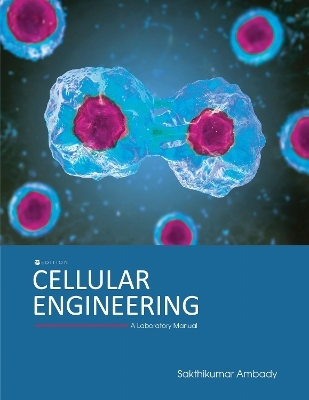
Cellular Engineering
A Laboratory Manual
Seiten
2024
Cognella, Inc (Verlag)
979-8-8233-0212-8 (ISBN)
Cognella, Inc (Verlag)
979-8-8233-0212-8 (ISBN)
Uncover fundamental techniques for mammalian cell culture, spanning historical underpinnings, essential protocols, and vital measures against contamination. Detailed procedures for freezing, thawing, 3D culture, and immunocytochemistry offer a practical guide for laboratory work in biotechnology and cell biology.
Cellular Engineering: A Laboratory Manual focuses on the basic methods and protocols for conducting mammalian cell culture studies in a laboratory setting. It lays out foundational knowledge and detailed experimental procedures for students and professionals involved in the art of mammalian cell culture.
The laboratory manual is organized into two core units. In the first, the manual covers the history of cell culture, cell culture basics, cell culture environment, and media composition. It progresses to illuminate students on the concept of Hayflick limit, the importance of differentiating between passage number and population doubling, discusses microbial contamination and the importance of preventing cross culture contamination. The second unit is dedicated to detailed protocols such as freezing and thawing of cells, cellular differentiation, 3D cell culture, immunocytochemistry, cell proliferation assay, biocompatibility and toxicity testing and more. Additionally, advanced protocols and independent project ideas are included for students who have gained proficiency in the basic cell culture procedures.
Cellular Engineering is ideal for coursework in mammalian cell culture, biotechnology, and cellular differentiation. It presents knowledge and technical skills pivotal to the field, making it suitable for courses that include laboratory work in cell culture, tissue culture, and cell biology for students majoring in biomedical engineering, biological sciences, biochemistry, or other allied fields.
Cellular Engineering: A Laboratory Manual focuses on the basic methods and protocols for conducting mammalian cell culture studies in a laboratory setting. It lays out foundational knowledge and detailed experimental procedures for students and professionals involved in the art of mammalian cell culture.
The laboratory manual is organized into two core units. In the first, the manual covers the history of cell culture, cell culture basics, cell culture environment, and media composition. It progresses to illuminate students on the concept of Hayflick limit, the importance of differentiating between passage number and population doubling, discusses microbial contamination and the importance of preventing cross culture contamination. The second unit is dedicated to detailed protocols such as freezing and thawing of cells, cellular differentiation, 3D cell culture, immunocytochemistry, cell proliferation assay, biocompatibility and toxicity testing and more. Additionally, advanced protocols and independent project ideas are included for students who have gained proficiency in the basic cell culture procedures.
Cellular Engineering is ideal for coursework in mammalian cell culture, biotechnology, and cellular differentiation. It presents knowledge and technical skills pivotal to the field, making it suitable for courses that include laboratory work in cell culture, tissue culture, and cell biology for students majoring in biomedical engineering, biological sciences, biochemistry, or other allied fields.
Sakthikumar Ambady is an associate teaching professor of biomedical engineering at Worcester Polytechnic Institute. He holds a DVM from Andhra Pradesh Agricultural University, an MVSc from Kerala Agricultural University, and a Ph.D. from the University of Massachusetts. Dr. Ambady's research interests include regenerative medicine, genome analysis, gene expression studies, and molecular biology.
| Erscheinungsdatum | 17.12.2024 |
|---|---|
| Verlagsort | San Diego |
| Sprache | englisch |
| Maße | 152 x 229 mm |
| Themenwelt | Medizin / Pharmazie ► Physiotherapie / Ergotherapie ► Orthopädie |
| Medizin / Pharmazie ► Studium ► 1. Studienabschnitt (Vorklinik) | |
| Naturwissenschaften ► Biologie | |
| Technik ► Medizintechnik | |
| Technik ► Umwelttechnik / Biotechnologie | |
| ISBN-13 | 979-8-8233-0212-8 / 9798823302128 |
| Zustand | Neuware |
| Informationen gemäß Produktsicherheitsverordnung (GPSR) | |
| Haben Sie eine Frage zum Produkt? |
Mehr entdecken
aus dem Bereich

aus dem Bereich
Spiraldynamik - programmierte Therapie für konkrete Resultate
Buch | Hardcover (2021)
Thieme (Verlag)
CHF 146,95
Kommentar zu DIN EN ISO 14155
Buch | Softcover (2024)
Beuth (Verlag)
CHF 102,20


