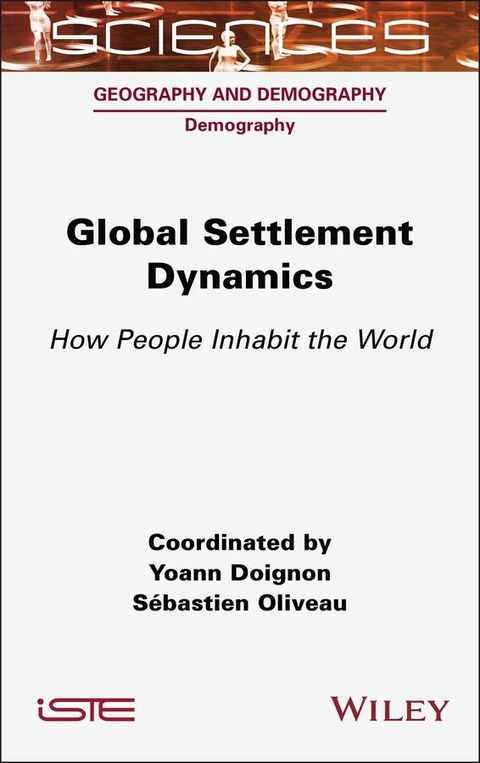
Global Settlement Dynamics (eBook)
348 Seiten
Wiley-Iste (Verlag)
978-1-394-34058-3 (ISBN)
There are currently over eight billion people on Earth: how did we arrive at the current distribution of humans on the planet? What shape is it taking, and how will it evolve?
This book proposes an original answer to this, which is based on the explicit desire to place settlement at the heart of its questioning, by varying the level of analysis from global to local. After recalling how humans colonized the entire planet, this book presents their current distribution, which is predominantly urban.
Population dynamics (birth rate, death rate and migration) are driving changes - including the demographic decline of certain regions - which are presented and explained from the angle of residential mobility and international migration, as well as the impact of ongoing climate change. Global Settlement Dynamics concludes with a discussion of the future of these settlements, based on data from the United Nations, and the question of the sustainability of human settlements on Earth.
Yoann Doignon is a researcher in population geography at the IDEES Laboratory at the CNRS in Rouen, France. He is also a research associate at the Centre for Demographic Research, UCLouvain, Belgium.
Sébastien Oliveau is a lecturer, as well as a geographer and demographer at the University of Aix-Marseille, and Director of MSH Paris-Saclay, France. He is also a member of the Observatoire démographique de la Méditerranée, France.
There are currently over eight billion people on Earth: how did we arrive at the current distribution of humans on the planet? What shape is it taking, and how will it evolve? This book proposes an original answer to this, which is based on the explicit desire to place settlement at the heart of its questioning, by varying the level of analysis from global to local. After recalling how humans colonized the entire planet, this book presents their current distribution, which is predominantly urban. Population dynamics (birth rate, death rate and migration) are driving changes including the demographic decline of certain regions which are presented and explained from the angle of residential mobility and international migration, as well as the impact of ongoing climate change. Global Settlement Dynamics concludes with a discussion of the future of these settlements, based on data from the United Nations, and the question of the sustainability of human settlements on Earth.
Introduction
Sébastien OLIVEAU1 and Yoann DOIGNON2,3
1 Mesopolhis, UMR 7064, CNRS, Université d’Aix-Marseille, France
2 IDEES, UMR 6266, CNRS, Rouen, France
3 Center for Demographic Research, UCLouvain, Belgium
The distribution of human populations across the surface of the planet is not random. Some areas are nearly uninhabited, while others contain a significant portion of humanity. The study of this distribution occurs at various scales, ranging from global to very local, but it is primarily the disparities in population density that leave a lasting impression. Indeed, densities vary significantly across different spaces, with the least populated rural areas sometimes dropping below three inhabitants per square kilometer (hbts/km2), while certain urban zones may exceed 30,000 hbts/km2. These disparities are evident universally and at all scales: between continents, countries, regions within a country, urban and rural areas, as well as between city centers and peripheries. For instance, we can think of the stark contrast between the Egyptian desert and the capital city (Oliveau et al. 2020). However, marked disparities are also observed elsewhere globally. In France, rural densities can fall below 15 hbts/km2, whereas Paris boasts more than 20,000. In India, the Kashmir region has a density of 22 hbts/km2, contrasting sharply with Mumbai, which is 1,000 times more densely populated, etc.
These disparities in population distribution, referred to as settlement, constitute a crucial aspect of societal functioning. However, settlement goes beyond mere density inequalities, encompassing various forms of population distribution. Populations can be dispersed or concentrated across territories, and this dynamic operates at different scales. One region may be distinguished by a scattering of sparsely populated yet dense villages, while another region may exhibit medium density but dispersed habitation. Conversely, in certain instances, metropolises are situated amidst human deserts, as exemplified by Brasília with its 3 million inhabitants in the heart of the Amazon.
The settlement, as we understand it, stands as a significant challenge in the planning of societies’ territories, meaning their organization and future development. Settlement is a complex subject, arising from demographic dynamics encompassing factors – fertility, mortality and migration – and geographical constraints that have either facilitated or hindered population accumulation (including factors like accessibility of locations, available resources, and environmental quality, etc.); it is shaped by the social and spatial processes involved in its assessment and utilization, processes that have undergone substantial variations throughout historical periods.
At the intersection of geography and demography, the study of settlement is crucial for a thorough understanding of societies and their challenges. The issue of mobility is a pervasive theme in our analysis, examined from various angles, including its impact on population distribution, contemporary dynamics and associated challenges. Mobility influences settlement patterns on all scales: within territories, bridging rural and urban areas, within cities, and between regions and countries, tracing back to the dawn of humanity. Population aging also emerges as a significant factor in population change, influencing both the composition of places, exemplified by the evolution of certain urban districts, and the dynamics of regions experiencing depopulation. The question of the sustainability of settlement in specific territories is then raised. Lastly, climate change raises questions, acknowledging its anticipated impact on population distribution, albeit with challenges in accurate assessments. In conclusion, while acknowledging the need for caution in interpreting projections, the exercise of prospective analysis remains intellectually invigorating for contemplating the future of territories. Consequently, it is apt that we conclude our reflection by attempting to project ourselves into the conclusion of this century.
It is within this framework that we have orchestrated this book, with the aim of providing a comprehensive synthesis on the subject of settlement. The book is dedicated to presenting a global perspective on settlement, employing multiscale analyses to underscore both the commonalities and the unique characteristics within the observed configurations. The overall progression of the book explores how contemporary human societies populate Earth.
Therefore, it is only logical that Pierre-Jean Thumerelle elucidates how humans left their African origins to eventually inhabit the entire planet in Chapter 1. The temporal dynamics of these movements initially underscore the significant inertia characterizing global-scale settlement, and this stands as a key takeaway from the book: current observed population concentrations typically result from ancient accumulations of populations (see Chapters 3 and 6). Nevertheless, the modern era introduces striking bifurcations in specific locations. Geopolitical and economic forces have the potential to induce rapid and substantial changes. The colonization of the American continent, pioneer frontiers in tropical regions, mining activities, and more recently, the concentration of capital in metropolises are all factors that have disrupted population distribution at global, regional and local scales.
Catherine Linard and Florence de Longueville demonstrate how humanity currently occupies the planet in Chapter 2. Following the definition of the ecumene’s extent, they provide a measurement. The complexity of the sources required for this endeavor is outlined, allowing us to visualize its scope. However, human occupation is dynamic, and they help in raising awareness of the ongoing dynamics, encompassing not only nocturnal and seasonal aspects but also those of longer duration.
The distribution of humans on a global scale is initially marked by significant heterogeneity but is also characterized by immense diversity. While rural housing exhibits a variety of forms (Lebeau 1969), urban housing, having become predominant in recent decades, introduces new complexities. François Moriconi-Ebrard and Joan Perez concentrate on this specific settlement pattern to underscore its intricate nature in Chapter 3. The definition stage remains challenging but indispensable. The authors guide us in distinguishing cities from urban areas, articulating the implications of conceptualizing in terms of agglomerations, metropolization, etc. They emphasize the impact of varying definitions (across authors and countries) on the perception and understanding of the phenomenon. The adoption of standardized definitions and databases becomes imperative, facilitating effective international comparisons. Nevertheless, despite cities currently constituting the predominant habitat globally, they exhibit substantial diversity, both in terms of physical attributes (morphology) and demographic trajectories, as eloquently illustrated in this chapter. The chapter concludes by examining the manifestations of demographic and/or spatial decline in certain cities, a phenomenon that prompts reflection in the context of demographic and spatial growth that appeared boundless in the 20th century.
One of the questions addressed in Chapter 3 pertains to the depopulation of specific cities. In Chapter 4, Yoann Doignon extends this inquiry to encompass all spaces (both urban and rural) on a global scale: How does depopulation manifest? What roles do different components of the demographic equation (fertility, mortality, migration) play? Which regions of the world experience depopulation, and to what extent? By presenting a granular perspective at the subnational level through a 15–20 km tile map, the chapter underscores that depopulation can occur even in countries with population growth. Is it conceivable that the ecumene is receding?
Subsequently, the book delves into population movements within spaces, reshaping the distribution of settlement. Chapter 5 specifically explores the intricacies of population mobility at the most granular level – residential movements of households. Frédéric Audard and Samuel Carpentier-Postel revisit the concepts used to characterize this phenomenon, providing a global overview that contemplates the diversity of situations. These situations underscore, on the one hand, the influence of the individual life cycle, highlighting that relocation patterns vary with age. On the other hand, they underscore that the economic conditions of households are also a crucial factor for understanding these patterns. Presently, it is observed that, for over half a century, there has been significant diversification in personal, family and professional trajectories. This diversification leads to distinct settlement methods and prompts reflection on our ability to define it in a world where phenomena such as multi-residence or teleworking complicate its understanding.
In Chapter 6, Philippe Venier and Sébastien Oliveau present a quantitative synthesis of global migrations to facilitate our comprehension of their impacts on settlement patterns. What is the scale of these migrations? Are they reconfiguring major settlement areas worldwide? What are the repercussions of migrations on a more localized level? These are challenging questions to address, given the diversity of sources and the interpretative nature of the data. Nevertheless, a geography of migrations is taking shape, shedding light on...
| Erscheint lt. Verlag | 22.11.2024 |
|---|---|
| Reihe/Serie | ISTE Consignment |
| Sprache | englisch |
| Themenwelt | Naturwissenschaften ► Geowissenschaften ► Geografie / Kartografie |
| Schlagworte | climate change • Colonization • Demography • Emigration • global settlement • Immigration • Migration • population dynamics • residential mobility • sustainability |
| ISBN-10 | 1-394-34058-3 / 1394340583 |
| ISBN-13 | 978-1-394-34058-3 / 9781394340583 |
| Informationen gemäß Produktsicherheitsverordnung (GPSR) | |
| Haben Sie eine Frage zum Produkt? |
 EPUB (Adobe DRM)
Kopierschutz: Adobe-DRM
Adobe-DRM ist ein Kopierschutz, der das eBook vor Mißbrauch schützen soll. Dabei wird das eBook bereits beim Download auf Ihre persönliche Adobe-ID autorisiert. Lesen können Sie das eBook dann nur auf den Geräten, welche ebenfalls auf Ihre Adobe-ID registriert sind.
Details zum Adobe-DRM
Dateiformat: EPUB (Electronic Publication)
EPUB ist ein offener Standard für eBooks und eignet sich besonders zur Darstellung von Belletristik und Sachbüchern. Der Fließtext wird dynamisch an die Display- und Schriftgröße angepasst. Auch für mobile Lesegeräte ist EPUB daher gut geeignet.
Systemvoraussetzungen:
PC/Mac: Mit einem PC oder Mac können Sie dieses eBook lesen. Sie benötigen eine
eReader: Dieses eBook kann mit (fast) allen eBook-Readern gelesen werden. Mit dem amazon-Kindle ist es aber nicht kompatibel.
Smartphone/Tablet: Egal ob Apple oder Android, dieses eBook können Sie lesen. Sie benötigen eine
Geräteliste und zusätzliche Hinweise
Buying eBooks from abroad
For tax law reasons we can sell eBooks just within Germany and Switzerland. Regrettably we cannot fulfill eBook-orders from other countries.
aus dem Bereich