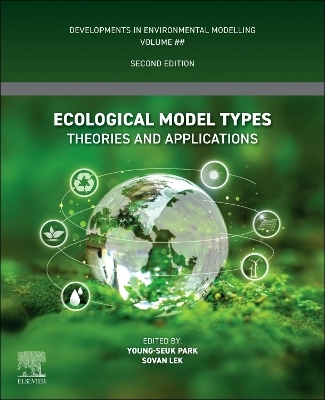
Ecological Model Types
Elsevier - Health Sciences Division (Verlag)
978-0-443-36304-7 (ISBN)
Young-Seuk Park is a Professor at the Department of Biology, Kyung University, Seoul, Republic of Korea. After completing a PhD at Pusan National University, he undertook post-doctoral research at CNRS, Université Paul Sabatier, and Cemagraf in France, and he obtained an HDR (Habilitation à Diriger des Recherches / Accreditation to Supervise Research) from the Université Paul Sabatier in Toulouse, France, before returning Korea to establish his independent reseach group at Kyung Hee University. His laboratory studies the effects of environmental changes on biological systems at different hierarchical levels from molecules, individuals, populations, and communities through ecological modelling and ecological informatics approaches. In particular, his research is focused on the effects of global changes on ecosystems, and ecological monitoring and assessment for sustainable ecosystem management. He is interested in computational approaches such as machine learning techniques and advanced statistical methods. He is an associate editor of two scientific journals Annales de Limnologie – International Journal of Limnology and Journal of Ecology and Environment, and he is also on the editorial boards of several journals including Ecological Informatics and Animal Cells and Systems. He was a guest editor for several Special Issues in scientific journals including Ecological Modelling, Ecological Informatics, Annales de Limnologie – International Journal of Limnology, Inland Waters, and Water. He is the recipient of the 2014 Yeocheon Ecology Award. Sovan Lek is a Professor at the University of Toulouse. His research is mainly in Fish Community Ecology and Ecological Modelling. In Fish Community Ecology, his research concerns the biodiversity and the spatial distribution of fish according to the environmental characteristics and the response of fish community to the human disturbances, especially land-use, hydromorphology, climate warming. The distribution of fish is considered according to the scale of variation, varying from local to regional and global scales, in relationship with the environmental variables. In Ecological Modelling, he is mainly interested in the use of machine learning techniques. He is also familiar with the uses of classical modelling techniques like classical statistic methods (multiple linear regression, multi-variate analyses ) and modern statistical methods (CART, GAM, PLS ).He has participated in several EU projects in the fields of Ecology and Global changes. He also participated in bilateral projects with several Asian countries. He is an editorial member of Ecological Modelling and associate editor of Ecological Informatics.
1. Introduction: An Overview
Section 1: Process-based models
2. Biogeochemical models
3. Dynamic Population Models
4. Ecotoxicological Models
5. Structurally Dynamic Models (SDMs)
6. Steady State Models
7. Spatially Explicit Models
8. Fugacity Models
9. Network model: Econet
10. Process-based Modelling in Ecology
Section 2: Data-driven models
11. Artificial Neural Networks (Multilayer Perceptron) in Ecology
12. Decision Tree Models
13. Ensemble Models
14. Support Vector Machines for Ecological Modelling
15. Deep learning: Long short-term memory networks
16. Automated Machine Learning
| Erscheinungsdatum | 02.12.2025 |
|---|---|
| Reihe/Serie | Developments in Environmental Modelling |
| Verlagsort | Philadelphia |
| Sprache | englisch |
| Maße | 191 x 235 mm |
| Themenwelt | Naturwissenschaften ► Biologie ► Ökologie / Naturschutz |
| ISBN-10 | 0-443-36304-8 / 0443363048 |
| ISBN-13 | 978-0-443-36304-7 / 9780443363047 |
| Zustand | Neuware |
| Informationen gemäß Produktsicherheitsverordnung (GPSR) | |
| Haben Sie eine Frage zum Produkt? |
aus dem Bereich