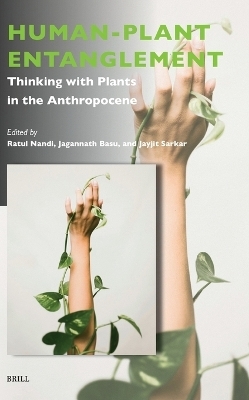
Human-Plant Entanglement: Thinking with Plants in the Anthropocene
Brill (Verlag)
978-90-04-72063-3 (ISBN)
Ratul Nandi (Ph.D.) is Assistant Professor of English at Siliguri College, West Bengal, India. His areas of interest include the nonhuman agency and the role of arts and literature, animal studies, environmental humanities and continental philosophy. He is the author of Animal Poetics and Literary Thinking (2025). Jagannath Basu (Ph.D.) is Assistant Professor in the Department of English, Sitalkuchi College, India. He is the editor of The Portrait of an Artist as a Pathographer: On Writing Illnesses and Illnesses in Writing (2021) and Geographia Literaria: Studies in Earth, Ethics and Literature (2021). Jayjit Sarkar (Ph.D.) is Assistant Professor in the Department of English, Raiganj University, India. He is the author of Illness as Method: Beckett, Kafka, Mann, Woolf and Eliot (2019).
Foreword
Acknowledgements
Notes on Contributors
List of Figures and Tables
Introduction
Alexandra M. Peck
Part 1: Human-Plant and Territoriality
Charles Edenshaw’s “Fungus Man” Platters and Tlingit Grave Effigies: Exploring Human-Fungus Relationships through Agarikon Art
Alexandra M. Peck
How to Coexist: the Teaching of the Plant Kingdom at the Universities of Coimbra and Salamanca (XVIII–XIX)
Carlos Alves
Tēichigi Colors of Artistic Resistance
James Jack
Plant-Thinking and Critical Pedagogy in Costa Rica: The Revolutionary Praxis of Carmen Lyra
Juan Manuel Ávila Conejo
Part 2: Human-Plant and the Literary
The Root of the Problem: How Trees Can Be Utilized in Climate Change Literature to Depict the Interconnectedness of Past, Present and Future
Andrea Färber
Multispecies Exchange Rates: Multicultural Plant Entanglement in The Embrace of the Serpent
Jacob Price
Enchanting Encounters with Plants in Reshma Aquil and Sumana Roy’s Poems
Nesrin Eruysal
Flowering-with the Silence of Plant: Affective Attuning to the Vegetal Event in Tang Poetry
Perkus Leung
Part 3: Human-Plant and Transfiguration
Vegetal Apophasis: Reclaiming Dark Intimacies and Un/knowing with Plants
Clara Soudan
To Be a Pixel Flower: Player-Plant Entanglement in Video Games
Carolin Becklas
Theatrics of the West, and Geopolitical Economy in the Plantationocene: Opium Poppy and Its Nation-Based Phenomenological Understanding
Sindhura Dutta
Index
| Erscheinungsdatum | 24.05.2025 |
|---|---|
| Reihe/Serie | Critical Plant Studies ; 9 |
| Verlagsort | Leiden |
| Sprache | englisch |
| Maße | 155 x 235 mm |
| Gewicht | 587 g |
| Themenwelt | Geisteswissenschaften ► Philosophie ► Ethik |
| Geisteswissenschaften ► Philosophie ► Philosophie der Neuzeit | |
| Naturwissenschaften ► Biologie ► Ökologie / Naturschutz | |
| Sozialwissenschaften ► Politik / Verwaltung ► Politische Systeme | |
| Sozialwissenschaften ► Politik / Verwaltung ► Politische Theorie | |
| Technik ► Umwelttechnik / Biotechnologie | |
| ISBN-10 | 90-04-72063-4 / 9004720634 |
| ISBN-13 | 978-90-04-72063-3 / 9789004720633 |
| Zustand | Neuware |
| Informationen gemäß Produktsicherheitsverordnung (GPSR) | |
| Haben Sie eine Frage zum Produkt? |
aus dem Bereich