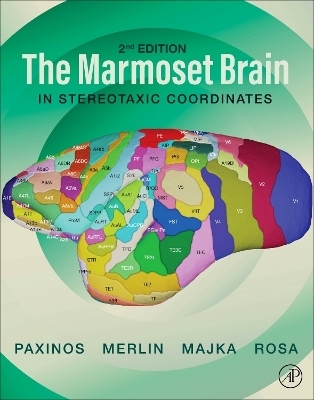
The Marmoset Brain in Stereotaxic Coordinates
Academic Press Inc (Verlag)
978-0-443-29086-2 (ISBN)
- Noch nicht erschienen (ca. März 2026)
- Versandkostenfrei
- Auch auf Rechnung
- Artikel merken
What is new in the 2nd Edition?
For the first time sagittal and horizontal planes are included based on the computational average of 20 brains.
For the first time cortical layers are identified.
For the first time major divisions of the white matter are identified on the basis of Marmoset Brain Mapping Project (https://marmosetbrainmapping.org/) (Liu et al., 2020).
Cortical and subcortical delineations are thoroughly updated to reflect advances over the last 14 years.
George Paxinos has written 62 books on the brain of humans, monkeys, rodents and birds. His first atlas, The Rat Brain in Stereotaxic Coordinates, is the most cited neuroscience publication. His Atlas of the Human Brain received The Award for Excellence in Publishing in Medical Science (Assoc American Publishers, 1997) and The British Medical Association Illustrated Book Award (2016). His eco-fiction book A River Divided (georgepaxinos.com.au) considers the question of whether the brain in the Goldilocks Zone - the right “size for survival. Marcello Rosa was born in Rio de Janeiro, Brazil, where he completed a PhD in 1992. He moved to Australia for a post-doctoral position in the University of Queensland, where he worked on aspects of comparative neuroscience, neural plasticity and neuroethology with Jack Pettigrew FRS. He received a Research Fellowship from the National Health and Medical Research Council in 1996, and was appointed in 2000 to the Academic staff of Monash University. He is a Fellow of the University of Bologna Institute of Advanced Studies, and was a member of the Australian Research Council‘s College of Experts between 2007 and 2009. Marcello has published approximately 200 papers, the majority of which focused on the functional organisation and plasticity of the cerebral cortex. This includes pioneering work in developing informatics tools for analysing and sharing data on the neuronal interconnections in complex brains. He also contributed to multidisciplinary applied research towards the development of brain- computer interfaces, under the Australian Research Council’s Special Research Initiative on Bionic Vision and Technology. Sam Merlin was born in Melbourne, Australia, and studied at the University of Melbourne, before completing his PhD at the University of Sydney, in 2011. He then moved to Salt Lake City for a post-doctoral position as the University of Utah, studying primate visual neurocircuitry with Alessandra Angelucci. He moved back to Australia to take up an academic position at Western Sydney University in 2017. His work has focused primarily on the neural circuits underlying contextual modulation in visual processing, but has recently included prefrontal cortical influences on learning and behaviour. Sam has published 15 papers, and was awarded the Bercovici Prize in Anatomy in 2014. He also holds an honorary fellow appointment in the Department of Optometry and Vision Science at the University of Melbourne, with collaborator Trichur Vidyasagar Piotr Majka was born in Białystok, Poland, and graduated in Applied Physics at the Warsaw University of Technology. He completed his PhD in Neuroinformatics in 2014 at the Nencki Institute of Experimental Biology. He then transferred to Melbourne, Australia, for a post-doctoral position in Marcello Rosa's laboratory at Monash University to focus on integrating data on structural connectivity of the marmoset monkey cerebral cortex. After moving back to Poland in 2016, Piotr assumed the position of assistant professor at the Nencki Institute, where he concentrated on interdisciplinary research related to the integration of multimodal and multiscale imaging datasets and the application of statistical and machine learning methods to get insight into large–scale imaging datasets, in particular in the context of computational neuroanatomy. Piotr has published twenty four papers and, as a strong supporter of open science, released several scientific software packages. He is also an active member of expert groups focusing on standardization and establishing the best practices in neurobiology, digital brain atlasing, and neuroimaging data exchange.
1. Introduction
2. Methods
3. Stereotaxic reference system
4. Nomenclature and the construction of abbreviations
5. The basis of delineation of structures
6. References Index of structures
7. Index of abbreviations
8. Parts of the marmoset brain figures
| Erscheint lt. Verlag | 2.3.2026 |
|---|---|
| Verlagsort | San Diego |
| Sprache | englisch |
| Maße | 216 x 279 mm |
| Gewicht | 450 g |
| Themenwelt | Naturwissenschaften ► Biologie ► Humanbiologie |
| Naturwissenschaften ► Biologie ► Zoologie | |
| ISBN-10 | 0-443-29086-5 / 0443290865 |
| ISBN-13 | 978-0-443-29086-2 / 9780443290862 |
| Zustand | Neuware |
| Informationen gemäß Produktsicherheitsverordnung (GPSR) | |
| Haben Sie eine Frage zum Produkt? |
aus dem Bereich