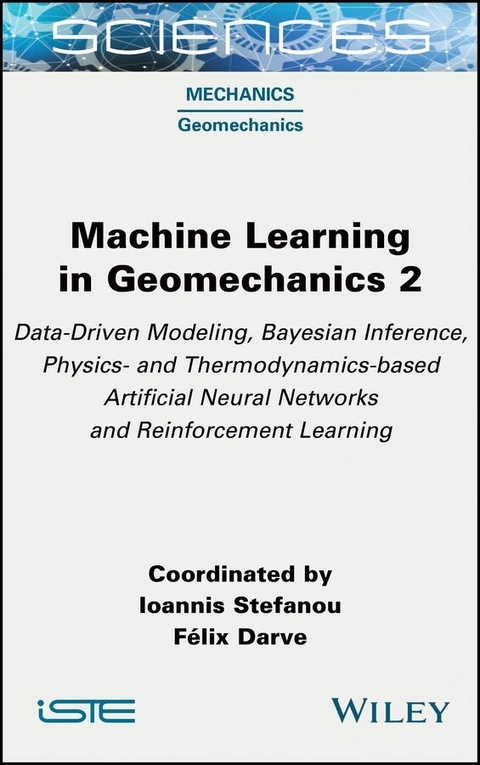
Machine Learning in Geomechanics 2 (eBook)
385 Seiten
Wiley-Iste (Verlag)
978-1-394-32565-8 (ISBN)
Machine learning has led to incredible achievements in many different fields of science and technology. These varied methods of machine learning all offer powerful new tools to scientists and engineers and open new paths in geomechanics.
The two volumes of Machine Learning in Geomechanics aim to demystify machine learning. They present the main methods and provide examples of its applications in mechanics and geomechanics. Most of the chapters provide a pedagogical introduction to the most important methods of machine learning and uncover the fundamental notions underlying them.
Building from the simplest to the most sophisticated methods of machine learning, the books give several hands-on examples of coding to assist readers in understanding both the methods and their potential and identifying possible pitfalls.
Ioannis Stefanou is Professor at ECN, France, and leads several geomechanics projects. His main research interests include mechanics, geomechanics, control, induced seismicity and machine learning.
Félix Darve is Emeritus Professor at the Soils Solids Structures Risks (3SR) laboratory, Grenoble-INP, Grenoble Alpes University, France. His research focuses on computational geomechanics.
Machine learning has led to incredible achievements in many different fields of science and technology. These varied methods of machine learning all offer powerful new tools to scientists and engineers and open new paths in geomechanics. The two volumes of Machine Learning in Geomechanics aim to demystify machine learning. They present the main methods and provide examples of its applications in mechanics and geomechanics. Most of the chapters provide a pedagogical introduction to the most important methods of machine learning and uncover the fundamental notions underlying them. Building from the simplest to the most sophisticated methods of machine learning, the books give several hands-on examples of coding to assist readers in understanding both the methods and their potential and identifying possible pitfalls.
1
Data-Driven Modeling in Geomechanics
Konstantinos KARAPIPERIS
ETH Zürich, Switzerland
The theoretical framework of data-driven computational mechanics presents an alternative formulation of mechanics, whereby optimal material states are sought within a dataset that most closely satisfies momentum and energy conservation principles. We review the framework for the case of simple and non-simple (polar), elastic and inelastic media, which represent common descriptions for geomaterials. Data mining from experiments and high-fidelity lower scale simulations (DEM and FEM) are discussed, while remedies for data scarcity (adaptive data sampling) are also highlighted. Representative examples of a flat punch indentation and a rupture through a soil layer are presented, and a link to open-source Python code is provided.
1.1. Introduction
Predictive models in geomechanics have traditionally relied on continuum modeling via the formulation constitutive equations (Darve and Labanieh 1982; Mühlhaus and Alfantis 1991; Vardoulakis and Aifantis 1991; Ortiz and Pandolfi 2004; Dafalias and Manzari 2004; Darve and Nicot 2005; Borja and Andrade 2006; Houlsby and Puzrin 2006), discrete particle-based models (Cundall and Strack 1979; Bardet 1994; Kawamoto et al. 2018) and multiscale techniques that bridge the continuum and discrete scales (Christoffersen et al. 1981; Nicot et al. 2005; Kamrin et al. 2007; Andrade and Tu 2009; Guo and Zhao 2014; Regueiro and Yan 2011). Initially informed by macroscopic experiments (Roscoe et al. 1958; Roscoe 1970), and later by high-fidelity grain-scale resolved experiments (Hall et al. 2010; Andò et al. 2012), these models have been successful in capturing essential aspects of granular materials and, more generally, geomaterials including pressure-dependent elasticity, history dependence and critical state, fabric evolution and non-locality. Despite their success, further progress has been hindered by numerous challenges including the uncertainty related to the models at different scales, as well as their complexity and the associated laborious process of calibration.
Recently, a variety of data-driven approaches have been developed in order to tackle the challenges outlined above, most importantly the bias, complexity or inefficiency of these methods, while incorporating information about the underlying mechanics and physics. These include physics-informed neural networks (Haghighat et al. 2021) with a built-in structure of elastoplasticity (Eghbalian et al. 2022; Haghighat et al. 2023; Vlassis and Sun 2023), or with incorporated thermodynamics constraints (Masi et al. 2021; Huang et al. 2022). Despite the physical basis of these models, they are often hard to interpret and could suffer from generalization errors for unseen stress–strain paths. An alternative approach that is not based on learning a constitutive law, but rather relies directly on the raw data, is furnished by the framework of data-driven computational mechanics (DDCM), introduced by Ortiz and co-workers. In DDCM, the mechanical problem is reformulated in terms of distances between a material dataset obtained from experiments, and an equilibrium set where the states that satisfy the physics reside. The method has been extended in various directions, including inelasticity (Eggersmann et al. 2019), non-locality (Karapiperis et al. 2021), stochasticity (Prume et al. 2023), fracture (Carrara et al. 2020) and breakage mechanics (Ulloa et al. 2023), and has been coupled with model-based approaches (Bahmani and Sun 2021) and machine-learning techniques (Eggersmann et al. 2021; Bahmani and Sun 2022) in an effort to boost the efficiency and robustness of the method. The source of the data can be experiments (Leygue et al. 2018) or high-fidelity micromechanical calculations (Karapiperis et al. 2020b).
The chapter is organized as follows. In section 1.2.1, the framework of data-driven mechanics is presented for simple continua, which is then extended to micropolar continua with a microstructure in section 1.2.2. The enhancement of the framework to inelasticity is addressed in section 1.2.3. Then, the source of data (experiments and micromechanical simulations) is discussed (section 1.2.4), focusing also on data scarcity and how it can be efficiently overcome. We conclude with representative examples and a link to an open-source code repository (section 1.3).
1.2. Data-driven computational mechanics
1.2.1. Cauchy continuum – elasticity
Let us first restrict our attention to the geometrically linear mechanical problem of a simple (nonlinear) elastic body that is discretized into N nodes and M material points (Figure 1.1). The body is subject to applied forces and undergoes displacements at its nodes. The state of each material point is described by a stress–strain pair indicating a point in the local phase space, that is, ze = (εe, σe) ∈ Ze, and the state of the entire system is collectively a point in the global phase space z = ∈ Z. The system is subject to the following discretized compatibility and equilibrium constraints:
where Nea is the shape function of node α evaluated at the material point e within a finite element approximation scheme, and are elements of volume. The set of global states satisfying the above constraints define the equilibrium set E.
Figure 1.1. (a) Simple continuum with granular microstructure. (b) Illustration of the stress–strain states in the material dataset (D) and their projections on the equilibrium set (E) with highlighted iterative procedure leading to a minimum distance solution
Instead of relying on a constitutive relation of the form σe = σe(εe) for closure, the data-driven formulation of the problem consists of finding the global state z that satisfies the compatibility and equilibrium constraints and, at the same time, minimizes the distance to a given material dataset D. Therefore, the local phase spaces Ze are equipped with an appropriate metric:
where ℂe is a symmetric positive-definite tensor. Although the purpose of this tensor is numerical, and does not represent actual material behavior, it is typically given as the isotropic linear elasticity tensor:
Note that this introduces two parameters λ, μ to the problem, the choice of which may generally affect how well the compatibility or equilibrium constraints are satisfied. To avoid this issue, and at the same time, obtain a parameter-free scheme, one can alternatively introduce a nested optimization problem within the definition of the distance as follows (e.g. Karapiperis et al. (2021)):
In the following, we will assume that a constant ℂe is used, for the definition of the distance in the phase space. As a result, a metrization of the global phase space Z is induced by means of the norm:
The problem is mathematically formulated as:
where z denotes the mechanical state of the system, that is, the set of stress–strain pairs that satisfy equilibrium and compatibility, and y denotes the material state of the system, that is, the set of stress–strain pairs in the dataset.
The compatibility constraints are imposed by means of direct substitution, while the equilibrium constraints are enforced using Lagrange multipliers, resulting in the stationary problem:
Taking all possible variations , and manipulating the resulting equations, we obtain a system of Euler–Lagrange equations (Kirchdoerfer and Ortiz 2016):
where ze* = (εe*, σe*) are the optimal local data points in the dataset De that result in the closest possible satisfaction of the constraints. Equations [1.8] and [1.9] represent two standard linear elasticity problems, one in terms of u and another in terms of η.
Solution algorithm
Note that the optimal local points ye = (εe*, σe*) in the dataset De are not known a priori, which therefore calls for an iterative solution scheme. The simplest algorithm involves a fixed point iteration, where a fixed material state y(k) is projected onto E (i.e. equations [1.8] and [1.9] are solved) to obtain the updated mechanical state z(k), where k denotes the iteration number. Then a search through the dataset is carried out to find the closest material state y(k+1), and the process is repeated until the material states remain unchanged. For more details, the interested reader is referred to some previous studies (Kirchdoerfer and Ortiz 2016; Karapiperis et al. 2020b).
1.2.2....
| Erscheint lt. Verlag | 11.10.2024 |
|---|---|
| Reihe/Serie | ISTE Consignment |
| Sprache | englisch |
| Themenwelt | Naturwissenschaften ► Geowissenschaften ► Geologie |
| Naturwissenschaften ► Physik / Astronomie | |
| Schlagworte | Artificial Neural Networks • Bayesian inference • Geomechanics • machine learning • Reinforcement Learning |
| ISBN-10 | 1-394-32565-7 / 1394325657 |
| ISBN-13 | 978-1-394-32565-8 / 9781394325658 |
| Informationen gemäß Produktsicherheitsverordnung (GPSR) | |
| Haben Sie eine Frage zum Produkt? |
 EPUB (Adobe DRM)
Kopierschutz: Adobe-DRM
Adobe-DRM ist ein Kopierschutz, der das eBook vor Mißbrauch schützen soll. Dabei wird das eBook bereits beim Download auf Ihre persönliche Adobe-ID autorisiert. Lesen können Sie das eBook dann nur auf den Geräten, welche ebenfalls auf Ihre Adobe-ID registriert sind.
Details zum Adobe-DRM
Dateiformat: EPUB (Electronic Publication)
EPUB ist ein offener Standard für eBooks und eignet sich besonders zur Darstellung von Belletristik und Sachbüchern. Der Fließtext wird dynamisch an die Display- und Schriftgröße angepasst. Auch für mobile Lesegeräte ist EPUB daher gut geeignet.
Systemvoraussetzungen:
PC/Mac: Mit einem PC oder Mac können Sie dieses eBook lesen. Sie benötigen eine
eReader: Dieses eBook kann mit (fast) allen eBook-Readern gelesen werden. Mit dem amazon-Kindle ist es aber nicht kompatibel.
Smartphone/Tablet: Egal ob Apple oder Android, dieses eBook können Sie lesen. Sie benötigen eine
Geräteliste und zusätzliche Hinweise
Buying eBooks from abroad
For tax law reasons we can sell eBooks just within Germany and Switzerland. Regrettably we cannot fulfill eBook-orders from other countries.
aus dem Bereich