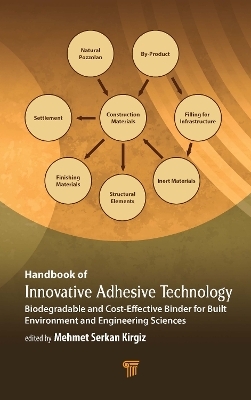
Handbook of Innovative Adhesive Technology
Jenny Stanford Publishing (Verlag)
978-981-5129-51-9 (ISBN)
This book provides an advanced overview of formaldehyde-free binder and materials based on it, including the procedures and prescriptions for their application. It discusses the synthesis of materials, measurement of the physical and mechanical properties as well as the durability, and analysis of the inner structure of such materials. It presents innovative approaches and advanced solutions to manufacture cost-effective as well as ecologically and environmentally friendly formaldehyde-free hydraulic binder and binder-based materials, using common construction binders and biodegradable binders. As adhesive manufacturing is gaining popularity, this book identifies various formaldehyde-free hydraulic binders and binder-based materials for constructional applications. It also provides information on the most suitable materials and their manufacturing techniques and applications.
Mehmet Serkan Kirgiz is a pro-active, full-time, tenured-track professor at the Academia of ACMCEN, Oregon, USA. He has also been a full professor at various universities in Turkey, UK, and USA. His professional experience includes research and development with Scientific and Technological Research Council of Turkey (TUBITAK), teaching graduate- and postgraduate-level students in international institutions and universities collaboratively, and advising students in their theses since 1998. He has authored 260 peer-reviewed articles, 6 books, and 37 book chapters published in highly reputable SCI journals and Scopus-based publications. He also holds an international patent on cement manufacturing with marble powder and brick powder as farina.
1. Starch-based Compound for Eco-friendly and Sustainable Construction Adhesive and Binder System 2. Self-Compacting Composite Containing Mine Tailing and Fortified by Nanocarbon Dot for Manufacturing of Cost-Effective and CO2-Neutral Material in Construction and Infrastructure 3. Valorization of Nano Carbon Dot-Based Green Binder Systems in Terms of Earthquake Engineering, Reinforced Concrete Building, Applied Mechanics, Transportation Engineering, and Their Applications 4. Some Technological Properties of Hydraulic Construction Lime and Grouting Incorporated with Carbon Nanotube Fiber Chopped for Manufacturing of Cost-Effective and CO2-Neutral Material in a Cleaner Built Environment 5. Transforming Oil Sand Waste Ash into Construction Material Using Net-Zero Energy 6. Ecological, Sustainable, Green Brick Materials: Unfired Manufacturing System, Some Features, and Usage for Greener Built Environment and Construction Technology 7. Adhesively Bonded T-Joint Optimization by Cohesive Models: Effect of Adhered Material, Adhesive Type, Geometry, and Bonding Technique 8. High-Performance Concrete Made of Seawater and Cured in Seawater to Evaluate Hydration Composition and Porosity with Analysis of SEM, Petrography, and Mercury Porosimetry in the Lack of Fresh Water of Cleaner Built Environment 9. High-Performance Concrete Made of Seawater and Cured in Seawater to Evaluate Hydration Composition and Porosity with Analysis of SEM, Petrography, and Mercury Porosimetry in the Lack of Freshwater of a Cleaner Built Environment 10. Properties of Innovative and Eco-friendly Pavement and Structural Materials Using Waste Marble Sludge Dust, Rice Husk Ash, Coir Fiber, Starch-Based Binder, and Carbon Quantum Dots 11. Behavior of Bacterial Strain over Cementless Geopolymer Concrete for Sustainable Development 12. Geopolymer Bricks Using Industrial Wastes to Reduce CO2 Footprint 13. Natural Rubber Latex–Substituted Bitumen Binder for Road Construction: A Review 14. Agro-Industrial Supplementary Cementitious Materials for Realizing Sustainable Development Goals of the UN and Net-Zero CO2 Emission 15. Natural Rubber Latex and Its Effects on Some Properties of Bitumen for Cleaner Built Environment 16. Analysis of E-Waste Containing Carbon and Other Components as Composite Material for a Cleaner Built Environment and Realizing UN Sustainable Development Goals
| Erscheinungsdatum | 06.12.2024 |
|---|---|
| Zusatzinfo | 10 Line drawings, color; 46 Line drawings, black and white; 18 Halftones, color; 10 Halftones, black and white; 28 Illustrations, color; 56 Illustrations, black and white |
| Sprache | englisch |
| Maße | 152 x 229 mm |
| Gewicht | 720 g |
| Themenwelt | Naturwissenschaften ► Geowissenschaften ► Geologie |
| Technik ► Bauwesen | |
| Technik ► Maschinenbau | |
| ISBN-10 | 981-5129-51-1 / 9815129511 |
| ISBN-13 | 978-981-5129-51-9 / 9789815129519 |
| Zustand | Neuware |
| Informationen gemäß Produktsicherheitsverordnung (GPSR) | |
| Haben Sie eine Frage zum Produkt? |
aus dem Bereich