


New Geometries for New Materials
Seiten
2006
Cambridge University Press (Verlag)
978-0-521-86104-5 (ISBN)
Cambridge University Press (Verlag)
978-0-521-86104-5 (ISBN)
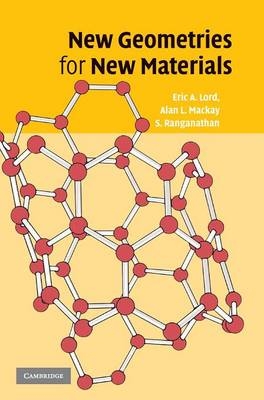
This 2006 book presents the geometrical ideas of structure at the atomic level that are being developed and integrated into materials science. Emphasis is placed on the intuitive understanding of geometrical principles through illustrations not detailed computation. This book will appeal to those working in crystallography, solid-state science and materials science.
Advances in materials science have given rise to novel materials with unique properties, through the manipulation of structure at the atomic level. Elucidating the shape and form of matter at this scale requires the application of mathematical concepts. This 2006 book presents the geometrical ideas that are being developed and integrated into materials science to provide descriptors and enable visualisation of the atomic arrangements in three-dimensional space. Emphasis is placed on the intuitive understanding of geometrical principles, presented through numerous illustrations. Mathematical complexity is kept to a minimum and only a superficial knowledge of vectors and matrices is required, making this an accessible introduction to the area. With a comprehensive reference list, this book will appeal to those working in crystallography, solid state and materials science.
Advances in materials science have given rise to novel materials with unique properties, through the manipulation of structure at the atomic level. Elucidating the shape and form of matter at this scale requires the application of mathematical concepts. This 2006 book presents the geometrical ideas that are being developed and integrated into materials science to provide descriptors and enable visualisation of the atomic arrangements in three-dimensional space. Emphasis is placed on the intuitive understanding of geometrical principles, presented through numerous illustrations. Mathematical complexity is kept to a minimum and only a superficial knowledge of vectors and matrices is required, making this an accessible introduction to the area. With a comprehensive reference list, this book will appeal to those working in crystallography, solid state and materials science.
Dr Eric A. Lord is a Visiting Scientist in the Department of Metallurgy at the Indian Institute of Science. Professor Alan L. Mackay retired in 1991 as Professor Emeritus for the School of Crystallography at the University of London. He continues to pursue several research collaborations and is a Fellow of the Royal Society. Professor S. Ranganathan is an Honorary Professor in the Department of Metallugy at the Indian Institute of Science and has contributed to some 250 papers in scientific journals.
1. Introduction; 2. 2D Tilings; 3. 3D Tilings; 4. Circle and sphere packing; 5. Hierarchical structures; 6. Clusters; 7. Helical and spiral structures; 8. 3D Nets; 9. Triply periodic surfaces; 10. Novel atomic configurations in metallics.
| Erscheint lt. Verlag | 21.9.2006 |
|---|---|
| Verlagsort | Cambridge |
| Sprache | englisch |
| Maße | 170 x 244 mm |
| Gewicht | 610 g |
| Themenwelt | Naturwissenschaften ► Chemie ► Physikalische Chemie |
| Naturwissenschaften ► Physik / Astronomie ► Festkörperphysik | |
| Technik ► Maschinenbau | |
| ISBN-10 | 0-521-86104-7 / 0521861047 |
| ISBN-13 | 978-0-521-86104-5 / 9780521861045 |
| Zustand | Neuware |
| Informationen gemäß Produktsicherheitsverordnung (GPSR) | |
| Haben Sie eine Frage zum Produkt? |
Mehr entdecken
aus dem Bereich

aus dem Bereich
Quantenmechanik | Spektroskopie | Statistische Thermodynamik
Buch | Softcover (2024)
De Gruyter (Verlag)
CHF 83,90
200 Aufgaben zum sicheren Umgang mit Quellen ionisierender Strahlung
Buch | Hardcover (2023)
Hanser, Carl (Verlag)
CHF 48,95


