


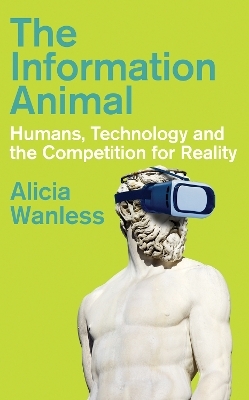
The Information Animal
Humans, Technology and the Competition for Reality
Seiten
2025
C Hurst & Co Publishers Ltd (Verlag)
978-1-80526-288-6 (ISBN)
C Hurst & Co Publishers Ltd (Verlag)
978-1-80526-288-6 (ISBN)
Humanity has always craved, and feared, information. How should we understand our enduring, ever-changing relationships with technology and knowledge?
Depending on the news you read, new tools like AI will either save or destroy us. But our response to emerging technology’s ‘unprecedented’ threats actually follows a pattern as old as civilisation. From ancient Athens to COVID-19, social media to spam, Alicia Wanless shows how humans have always consumed information, whether accurate or not.
First a new technology changes how information is shared, broadening its availability and accelerating how fast it travels. Then, as more people engage with this new content, fresh ideas arise, often challenging prevailing beliefs. Some use the new tools to promote their views, win power or simply profit, adding to the mounting information pollution. Competition and conflict follow. We scramble—in vain—to control information flows and use of the new technology.
With democracies worldwide lurching from crisis to crisis, knee-jerk reactions to information conflict won’t suffice. What’s needed is an understanding of our nature as ‘information animals’, in a millennia-long relationship with technology—and of how a content-saturated world impacts the political battle for hearts and minds.
Depending on the news you read, new tools like AI will either save or destroy us. But our response to emerging technology’s ‘unprecedented’ threats actually follows a pattern as old as civilisation. From ancient Athens to COVID-19, social media to spam, Alicia Wanless shows how humans have always consumed information, whether accurate or not.
First a new technology changes how information is shared, broadening its availability and accelerating how fast it travels. Then, as more people engage with this new content, fresh ideas arise, often challenging prevailing beliefs. Some use the new tools to promote their views, win power or simply profit, adding to the mounting information pollution. Competition and conflict follow. We scramble—in vain—to control information flows and use of the new technology.
With democracies worldwide lurching from crisis to crisis, knee-jerk reactions to information conflict won’t suffice. What’s needed is an understanding of our nature as ‘information animals’, in a millennia-long relationship with technology—and of how a content-saturated world impacts the political battle for hearts and minds.
Alicia Wanless is a senior fellow at the Carnegie Endowment for International Peace, where she runs the Information Environment Project. She completed her PhD in War Studies at King's College London, combining ecology and strategic theory in a new approach to understanding conflict within the information environment.
| Erscheinungsdatum | 24.05.2025 |
|---|---|
| Verlagsort | London |
| Sprache | englisch |
| Maße | 138 x 216 mm |
| Themenwelt | Informatik ► Software Entwicklung ► User Interfaces (HCI) |
| Informatik ► Theorie / Studium ► Künstliche Intelligenz / Robotik | |
| Naturwissenschaften | |
| ISBN-10 | 1-80526-288-2 / 1805262882 |
| ISBN-13 | 978-1-80526-288-6 / 9781805262886 |
| Zustand | Neuware |
| Informationen gemäß Produktsicherheitsverordnung (GPSR) | |
| Haben Sie eine Frage zum Produkt? |
Mehr entdecken
aus dem Bereich


aus dem Bereich
Wissensverarbeitung - Neuronale Netze
Buch | Hardcover (2023)
Carl Hanser (Verlag)
CHF 48,95
was alle wissen sollten, die Websites und Apps entwickeln
Buch | Hardcover (2024)
Rheinwerk (Verlag)
CHF 55,85
Der Leitfaden für rechtliche Herausforderungen beim Einsatz von …
Buch (2024)
Hanser, Carl (Verlag)
CHF 55,95


