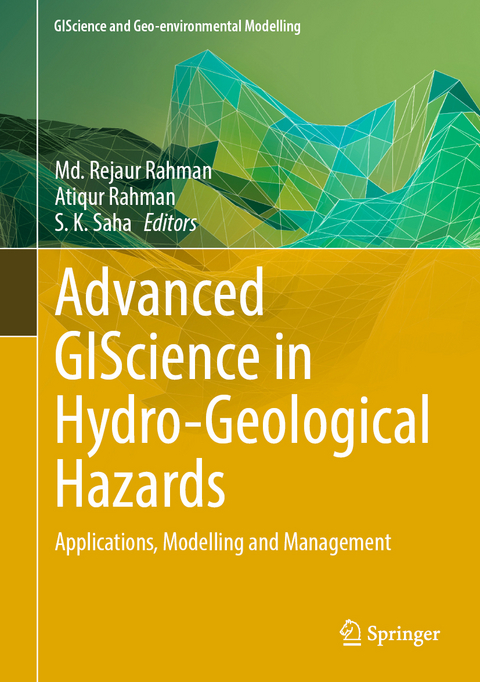
Advanced GIScience in Hydro-Geological Hazards
Springer International Publishing (Verlag)
978-3-031-76188-1 (ISBN)
In recent decades, natural hazards have increasingly threatened lives, livelihoods, and economies, with annual losses totalling billions of dollars globally. According to the Insurance Information Institute (III) and the Zebra, USA, natural disaster losses reached $74.4 billion in 2020, and an average of 6,800 natural disasters occur each year, claiming around 1.35 million lives. Hydrological and geological hazards, in particular, have significant societal and environmental impacts, making them critical areas of research. Understanding and mitigating these hazards is vital for developing legal mechanisms related to environmental restoration, societal improvements, and sustainable development.
Modern technologies and earth observation data play a crucial role in disaster monitoring, prediction, modelling, and management. Recent advancements in geoinformation science have introduced multi-source data for natural hazards research. In addition, cutting-edge methods such as machine learning, deep learning, and big data science offer powerful tools for in-depth studies of natural hazards through remote sensing and geoinformatics. This book, Advanced GIScience in Hydro-Geological Hazards, presents up-to-date contributions on applying advanced GIScience to research various hydro-geological hazards, including floods, landslides, tropical cyclones, soil erosion, coastal erosion, riverbank erosion, coastal area vulnerability, drought, wetlands shrinking etc. It also explores multi-hazard studies using SAR, GNSS, and other innovative methods. The chapters focus on integrating artificial intelligence, machine learning techniques, and remote sensing to enhance preparedness, response, and resilience against these hazards. Targeting a broad audience of academics, scientists, students, environmentalists, government agencies, disaster planners, and GIS experts, this book aims to showcase the latest advancements in GIScience for assessing and managing hydro-geological hazards. It offers strategies for disaster risk reduction and capacity building, providing readers with the knowledge needed to address pressing environmental challenges.
Dr. Md. Rejaur Rahman is a Professor of Geography and Environmental Studies at the University of Rajshahi, Bangladesh. He did Ph.D. in Information Engineering of Resources and Environment from the College of Resources and Environment of Huazhong Agricultural University in Wuhan, China. He holds a M.Tech degree in Remote Sensing (RS) and Geographic Information System (GIS) from the Centre for Space Science and Technology Education in Asia and the Pacific (CSSTEAP) in India (one of the four regional centers for Space Science and Technology Education affiliated to the United Nations). He worked as a Post-Doctoral Research Fellow for one year at the University of Science Malaysia (Universiti Sains Malaysia, USM). He was Associate Sub-Project Manager of Higher Education Quality Enhancement Project (HEQEP), funded by the Government of Bangladesh and World Bank, 2012-2013. He also worked as Research Fellow in the project GIS application in Coastal Area Planning and Management, Dept. of Environmental Science, University Putra Malaysia (UPM), Malaysia, 2000-2001. Prof. Rahman served as a Chairperson, Dept. of Geography and Environmental Studies and as a Dean, Faculty of Geo-Sciences, University of Rajshahi, Bangladesh. His research interests include applications of remote sensing, GIS and AI in natural disaster monitoring, modeling and management (flood, soil erosion, draught, river bank erosion, landslides, forest/vegetation degradation); climate change issues; land use/land cover change analysis, modeling and planning; cropland monitoring and planning. Dr. Rahman has published more than 35 reviewed research papers in the international and national refereed journals including Ecological Modelling, The Egyptian Journal of Remote Sensing and Space Science, Climate Dynamics, Theoretical and Applied Climatology, Environmental Monitoring and Assessment, Journal of Spatial Science, Environmental Earth Sciences, Earth Science Informatics, Geo-Spatial Information Science, International Journal of Geoinformatics and quite number of book chapter published from Springer related to the applications of remote sensing and GIS, image processing, natural disaster monitoring and modeling, climate variability and change, landuse/land cover mapping, monitoring and planning. He also attended and presented several research papers in the national and international seminars/workshops. Besides, Prof. Rahman has also done several advanced/specialized training courses on Remote Sensing and GIS in abroad including India, China, Jordan, Egypt, Sweden, Russia, Iran, South Korea, Turkey and Netherlands. Dr. Rahman has also served as reviewer for many journals of Springer, Elsevier, Taylor and Francis, MDPI, and Frontiers.
Dr. Atiqur Rahman is a Professor of Geography at Dept. of Geography, Faculty of Natural Sciences, Jamia Millia Islamia. He is alumnus of Aligarh Muslim University Aligarh. He completed B. Sc. (Hons.), M Sc., M Phil and Ph. D from AMU, Aligarh. His research interest is urban environmental management, water resources and use of remote sensing satellite data, GIS and GPS. He was Post Doctoral Fellow (PDF) at UFZ-Centre for Environmental Research, Leipzig, Germany (1999). He was Co-PI of Indo-Germany DST-DAAD major project. He is the recipient of prestigious Young Scientist Project Grant Award (2001-2004) from Department of Science and Technology (DST), Govt. of India. He worked as one a member of Scientific Research Team of NASA funded UEM project on Urban Ecology and Sustainability (2004-2007). He is the Co-PI Indo-Canadian major research projects on Economic Transformation and Childhood Obesity funded by ICMR (India) and CHI (Canada) 2010-2015. He was Co-PI of a major research project funded by Ministry of Environment and Forest, Govt. of India. He was the collaborating Scientist of NASA funded major project on Impacts of Desert Urbanization on Climate using Remote Sensing and Numerical Modeling (2012-2015). Prof. Rahman has also done p
GIScience and Earth observation Technology in Hydro-Geological hazard Analysis-An Overview.- Application of Advanced Geoinformation Science-A Disaster Risk Reduction Perspective.- New Paradigms of Decision Support Systems through Applications Leveraging Earth Observations and Machine Learning Approaches.- Soil erosion susceptibility modelling using machine learning in Guwahati urban watershed.- Flood vulnerability assessment in Jamuna (Brahmaputra) river basin, Bangladesh using remote sensing data, frequency ratio and machine learning based geospatial approach towards management strategies.- Introducing Autoencoder-Convolutional neural network for landslide susceptibility modelling in Kalimpong hill.- Artificial Neural Networks for combined forecasting of Tropical Cyclone track and intensity in the Bay of Bengal.- Geospatial approach to assess possible impact of groundwater abstraction in Bharatpur metropolitan city, Nepal.- Application of aerial photographs to monitor the dynamicsof fluvial tidal island and coastal erosion hazard in the Sundarbans delta plain of Bangladesh.- RS and GIS modelling for disaster management: Opportunities and challenges-A case study from Kerala, India.- Coastal Area Vulnerability to Cyclone Hazard-A Geoinformation and IPCC approach based study.- Spatial and Temporal Distribution of Drought in Bangladesh Using Novel China Z Index.- Livelihood vulnerability modelling with deep learning in erosion and flooding induced river islands in Ganga River corridor.- Assessment of soil erosion and landslide hazards in Rohingya refugee areas of Bangladesh: An integrated remote sensing and field observation approach.- Geospatial Analysis of River Bank Erosion-Accretion and Land Use Change of Teesta River, Bangladesh using Fuzzy ARTMAP Neural Network.- Landslides Vulnerability Assessment using Fuzzy logic based Spatial Multi-criteria Evaluation (Fuzzy-SMCE)-A Case Study from Hill Tract Districts, Bangladesh.- Impact of wetland transformation on fishing community in floodplain of Tangan River.- Multi-hazard risk assessment using Geo-statistical and Machine Learning Algorithm.- GNSS remote sensing in disaster management.- Land subsidence estimation using SAR time series data.
| Erscheinungsdatum | 04.02.2025 |
|---|---|
| Reihe/Serie | GIScience and Geo-environmental Modelling |
| Zusatzinfo | XXIV, 401 p. 173 illus., 160 illus. in color. |
| Verlagsort | Cham |
| Sprache | englisch |
| Maße | 178 x 254 mm |
| Themenwelt | Naturwissenschaften ► Geowissenschaften ► Geografie / Kartografie |
| Schlagworte | Artificial Intelligence • Artificial Neural Networks • Deep learning • Drought • Erosion • floods • Geospatial Technology • GIS • groundwater • Hazard • Hydro-geological Hazards • landslide • Land Subsistence • machine learning • Remote Sensing • Support Vector Machine • susceptibility • Tropical Cyclone • vulnerability • Wetlands |
| ISBN-10 | 3-031-76188-X / 303176188X |
| ISBN-13 | 978-3-031-76188-1 / 9783031761881 |
| Zustand | Neuware |
| Informationen gemäß Produktsicherheitsverordnung (GPSR) | |
| Haben Sie eine Frage zum Produkt? |
aus dem Bereich