


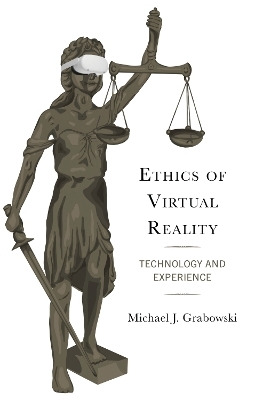
Ethics of Virtual Reality
Technology and Experience
Seiten
2024
Lexington Books (Verlag)
978-1-7936-5197-6 (ISBN)
Lexington Books (Verlag)
978-1-7936-5197-6 (ISBN)
In this book, Michael Grabowski uses established theories of ethics to evaluate the benefits and risks of using virtual reality (VR). By examining and imagining use cases of VR and related technologies, Grabowski questions how rules should govern VR to address issues of control, access, privacy, bias, deception, and abuse.
In this book, Michael Grabowski draws on established theories of ethics to consider critical questions surrounding the growing adoption of virtual reality (VR) technologies. These questions include who should control and have access to VR, its impact on privacy, its potential for misrepresentation and bias, and how to provide a platform for free expression while mitigating harassment and abuse.
Grabowski examines use cases of other digital technologies, including social media and artificial intelligence, to examine who is helped and harmed by the widespread implementation of VR and how it might transform existing institutions, social relationships, and communication. Finally, Grabowski forecasts the possible futures of VR and what limits, if any, should be placed on representing the real world or imagining new ones. Scholars of media studies, technology studies, communication, and ethics will find this book of particular interest.
In this book, Michael Grabowski draws on established theories of ethics to consider critical questions surrounding the growing adoption of virtual reality (VR) technologies. These questions include who should control and have access to VR, its impact on privacy, its potential for misrepresentation and bias, and how to provide a platform for free expression while mitigating harassment and abuse.
Grabowski examines use cases of other digital technologies, including social media and artificial intelligence, to examine who is helped and harmed by the widespread implementation of VR and how it might transform existing institutions, social relationships, and communication. Finally, Grabowski forecasts the possible futures of VR and what limits, if any, should be placed on representing the real world or imagining new ones. Scholars of media studies, technology studies, communication, and ethics will find this book of particular interest.
Michael Grabowski is professor of communication, sound, and media arts and director of the Game Design and Production program at Manhattan College.
Chapter 1: What is VR?
Chapter 2: Applying Ethics to VR
Chapter 3: Control of VR
Chapter 4: Access to VR
Chapter 5: Privacy in VR
Chapter 6: Misrepresentation and Bias in VR
Chapter 7: Harassment and Abuse in VR
Chapter 8: What Should VR Be?
| Erscheinungsdatum | 24.12.2024 |
|---|---|
| Zusatzinfo | 9 BW Photos |
| Sprache | englisch |
| Maße | 152 x 229 mm |
| Themenwelt | Kunst / Musik / Theater ► Film / TV |
| Geisteswissenschaften ► Philosophie ► Ethik | |
| Naturwissenschaften | |
| Sozialwissenschaften ► Kommunikation / Medien ► Medienwissenschaft | |
| ISBN-10 | 1-7936-5197-3 / 1793651973 |
| ISBN-13 | 978-1-7936-5197-6 / 9781793651976 |
| Zustand | Neuware |
| Informationen gemäß Produktsicherheitsverordnung (GPSR) | |
| Haben Sie eine Frage zum Produkt? |
Mehr entdecken
aus dem Bereich



aus dem Bereich
Buch | Hardcover (2025)
Suhrkamp (Verlag)
CHF 32,15
ein Versuch über Kardinaltugenden und Laster
Buch | Hardcover (2025)
De Gruyter (Verlag)
CHF 55,90


