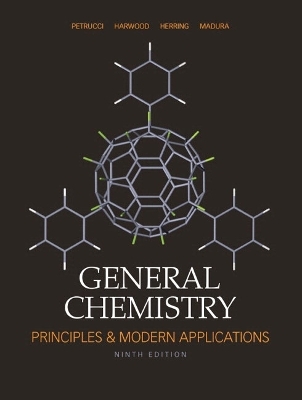
General Chemistry
Prentice Hall
978-0-13-238826-9 (ISBN)
- Titel erscheint in neuer Auflage
- Artikel merken
For 2-semester or 3-quarter general chemistry courses.
General Chemistry: Principles and Modern Applications is recognized for its superior problems, lucid writing, precision of argument, and precise and detailed treatment of the subject. Popular and innovative features include Feature Problems, follow-up A and B Practice Exercises to accompany every in-chapter Example, Focus On application boxes, and new Keep in Mind marginal notes
Ralph H. Petrucci Ralph Petrucci received his B.S. in Chemistry from Union College, Schenectady, NY, and his Ph.D. from the University of Wisconsin–Madison. Following ten years of teaching, research, consulting, and directing the NSF Institutes for Secondary School Science Teachers at Case Western Reserve University, Cleveland, OH, Dr. Petrucci joined the planning staff of the new California State University campus at San Bernardino in 1964. There, in addition to his faculty appointment, he served as Chairman of the Natural Sciences Division and Dean of Academic Planning. Professor Petrucci, now retired from teaching, is also a coauthor of General Chemistry with John W. Hill, Terry W. McCreary, and Scott S. Perry. William S. Harwood Bill Harwood received his B.Sc. from the University of Massachusetts, Amherst and his Ph.D. in Inorganic Chemistry from Purdue University in 1986. He is currently a Professor of Science Education at Indiana University, Bloomington. Previously, Dr. Harwood was at the Department of Chemistry and Biochemistry at the University of Maryland, College Park. In his current role, Dr. Harwood continues to teach chemistry and conduct research in chemical education. He has received several awards for teaching excellence. Dr. Harwood is also active in the American Chemical Society and the Division of Chemical Education and was a consultant to AAAS project 2061. He is involved in the science reform efforts at both the pre-college and college levels. His research focuses on how best to use technology to improve learning in chemistry. F. Geoffrey Herring Geoff Herring received his B.Sc. and his Ph.D. in Physical Chemistry, both from the University of London. He is currently a Professor in the Department of Chemistry of the University of British Columbia, Vancouver. Dr. Herring has research interests in the area of biophysical chemistry and has published over 100 papers in the area of physical chemistry and chemical physics. Recently, Dr. Herring has undertaken studies in the use of information technology and interactive engagement methods in teaching general chemistry with a view to improving student comprehension and learning. Dr. Herring has taught chemistry from undergraduate to graduate levels for 30 years and has twice been the recipient of the Killam Prize for Excellence in Teaching. Jeffry D. Madura Jeffry D. Madura received his B.A. from Thiel College and his Ph.D. in Physical Chemistry from Purdue University, He is currently Professor and Chair in the Department of Chemistry and Biochemistry of Duquesne University in Pittsburgh, PA. Dr. Madura’s research interests are in the area of computational chemistry and biophysical chemistry, and he has published over 70 papers in the area of physical chemistry and chemical physics. Recently, Dr. Madura has undertaken studies in the use of technology and interactive personal response systems in teaching general and physical chemistry with the goal of improving student comprehension and learning. Dr. Madura has taught chemistry from undergraduate to graduate levels for 15 years and has been the recipient of a Dreyfus Teacher-Scholar Award.
NOTE: Each chapter concludes with Summary, Integrative Example, Exercises, Integrative and Advanced Exercises, Feature Problems, Self-Assessment Questions, and eMedia Exercises.
1 Matter–Its Properties and Measurement
1-1 The Scientific Method
1-2 Properties of Matter
1-3 Classification of Matter
1-4 Measurement of Matter: SI (Metric) Units
1-5 Density and Percent Composition: Their Use in Problem Solving
1-6 Uncertainties in Scientific Measurements
1-7 Significant Figures
Focus on The Scientific Method at Work: Polywater
2 Atoms and the Atomic Theory
2-1 Early Chemical Discoveries and the Atomic Theory
2-2 Electrons and Other Discoveries in Atomic Physics
2-3 The Nuclear Atom
2-4 Chemical Elements
2-5 Atomic Masses
2-6 Introduction to the Periodic Table
2-7 The Concept of the Mole and the Avogadro Constant
2-8 Using the Mole Concept in Calculations
Focus on Occurrence and Abundances of the Elements
3 Chemical Compounds
3-1 Types of Chemical Compounds and Their Formulas
3-2 The Mole Concept and Chemical Compounds
3-3 Composition of Chemical Compounds
3-4 Oxidation States: A Useful Tool in Describing Chemical Compounds
3-5 Naming Compounds: Organic and Inorganic Compounds
3-6 Names and Formulas of Inorganic Compounds
3-7 Names and Formulas of Organic Compounds
Focus on Mass Spectrometry—Determining Molecular Formulas
4 Chemical Reactions
4-1 Chemical Reactions and Chemical Equations
4-2 Chemical Equations and Stoichiometry
4-3 Chemical Reactions in Solution
4-4 Determining the Limiting Reactant
4-5 Other Practical Matters in Reaction Stoichiometry
Focus on Industrial Chemistry
5 Introduction to Reactions in Aqueous Solutions
5-1 The Nature of Aqueous Solutions
5-2 Precipitation Reactions
5-3 Acid–Base Reactions
5-4 Oxidation–Reduction: Some General Principles
5-5 Balancing Oxidation–Reduction Equations
5-6 Oxidizing and Reducing Agents
5-7 Stoichiometry of Reactions in Aqueous Solutions: Titrations
Focus on Water Treatment
6 Gases
6-1 Properties of Gases: Gas Pressure
6-2 The Simple Gas Laws
6-3 Combining the Gas Laws: The Ideal Gas Equation and the General Gas Equation
6-4 Applications of the Ideal Gas Equation
6-5 Gases in Chemical Reactions
6-6 Mixtures of Gases
6-7 Kinetic-Molecular Theory of Gases
6-8 Gas Properties Relating to the Kinetic-Molecular Theory
6-9 Nonideal (Real) Gases
Focus on Earth’s Atmosphere
7 Thermochemistry 220
7-1 Getting Started: Some Terminology
7-2 Heat
7-3 Heats of Reaction and Calorimetry
7-4 Work
7-5 The First Law of Thermodynamics
7-6 Heats of Reaction: DU and DH
7-7 Indirect Determination of DH: Hess’s Law
7-8 Standard Enthalpies of Formation
7-9 Fuels as Sources of Energy
Focus on Fats, Carbohydrates, and Energy Storage
8 Electrons in Atoms
8-1 Electromagnetic Radiation
8-2 Atomic Spectra
8-3 Quantum Theory
8-4 The Bohr Atom
8-5 Two Ideas Leading to a New Quantum Mechanics
8-6 Wave Mechanics
8-7 Quantum Numbers and Electron Orbitals
8-8 Interpreting and Representing the Orbitals of the Hydrogen Atom
8-9 Electron Spin: A Fourth Quantum Number
8-10 Multielectron Atoms
8-11 Electron Configurations
8-12 Electron Configurations and the Periodic Table
Focus on Helium–Neon Lasers
9 The Periodic Table and Some Atomic Properties
9-1 Classifying the Elements: The Periodic Law and the Periodic Table
9-2 Metals and Nonmetals and Their Ions
9-3 The Sizes of Atoms and Ions
9-4 Ionization Energy
9-5 Electron Affinity
9-6 Magnetic Properties
9-7 Periodic Properties of the Elements
Focus on The Periodic Law and Mercury
10 Chemical Bonding I: Basic Concepts
10-1 Lewis Theory: An Overview
10-2 Covalent Bonding: An Introduction
10-3 Polar Covalent Bonds and Electrostatic Potential Maps
10-4 Writing Lewis Structures
10-5 Resonance
10-6 Exceptions to the Octet Rule
10-7 Shapes of Molecules
10-8 Bond Order and Bond Lengths
10-9 Bond Energies
Focus on Molecules in Space: Measuring Bond Lengths
11 Chemical Bonding II: Additional Aspects
11-1 What a Bonding Theory Should Do
11-2 Introduction to the Valence-Bond Method
11-3 Hybridization of Atomic Orbitals
11-4 Multiple Covalent Bonds
11-5 Molecular Orbital Theory
11-6 Delocalized Electrons: Bonding in the Benzene Molecule
11-7 Bonding in Metals
11-8 Some Unresolved Issues; Can Electron Charge-Density Plots Help
Focus on Photoelectron Spectroscopy
12 Liquids, Solids, and Intermolecular Forces
12-1 Intermolecular Forces and Some Properties of Liquids
12-2 Vaporization of Liquids: Vapor Pressure
12-3 Some Properties of Solids
12-4 Phase Diagrams
12-5 Van der Waals Forces
12-6 Hydrogen Bonding
12-7 Network Covalent Solids and Ionic Solids
12-8 Crystal Structures
12-9 Energy Changes in the Formation of Ionic Crystals
Focus on Liquid Crystals
13 Solutions and Their Physical Properties
13-1 Types of Solutions: Some Terminology
13-2 Solution Concentrations
13-3 Intermolecular Forces and the Solution Process
13-4 Solution Formation and Equilibrium
13-5 Solubilities of Gases
13-6 Vapor Pressures of Solutions
13-7 Osmotic Pressure
13-8 Freezing-Point Depression and Boiling-Point Elevation of Nonelectrolyte Solutions
13-9 Solutions of Electrolytes
13-10 Colloidal Mixtures
Focus on Chromatography
14 Chemical Kinetics
14-1 Rate of a Chemical Reaction
14-2 Measuring Reaction Rates
14-3 Effect of Concentration on Reaction Rates: The Rate Law
14-4 Zero-Order Reactions
14-5 First-Order Reactions
14-6 Second-Order Reactions
14-7 Reaction Kinetics: A Summary
14-8 Theoretical Models for Chemical Kinetics
14-9 The Effect of Temperature on Reaction Rates
14-10 Reaction Mechanisms
14-11 Catalysis
Focus on Combustion and Explosions
15 Principles of Chemical Equilibrium
15-1 Dynamic Equilibrium
15-2 The Equilibrium Constant Expression
15-3 Relationships Involving Equilibrium Constants
15-4 The Magnitude of an Equilibrium Constant
15-5 The Reaction Quotient, Q: Predicting the Direction of Net Change
15-6 Altering Equilibrium Conditions: Le Châtelier’s Principle
15-7 Equilibrium Calculations: Some Illustrative Examples
Focus on The Nitrogen Cycle and the Synthesis of Nitrogen Compounds
16 Acids and Bases
16-1 Arrhenius Theory: A Brief Review
16-2 Brønsted–Lowry Theory of Acids and Bases
16-3 Self-Ionization of Water and the pH Scale
16-4 Strong Acids and Strong Bases
16-5 Weak Acids and Weak Bases
16-6 Polyprotic Acids
16-7 Ions as Acids and Bases
16-8 Molecular Structure and Acid–Base Behavior
16-9 Lewis Acids and Bases
Focus on Acid Rain
17 Additional Aspects of Acid–Base Equilibria
17-1 The Common-Ion Effect in Acid–Base Equilibria
17-2 Buffer Solutions
17-3 Acid–Base Indicators
17-4 Neutralization Reactions and Titration Curves
17-5 Solutions of Salts of Polyprotic Acids
17-6 Acid–Base Equilibrium Calculations: A Summary
Focus on Buffers in Blood
18 Solubility and Complex-Ion Equilibria
18-1 Solubility Product Constant,
18-2 Relationship Between Solubility and
18-3 Common-Ion Effect in Solubility Equilibria
18-4 Limitations of the Concept
18-5 Criteria for Precipitation and Its Completeness
18-6 Fractional Precipitation
18-7 Solubility and pH
18-8 Equilibria Involving Complex Ions
18-9 Qualitative Cation Analysis
Focus on Shells, Teeth, and Fossils
19 Spontaneous Change: Entropy and Free Energy
19-1 Spontaneity: The Meaning of Spontaneous Change
19-2 The Concept of Entropy
19-3 Evaluating Entropy and Entropy Changes
19-4 Criteria for Spontaneous Change: The Second Law of Thermodynamics
19-5 Standard Free Energy Change, DG°
19-6 Free Energy Change and Equilibrium
19-7 DG° and as Functions of Temperature
19-8 Coupled Reactions
Focus on Coupled Reactions in Biological Systems
20 Electrochemistry
20-1 Electrode Potentials and Their Measurement
20-2 Standard Electrode Potentials
20-3 DG, and
20-4 as a Function of Concentrations
20-5 Batteries: Producing Electricity Through Chemical Reactions
20-6 Corrosion: Unwanted Voltaic Cells
20-7 Electrolysis: Causing Nonspontaneous Reactions to Occur
20-8 Industrial Electrolysis Processes
Focus on Membrane Potentials
21 Chemistry of the Main-Group Elements I: Groups 1, 2, 13, and 14
21-1 Group 1: The Alkali Metals
21-2 Group 2: The Alkaline Earth Metals
21-3 Ions in Natural Waters: Hard Water
21-4 Group 13 Metals: The Boron Family
21-5 Group 14 Metals: The Carbon Family
Focus on Gallium Arsenide
22 Main-Group Elements II: Groups 18, 17, 16, 15, and Hydrogen 22-1 Group 18: The Noble Gases
22-2 Group 17: The Halogens
22-3 Group 16: The Oxygen Family
22-4 Group 15: The Nitrogen Family
22-5 Hydrogen: A Unique Element
Focus on The Ozone Layer and Its Environmental Role
23 The Transition Elements
23-1 General Properties
23-2 Principles of Extractive Metallurgy
23-3 Metallurgy of Iron and Steel
23-4 First-Row Transition Metal Elements: Scandium to Manganese
23-5 The Iron Triad: Iron, Cobalt, and Nickel
23-6 Group 11: Copper, Silver, and Gold
23-7 Group 12: Zinc, Cadmium, and Mercury
23-8 Lanthanides
Focus on High Temperature Superconductors
24 Complex Ions and Coordination Compounds
24-1 Werner’s Theory of Coordination Compounds: An Overview
24-2 Ligands
24-3 Nomenclature
24-4 Isomerism
24-5 Bonding in Complex Ions: Crystal Field Theory
24-6 Magnetic Properties of Coordination Compounds and Crystal Field Theory
24-7 Color and the Colors of Complexes
24-8 Aspects of Complex-Ion Equilibria
24-9 Acid–Base Reactions of Complex Ions
24-10 Some Kinetic Considerations 1
24-11 Applications of Coordination Chemistry
Focus on Colors in Gemstones
25 Nuclear Chemistry
25-1 Radioactivity
25-2 Naturally Occurring Radioactive Isotopes
25-3 Nuclear Reactions and Artificially Induced Radioactivity
25-4 Transuranium Elements
25-5 Rate of Radioactive Decay
25-6 Energetics of Nuclear Reactions
25-7 Nuclear Stability
25-8 Nuclear Fission
25-9 Nuclear Fusion
25-10 Effect of Radiation on Matter
25-11 Applications of Radioisotopes
Focus on Radioactive Waste Disposal
26 Organic Chemistry
26-1 Organic Compounds and Structures: An Overview
26-2 Alkanes
26-3 Alkenes and Alkynes
26-4 Aromatic Hydrocarbons
26-5 Alcohols, Phenols, and Ethers
26-6 Aldehydes and Ketones
26-7 Carboxylic Acids and Their Derivatives
26-8 Amines
26-9 Heterocyclic Compounds
26-10 Nomenclature of Stereoisomers in Organic Compounds
26-11 An Introduction to Substitution Reactions at Hybridized Carbon Atoms
26-12 Synthesis of Organic Compounds
26-13 Polymerization Reactions
Focus on Natural And Synthetic Dyes
27 Chemistry of the Living State
27-1 Chemical Structure of Living Matter: An Overview
27-2 Lipids
27-3 Carbohydrates
27-4 Proteins
27-5 Aspects of Metabolism
27-6 Nucleic Acids
Focus on Protein Synthesis and the Genetic Code
APPENDICES
A Mathematical Operations
A-1 Exponential Arithmetic
A-2 Logarithms
A-3 Algebraic Operations
A-4 Graphs
A-5 Using Conversion Factors (Dimensional Analysis)
B Some Basic Physical Concepts
B-1 Velocity and Acceleration
B-2 Force and Work
B-3 Energy
B-4 Magnetism
B-5 Static Electricity
B-6 Current Electricity
B-7 Electromagnetism
C SI Units
C-1 SI Base Units
C-2 SI Prefixes
C-3 Derived SI Units A
C-4 Units to Be Discouraged or Abandoned A16
D Data Tables
D-1 Ground-State Electron Configurations
D-2 Thermodynamic Properties of Substances at 298.15 K
D-3 Equilibrium Constants
D-4 Standard Electrode (Reduction) Potentials at 25 °C
E Concept Mapping
F Glossary
G Answers to Practice Examples and Selected Exercises
Photo Credits
Index
| Erscheint lt. Verlag | 19.9.2006 |
|---|---|
| Verlagsort | Upper Saddle River |
| Sprache | englisch |
| Gewicht | 3346 g |
| Themenwelt | Naturwissenschaften ► Chemie |
| ISBN-10 | 0-13-238826-X / 013238826X |
| ISBN-13 | 978-0-13-238826-9 / 9780132388269 |
| Zustand | Neuware |
| Informationen gemäß Produktsicherheitsverordnung (GPSR) | |
| Haben Sie eine Frage zum Produkt? |
aus dem Bereich