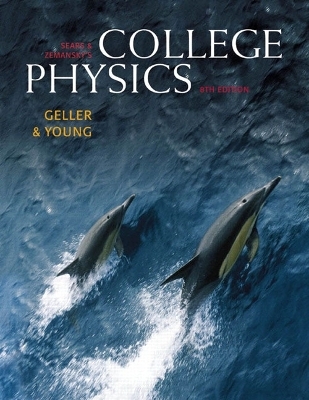
College Physics, Volume 1 (Chs. 1-16)
Benjamin-Cummings Publishing Company, Subs of Addison Wesley Longman, Inc
978-0-8053-7822-1 (ISBN)
- Titel ist leider vergriffen;
keine Neuauflage - Artikel merken
A broad and thorough introduction to physics, this new edition carefully integrates many solutions from educational research to help students to develop greater confidence in solving problems, deeper conceptual understanding, and stronger quantitative-reasoning skills, while helping them connect what they learn with their other courses and the changing world around them.
Hugh D. Young is Professor of Physics at Carnegie Mellon University in Pittsburgh, PA. He attended Carnegie Mellon for both undergraduate and graduate study and earned his Ph.D. in fundamental particle theory under the direction of the late Richard Cutkosky. He joined the faculty of Carnegie Mellon in 1956, and has also spent two years as a visiting Professor at the University of California at Berkeley. Hugh's career has centered entirely around undergraduate education. He has written several undergraduate-level textbooks, and in 1973 he became a coauthor with Francis Sears and Mark Zemansky for their well-known introductory texts. In addition to his role on Sears and Zemansky's College Physics, he is currently a coauthor with Roger Freedman on Sears and Zemanksy's University Physics. Hugh is an enthusiastic skier, climber, and hiker. He also served for several years as Associate Organist at St. Paul's Cathedral in Pittsburgh, and has played numerous organ recitals in the Pittsburgh area. Prof. Young and his wife Alice usually travel extensively in the summer, especially in Europe and in the desert canyon country of southern Utah. Robert M. Geller teaches physics at the University of California, Santa Barbara, where he also obtained his Ph.D. under Robert Antonucci in observational cosmology. Currently, he is involved in two major research projects: a search for cosmological halos predicted by the Big Bang, and a search for the flares that are predicted to occur when a supermassive black hole consumes a star. Rob also has a strong focus on undergraduate education. In 2003, he received the Distinguished Teaching Award. He trains the graduate student teaching assistants on methods of physics education. He is also a frequent faculty leader for the UCSB Physics Circus, in which student volunteers perform exciting and thought-provoking physics demonstrations to elementary schools. Rob loves the outdoors. He and his wife Susanne enjoy backpacking along rivers and fly fishing, usually with rods she has build and flies she has tied. Their daughter Zoe loves fishing too, but her fish tend to be plastic, and float in the bathtub.
Chapter 1 Models, Measurements, and Vectors
1.1 Introduction
1.2 Idealized Models
1.3 Standards and Units
1.4 Unit Consistency and Conversions
1.5 Precision and Significant Figures
1.6 Estimates and Orders of Magnitude
1.7 Vectors and Vector Addition
1.8 Components of Vectors
Chapter 2 Motion along a Straight Line
2.1 Displacement and Average Velocity
2.2 Instantaneous Velocity
2.3 Average and Instantaneous Acceleration
2.4 Motion with Constant Acceleration
2.5 Proportional Reasoning
2.6 Freely Falling Objects
*2.7 Relative Velocity along a Straight Line
Chapter 3 Motion in a Plane
3.1 Velocity in a Plane
3.2 Acceleration in a Plane
3.3 Projectile Motion
3.4 Uniform Circular Motion
*3.5 Relative Velocity in a Plane
Chapter 4 Newton’s Laws of Motion
4.1 Force
4.2 Newton’s First Law
4.3 Mass and Newton’s Second Law
4.4 Mass and Weight
4.5 Newton’s Third Law
4.6 Free-Body Diagrams
Chapter 5 Applications of Newton’s Laws
5.1 Equilibrium of a Particle
5.2 Applications of Newton’s Second Law
5.3 Contact Forces and Friction
5.4 Elastic Forces
5.5 Forces in Nature
Chapter 6 Circular Motion and Gravitation
6.1 Force in Circular Motion
6.2 Motion in a Vertical Circle
6.3 Newton’s Law of Gravitation
6.4 Weight
6.5 Satellite Motion
Chapter 7 Work and Energy
7.1 An Overview of Energy
7.2 Work
7.3 Work and Kinetic Energy
7.4 Work Done by a Varying Force
7.5 Potential Energy
7.6 Conservation of Energy
7.7 Conservative and Nonconservative Forces
7.8 Power
Chapter 8 Momentum
8.1 Momentum
8.2 Conservation of Momentum
8.3 Inelastic Collisions
8.4 Elastic Collisions
8.5 Impulse
8.6 Center of Mass
8.7 Motion of the Center of Mass
*8.8 Rocket Propulsion
Chapter 9 Rotational Motion
9.1 Angular Velocity and Angular Acceleration
9.2 Rotation with Constant Angular Acceleration
9.3 Relationship between Linear and Angular Quantities
9.4 Kinetic Energy of Rotation and Moment of Inertia
9.5 Rotation about a Moving Axis
Chapter 10 Dynamics of Rotational Motion
10.1 Torque
10.2 Torque and Angular Acceleration
10.3 Work and Power in Rotational Motion
10.4 Angular Momentum
10.5 Conservation of Angular Momentum
10.6 Equilibrium of a Rigid Body
*10.7 Vector Nature of Angular Quantities
Chapter 11 Elasticity and Periodic Motion
11.1 Stress, Strain, and Elastic Deformations
11.2 Periodic Motion
11.3 Energy in Simple Harmonic Motion
11.4 Equations of Simple Harmonic Motion
11.5 The Simple Pendulum
11.6 Damped and Forced Oscillations
Chapter 12 Mechanical Waves and Sound
12.1 Mechanical Waves
12.2 Periodic Mechanical Waves
12.3 Wave Speeds
*12.4 Mathematical Description of a Wave
12.5 Reflections and Superposition
12.6 Standing Waves and Normal Modes
12.7 Longitudinal Standing Waves
12.8 Interference
12.9 Sound and Hearing
12.10 Sound Intensity
12.11 Beats 12.12 The Doppler Effect
12.13 Applications of Acoustics
*12.14 Musical Tones
Chapter 13 Fluid Mechanics
13.1 Density
13.2 Pressure in a Fluid
13.3 Archimedes’ Principle: Buoyancy
*13.4 Surface Tension and Capillarity
13.5 Fluid Flow
13.6 Bernoulli’s Equation
13.7 Applications of Bernoulli’s equation
13.8 Real Fluids: Viscosity and Turbulence
Chapter 14 Temperature and Heat
14.1 Temperature and Thermal Equilibrium
14.2 Temperature Scales
14.3 Thermal Expansion
14.4 Quantity of Heat
14.5 Phase Changes
14.6 Calorimetry
14.7 Heat Transfer
*14.8 Solar Energy and Resource Conservation
Chapter 15 Thermal Properties of Matter
15.1 The Mole and Avogadro’s Number
15.2 Equations of State
15.3 Kinetic Theory of an Ideal Gas
15.4 Heat Capacities
15.5 The First Law of Thermodynamics
15.6 Thermodynamic Processes
15.7 Properties of an Ideal Gas
Chapter 16 The Second Law of Thermodynamics
16.1 Directions of Thermodynamic Processes
16.2 Heat Engines
16.3 Internal Combustion Engines
16.4 Refrigerators
16.5 The Second Law of Thermodynamics
16.6 The Carnot Engine: The Most Efficient Heat Engine
16.7 Entropy
*16.8 The Kelvin Temperature Scale
*16.9 Energy Resources: A Case Study in Thermodynamics
| Erscheint lt. Verlag | 28.2.2006 |
|---|---|
| Zusatzinfo | Illustrations (chiefly col.) |
| Verlagsort | San Francisco |
| Sprache | englisch |
| Themenwelt | Naturwissenschaften ► Physik / Astronomie |
| ISBN-10 | 0-8053-7822-7 / 0805378227 |
| ISBN-13 | 978-0-8053-7822-1 / 9780805378221 |
| Zustand | Neuware |
| Informationen gemäß Produktsicherheitsverordnung (GPSR) | |
| Haben Sie eine Frage zum Produkt? |
aus dem Bereich