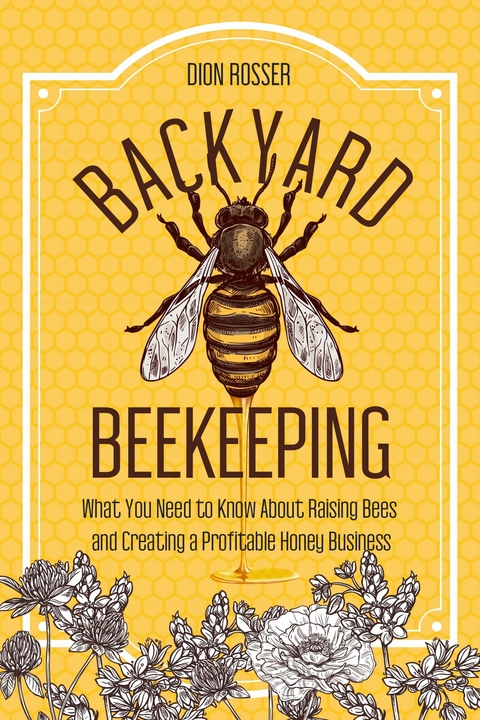
Backyard Beekeeping (eBook)
105 Seiten
Dion Rosser (Verlag)
978-1-393-26400-2 (ISBN)
Dion Rosser is renowned for his enlightening publications centered around homesteading, self-sufficiency, and sustainable living. With a profound passion for the land and its resources, Dion delves into the intricacies of achieving harmony with nature through gardening, animal husbandry, and crafting a productive homestead. His deep-rooted love for cultivating vibrant gardens and raising diverse livestock extends far beyond mere hobbies; it truly embodies a way of life.
Dion Rosser is renowned for his enlightening publications centered around homesteading, self-sufficiency, and sustainable living. With a profound passion for the land and its resources, Dion delves into the intricacies of achieving harmony with nature through gardening, animal husbandry, and crafting a productive homestead. His deep-rooted love for cultivating vibrant gardens and raising diverse livestock extends far beyond mere hobbies; it truly embodies a way of life.
It is perfectly understandable why many people are not fond of bees. They buzz and sting. That is double the trouble, but the sweet honey makes everything worth it.
The honey bees are, without a doubt, some of the essential members of the animal world. Despite their size, they have contributed so much to the world. A planet without bees would be a much less colorful one.
Bees have been around for a long time. There are numerous accounts from different cultures about bees, their significance, and their contribution to society. Now, take a look at a few of them.
Celtic Lore
According to the Celts, bees were harbingers of good luck and fortune. They were a symbol of immense wisdom, carriers of great knowledge. On the Western Isles of Scotland, they believed the bee carried the ancient wisdom of the Celtic priest, also known as the druid. This belief that spread and took root in all of Scotland is the origin of the English saying, “Ask the wild bees what the druid knows.”
Bees were deeply respected for the part they played in the supernatural. It was believed that they were tasked with carrying messages to and fro, between realms, straight from gods to men. The highlanders even believed that while they slept, their souls left their bodies and transformed into bees.
Mead, an alcoholic drink in Celtic culture, is a product of fermented honey. This was just one more reason the Celts held the bees in reverence, in addition to the fact that they believed the drink granted immortality. This made them create laws to protect the bees at all costs, ensuring a steady flow of this elixir.
African Lore
In a few African traditions, the bee is believed to have been involved in the creation of humans. The San people of the Kalahari Desert tell the tale of Mantis, who desperately needed to go to his family, who lived on the other side of a flooded river. Then came Bee, a nice creature offering to help the Mantis across.
Bee told Mantis to get on her back so she could fly him to the other side of the river for nothing in return. Mantis was grateful. Going against the angry waves, Bee flew and flew until a raging wind came upon them, making it difficult to keep going. As she drew close to the river, Bee flew with whatever strength she had left to save Mantis. As luck would have it, she saw a flower floating on the water. So, Bee placed her passenger on the flower. As all her strength was gone, she dropped dead right there beside Mantis.
When the river was calm, and the winds ceased, the sun shone brightly. Curled up inside the flower was the result of Bee’s sacrifice: The first human being.
Greek Lore
Greeks have a story for everything. Just like the Celts, they believed that bees were servants and messengers of the ancient gods and goddesses, responsible for the communication between gods and men, among other things. Honey was presumed to be a special drink, but for the gods alone. Wisdom and knowledge were associated with it.
A popular bee-related story in Greek myth is the story of the son of Kronos and Rhea, Titan. Unfortunately for a young Titan, he had a tyrant for a father who swore to eat all his kids. And he did—at least until Zeus was conceived. Rhea had grown tired of Kronos’s behavior, so she tricked him by getting him to swallow a rock wrapped in a blanket instead of Zeus, whom she hid in a secret cave. The hymn of Zeus, written by Callimachus, says that Zeus was protected and cared for by the bees. Until today, Zeus was called by one of his many names, Melissaios, which means “bee man.”
Zeus grew into a powerful god who defeated his father, Kronos, and was made the king of the gods. He married the goddess of family and marriage, Hera, and together, they lived in Olympus.
Bees were believed to have had a strong connection to nymphs who were thought to live in hollow tree trunks and caves. It is said that Zeus had sex with a beautiful nymph called Othreis, who then birthed him a son. Hera found out, was filled with jealousy, and made plans to murder the baby, so the nymph took her baby to the woods to hide. As the story goes, the boy lived on honey and grew to be Melitius, the founder of Melita, which is also called Honey Town.
Another story of honey in Greek mythology is Apollo’s account written in the hymns of Homer to Hermes. The story speaks of when Apollo granted Hermes the gift of prophecy in the form of three bees called the Thriae. They were depicted to have the body of a bee and head of a woman. Honey was regarded as an elixir of the gods, with the story of the sea god, Glaucus, to back it up. When Glaucus died, his body was placed in a jar full of honey. According to the story, he came back to life.
Roman Lore
Roman mythology tells the tale of how the bee got its sting. It was a beautiful day when the queen bee grew annoyed and very tired of humans stealing honey. So, she sought assistance from the king of the Roman gods, Jupiter. She gave him honey in exchange for a request. The minute Jupiter tasted her offering, he was so delighted that he promised to grant her request. The queen asked him to grant her a sting, which she could use to take the life of any human who attempted to steal her honey. While Jupiter was not pleased with her request because he was fond of the mortals, he kept his word and granted her wish. However, there was a catch: Jupiter told her that she could have her sting but at the risk of her own life. If she ever used the sting, it would stay in the wound she caused, and she would die from the separation.
Egyptian Lore
In prehistoric Egypt, honey bees were seen as a symbol of power. Egyptians believed that bees were created from the tears of the sun god, Ra. Like the Celts and Greeks, the bees were believed to be messengers that fell to Earth as tears from Ra’s face, where they turned into bees and pollinated flowers to make beeswax and honey. They also delivered messages to Earth from Heaven.
To the people of Lower Egypt, bees symbolized birth, death, and resurrection. They also guided people in the afterlife as they made their way into the land of the dead. Beehives, bee relics, and honey were considered burial gifts for the deceased.
Hindu Lore
Hindus believe honey is closely associated with the joys of nirvana, which means the end of all suffering. Different Hindu cultures portray certain gods like Indra, Vishnu, and Krishna as bees resting on a lotus. The Hindu god of love, Kamadeva, is usually seen holding a bowstring of honey bees.
There is no denying the lasting relationship people have with bees. Recently published evidence shows that human dependence on honey bees goes as far back as 9,000 years ago. This discovery can be attributed to the research of about 6,000 pottery fragments, which then revealed traces of beeswax in pots found in North Africa, Neolithic Europe, and the Near East, proof of human’s long-term relationship with the little buzzers.
With the oldest pottery fragment being a cooking pot, it is no secret that honey was used as a food source and sweetener. However, beeswax, another bee byproduct, served a myriad of purposes for the antiquarian and Neolithic people and still serves modern people. Beeswax was used in cosmetics, rituals, waterproofing pots, to heal different ailments, and for certain technological purposes.
How It All Began
There is no exact timeline for when humans began to domesticate bees, but it all likely started with a little honey hunting, where humans would search for wild bee colonies to collect some honey. This likely became a seasonal practice, with people seeking out the same colonies to harvest honey every year. Over time, it seemed like a pretty good idea to bring the bees home instead. This was the birth of beekeeping.
There are records of the earliest beekeeping methods, which involved moving the tree segments filled with cavities that housed the bee colonies closer to the human settlements. This practice exists today in some countries but is not as popular because the extraction of honey from such structures is destructive and difficult. This led people to go in search of other kinds of bee real estate.
The ancient Greeks also converted pots to early beehives. As time went on, other materials like woven straw and wood were used to make functional beehives.
The Birth of Modern and Commercial Beekeeping
Easy honey removal and hive manipulation did not happen until the 1800s, when Lorenzo Langstroth, a beekeeper, invented an artificial hive that many people still use today. It is called the Langstroth hive and is made up of eight to ten frames, usually wooden. It’s used to surround a sheet of beeswax, which is the preferred hive foundation.
The worker bees begin to construct the cavity walls that are used to house the developing bee larvae. They do this using wax produced by their bodies. They also make cells that will be used for the storage of pollen and nectar. The nectar will later be converted into honey.
The hives are constructed in such a way that the boxes and frames they contain are interchangeable. This lets the beekeeper move and stack resources whenever he wants to. The only thing left to do is add a lid and an opening, which will serve as the hive entrance for the...
| Erscheint lt. Verlag | 6.8.2020 |
|---|---|
| Verlagsort | Njurunda |
| Sprache | englisch |
| Themenwelt | Naturwissenschaften ► Biologie |
| Weitere Fachgebiete ► Land- / Forstwirtschaft / Fischerei | |
| Schlagworte | Backyard Farming • bee colony care. • Beekeeping • hive management tips • honey production • profitable beekeeping • raising bees for honey • Small Business • Sustainable living • urban beekeeping guide |
| ISBN-10 | 1-393-26400-X / 139326400X |
| ISBN-13 | 978-1-393-26400-2 / 9781393264002 |
| Informationen gemäß Produktsicherheitsverordnung (GPSR) | |
| Haben Sie eine Frage zum Produkt? |
 EPUB (Wasserzeichen)
DRM: Digitales Wasserzeichen
Dieses eBook enthält ein digitales Wasserzeichen und ist damit für Sie personalisiert. Bei einer missbräuchlichen Weitergabe des eBooks an Dritte ist eine Rückverfolgung an die Quelle möglich.
Dateiformat: EPUB (Electronic Publication)
EPUB ist ein offener Standard für eBooks und eignet sich besonders zur Darstellung von Belletristik und Sachbüchern. Der Fließtext wird dynamisch an die Display- und Schriftgröße angepasst. Auch für mobile Lesegeräte ist EPUB daher gut geeignet.
Systemvoraussetzungen:
PC/Mac: Mit einem PC oder Mac können Sie dieses eBook lesen. Sie benötigen dafür die kostenlose Software Adobe Digital Editions.
eReader: Dieses eBook kann mit (fast) allen eBook-Readern gelesen werden. Mit dem amazon-Kindle ist es aber nicht kompatibel.
Smartphone/Tablet: Egal ob Apple oder Android, dieses eBook können Sie lesen. Sie benötigen dafür eine kostenlose App.
Geräteliste und zusätzliche Hinweise
Buying eBooks from abroad
For tax law reasons we can sell eBooks just within Germany and Switzerland. Regrettably we cannot fulfill eBook-orders from other countries.
aus dem Bereich