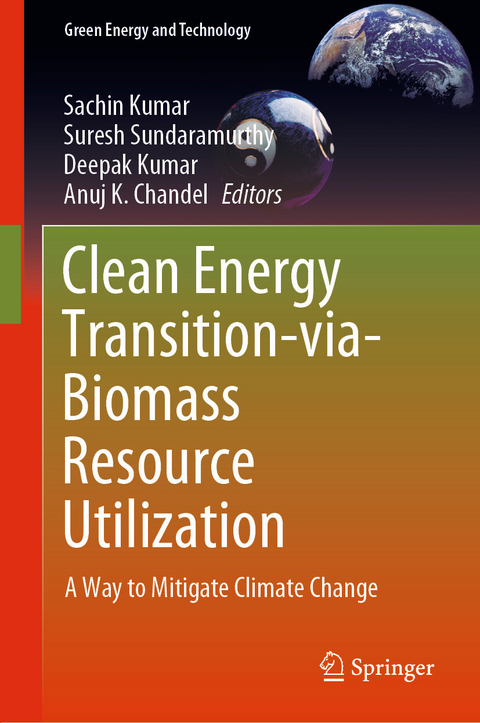
Clean Energy Transition-via-Biomass Resource Utilization (eBook)
319 Seiten
Springer Nature Singapore (Verlag)
978-981-97-6321-4 (ISBN)
This book highlights clean energy transition via sustainable utilization of biomass resources, viz. forestry, agriculture, agroforestry, grassland, and seaweeds to climate change mitigation.
Bioresources have tremendous potential to mitigate global warming. Also, biomass is expected to play a multifunctional role including food production, source of energy and fodder, biodiversity conservation, and yield of goods and services to the society. It brings together perspectives of various communities involved in the research and regulation of bioenergy deployment in the context of climate change mitigation. The book presents the way forward to policy makers and stakeholders involved with bioenergy development. This development may be directive challenges in the transport sector where options such as hydrogen and electric vehicles relying on hydro, wind, and solar PV will require decades to become established on a substantial scale. Furthermore, meeting ambitious climate change targets will also require environment-friendly fuels in air and marine transport where no alternative to biofuels is currently available.
The process design-via-onion model for sustainable utilization of biomass resources is also one of the most important subjects of the book. This book includes state-of-the-art approaches on bottlenecks and circular economy analysis for biomass energy use to reduce climate change and sustainability frameworks to guide bioenergy development.
This book highlights clean energy transition via sustainable utilization of biomass resources, viz. forestry, agriculture, agroforestry, grassland, and seaweeds to climate change mitigation.Bioresources have tremendous potential to mitigate global warming. Also, biomass is expected to play a multifunctional role including food production, source of energy and fodder, biodiversity conservation, and yield of goods and services to the society. It brings together perspectives of various communities involved in the research and regulation of bioenergy deployment in the context of climate change mitigation. The book presents the way forward to policy makers and stakeholders involved with bioenergy development. This development may be directive challenges in the transport sector where options such as hydrogen and electric vehicles relying on hydro, wind, and solar PV will require decades to become established on a substantial scale. Furthermore, meeting ambitious climate change targets will also require environment-friendly fuels in air and marine transport where no alternative to biofuels is currently available. The process design-via-onion model for sustainable utilization of biomass resources is also one of the most important subjects of the book. This book includes state-of-the-art approaches on bottlenecks and circular economy analysis for biomass energy use to reduce climate change and sustainability frameworks to guide bioenergy development.
| Erscheint lt. Verlag | 2.9.2024 |
|---|---|
| Reihe/Serie | Green Energy and Technology |
| Zusatzinfo | XIV, 319 p. 72 illus., 57 illus. in color. |
| Sprache | englisch |
| Themenwelt | Naturwissenschaften ► Biologie ► Ökologie / Naturschutz |
| Technik ► Elektrotechnik / Energietechnik | |
| Technik ► Umwelttechnik / Biotechnologie | |
| Schlagworte | Agri-wastes • Bioenergy development • Biofuels • Carbon Pricing • Carbon Tax • circular economy (CE) • climate change • Design-via-Onion Model • Energy Generation • Energy Policies • energy production • Forest Biomass • Greenhouse Effect • Sea weeds biomass |
| ISBN-10 | 981-97-6321-5 / 9819763215 |
| ISBN-13 | 978-981-97-6321-4 / 9789819763214 |
| Informationen gemäß Produktsicherheitsverordnung (GPSR) | |
| Haben Sie eine Frage zum Produkt? |
 PDF (Wasserzeichen)
DRM: Digitales Wasserzeichen
Dieses eBook enthält ein digitales Wasserzeichen und ist damit für Sie personalisiert. Bei einer missbräuchlichen Weitergabe des eBooks an Dritte ist eine Rückverfolgung an die Quelle möglich.
Dateiformat: PDF (Portable Document Format)
Mit einem festen Seitenlayout eignet sich die PDF besonders für Fachbücher mit Spalten, Tabellen und Abbildungen. Eine PDF kann auf fast allen Geräten angezeigt werden, ist aber für kleine Displays (Smartphone, eReader) nur eingeschränkt geeignet.
Systemvoraussetzungen:
PC/Mac: Mit einem PC oder Mac können Sie dieses eBook lesen. Sie benötigen dafür einen PDF-Viewer - z.B. den Adobe Reader oder Adobe Digital Editions.
eReader: Dieses eBook kann mit (fast) allen eBook-Readern gelesen werden. Mit dem amazon-Kindle ist es aber nicht kompatibel.
Smartphone/Tablet: Egal ob Apple oder Android, dieses eBook können Sie lesen. Sie benötigen dafür einen PDF-Viewer - z.B. die kostenlose Adobe Digital Editions-App.
Buying eBooks from abroad
For tax law reasons we can sell eBooks just within Germany and Switzerland. Regrettably we cannot fulfill eBook-orders from other countries.
aus dem Bereich