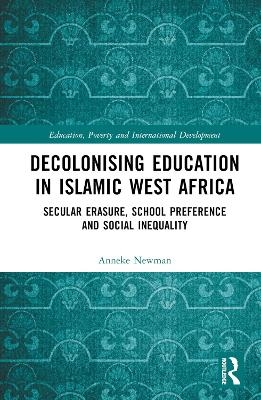
Decolonising Education in Islamic West Africa
Routledge (Verlag)
978-1-032-00044-2 (ISBN)
This book uses perceptions and experiences of Qur’anic schools in West Africa to outline a much-needed postsecular approach, reconsidering the place of Islamic education within African decolonial debates about educational pluralism, and the contributions of religious perspectives in academic and international development spaces.
Decolonial theory is used to overcome the challenges of problematic Eurocentric and colonialist stereotypes about religious actors and faith-based schools which persist within international education scholarship and global policy agendas. Through fine-grained ethnography, chapters discuss how parents and young people today engage with classical Qur’anic schools, Islamic schools and French-medium secular education in Senegal, thereby exposing inequalities around gender, descent-based or caste identities and socioeconomic status, as well as their influence on young people’s pursuit of knowledge. These findings are valuable for scholars exploring the development-education-religion nexus and promoting Education for All in communities characterised by other-than-secular worldviews.
The book will be of interest to academics, researchers and postgraduate students working in the sociology of education, international education, anthropology and religious education. Practitioners involved in postcolonial and decolonial debates will also benefit from recommendations regarding educational reform in plural educational contexts.
Anneke Newman is an anthropologist of development and Senior Postdoctoral Research Fellow at the Department of Conflict and Development Studies, University of Ghent, Belgium.
Chapter 1: Rethinking development, education and religion: A challenging nexus
Stereotypes, silences and secular bias in policy and academic scholarship
Coloniality and the development-education-religion nexus
About us without us: Studying the ‘religious Other’
Structure of the book
Chapter 2: A postsecular decolonial approach: Breaking the binaries
Introducing decolonial theory
Ontology and epistemology: ‘With these threads, we weave the world’
Decolonial perspectives on the study of religion
Stories and senses: A postsecular approach to educational engagement in Islamic West Africa
Conclusion
PART I: SECULAR BIAS IN EDUCATION POLICIES: FROM COLONISATION TO EDUCATION FOR ALL
Chapter 3: The evolution of Islam and education in West Africa
Content and pedagogy of classical Qur’anic schools
Race, religion, capitalist extraction: Colonial schools and education policy
Islamic modernities and education reform
Conclusion
Chapter 4: Coloniality of secularity and Education For All
The ‘talibé problem’: Development critiques of child begging
Assumptions about Qur’anic schools and ‘quality education’
The instrumentalisation of Islamic education under EFA
Conclusion
PART II: PATTERNS OF EDUCATIONAL ENGAGEMENT IN NORTHERN SENEGAL
Chapter 5: Understanding Qur’anic school preference
Coloniality of secularity in frameworks for understanding educational decision-making
Researching education in Medina Diallobé village
Explaining Qur’anic school preference
Choosing the Qur’anic school: An increasingly complex decision
Conclusion
Chapter 6: Racial hierarchies and Islamic education: From exclusion to resistance
Understanding descent-based inequalities in Islamic West Africa
Knowledge-power, education and social mobility: An evolving relationship
Islamic education in the Futa Tooro region: The ‘final frontier’
Using Islamic knowledge to resist racialised exclusion
Conclusion
Chapter 7: Islamic knowledge and women’s agency
Coloniality in discussions about African Muslim women’s agency
Situating female Islamic education in northern Senegal
Women mobilising Islamic knowledge in Medina Diallobé
Islamic education and women’s empowerment: Implications for policy
Conclusion
Chapter 8: Pursuing Islamic and state school knowledges: ‘You need both’
Social inequalities, onto-epistemologies and temporalities in young people’s trajectories
‘Hierarchical complementarity’: Islamic and state school knowledges
Mixed trajectories: Common concerns, diverse strategies
Barriers to educational pluralism in Senegal
Conclusion
PART III: DECOLONISING EDUCATION IN ISLAMIC WEST AFRICA: FROM RESEARCH TO POLICY
Chapter 9: Embracing African Islamic knowledge traditions: From critique to ‘border praxis’
Overcoming coloniality in education and development scholarship
Decolonial research methodologies in comparative education
Towards pluralistic education policy and programming
| Erscheinungsdatum | 21.11.2024 |
|---|---|
| Reihe/Serie | Education, Poverty and International Development |
| Zusatzinfo | 5 Tables, black and white; 4 Line drawings, black and white; 5 Halftones, black and white; 9 Illustrations, black and white |
| Verlagsort | London |
| Sprache | englisch |
| Maße | 156 x 234 mm |
| Gewicht | 453 g |
| Themenwelt | Naturwissenschaften ► Geowissenschaften ► Geografie / Kartografie |
| Sozialwissenschaften ► Pädagogik ► Bildungstheorie | |
| Sozialwissenschaften ► Pädagogik ► Sonder-, Heil- und Förderpädagogik | |
| Sozialwissenschaften ► Soziologie ► Spezielle Soziologien | |
| ISBN-10 | 1-032-00044-9 / 1032000449 |
| ISBN-13 | 978-1-032-00044-2 / 9781032000442 |
| Zustand | Neuware |
| Informationen gemäß Produktsicherheitsverordnung (GPSR) | |
| Haben Sie eine Frage zum Produkt? |
aus dem Bereich