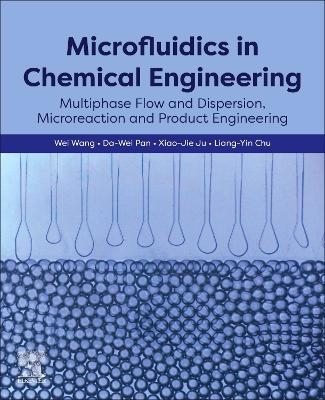
Microfluidics in Chemical Engineering
Elsevier - Health Sciences Division (Verlag)
978-0-443-27306-3 (ISBN)
- Noch nicht erschienen (ca. Juli 2026)
- Versandkostenfrei
- Auch auf Rechnung
- Artikel merken
The chapters clearly summarize the design concepts and general strategies involved as well as the involved mechanisms and classic instances. Instructive advice is also featured throughout on rational regulation of multiphase flows and interfaces in microfluidics, thus offering guidance for process intensification of chemical engineering. It is primarily written for advanced graduate/postdoc students and researchers chemical engineering, but with relevance to materials scientists, physical and materials (including polymer) chemists, physicists, biochemists, as well as pharmaceutical and biomedical scientists.
Wei Wang is a Professor at the School of Chemical Engineering at Sichuan University, PR China. He received his B.S. and Ph.D. degrees from Sichuan University in 2007 and 2012. His research interests include microfluidics, interfaces, and functional materials. He has published 150+ papers in peer-reviewed journals and written 10+ invited book chapters. He has received many honours and awards, including the Emerging Investigator 2014 of Lab on a Chip (The Royal Society of Chemistry), the Hou Debang Chemical Science and Technology Award - Youth Award issued by the Chemical Industry and Engineering Society of China (2017), Second Prize of the State Technological Invention Award (2018), and First Prize of the Sichuan Provincial Science and Technology Progress Award (2015, 2020). Da-Wei Pan received his B.S. and Ph.D. degrees from Sichuan University (SCU) in 2015 and 2019. He was a Post doctorate at the Research Center of Laser Fusion at the China Academy of Engineering Physics (2019-2021). He is currently working as an Associate Professor at the School of Chemical Engineering at Sichuan University, PR China. His research interests include microfluidics, multiphase flow, and process intensification. Xiao-Jie Ju is a Professor at the School of Chemical Engineering at Sichuan University, PR China. She received her Ph.D. degree from Sichuan University in 2008. Her research interests include controlled-release systems, targeting drug delivery and microfluidic technology. She has published more than 300 papers in peer-reviewed journals and 10 invited book chapters. She has received many honours and awards, including the Sichuan Youth Science and Technology Award, the Hou Debang Chemical Science and Technology Award (Youth Award), and received First Prize in the Sichuan Provincial Science and Technology Progress Award (2015 and 2020). Liang-Yin Chu is a Distinguished Professor of Chemical Engineering and a Vice President of Sichuan University, PR China. He received his Ph.D. degree in 1995 from Northeastern University. Prof. Chu was promoted as a full professor of Chemical Engineering at Sichuan University in 1997 and became Director of the Sichuan Provincial Key Laboratory for Filtration and Separation in 2001. He was a research fellow at the University of Tokyo (1999-2001) and a visiting scholar at Harvard University (2006-2007), ESPCI Paris (2007-2008) and the University of Birmingham (2011). He has received many honours and awards, including: Natural Science Awards issued by the Ministry of Education (2003) and the Sichuan Provincial Government (2015 and 2020), Distinguished Young Scholar issued by the National Natural Science Foundation of China (2008), Distinguished Professor of Chang Jiang Scholars Program issued by the Ministry of Education (2009), the Hou Debang Chemical Science and Technology Award for Innovation issued by the Chemical Industry and Engineering Society of China (2013 and 2022), Fellow of Royal Society of Chemistry (2014), National Technological Invention Award (2018), Fellow of the Global Academy of Chinese Chemical Engineers (2021), the Ho Leung Ho Lee Foundation Prize for Scientific and Technological Innovation (2021) and Fellow of the Chemical Industry and Engineering Society of China (2022). His teaching and research are focused on microfluidics, mass transfer and separations, membrane science and technology, smart controlled-release systems, and functional materials. He has authored and co-authored more than 500 peer-reviewed journal articles, 81 patents, 7 books and 19 book chapters.
1. Introduction
Part I - Multiphase flow and dispersion in microfluidics
2. Controllable microfluidic dispersion of microscale fluids
3. Formation mechanisms of droplets in microfluidics
4. Hydrodynamics of multiphase flows in microfluidics
5. Scale-up of microfluidic devices for high-throughput droplet production
Part II - Microfluidics for microreaction
6. Controllable coalescence of droplets in microflow for microreaction
7. Transfer of droplets across microfluidic laminar interfaces for microreaction
8. Smart microfluidic devices equipped with responsive nanocatalysts for tunable microreaction
PART III - Microfluidics for product engineering
9. Microfluidic fabrication of functional homogeneous microparticles
10. Microfluidic fabrication of functional porous microparticles
11. Microfluidic fabrication of functional core-shell microparticles
12. Microfluidic fabrication of functional multicompartmental microparticles
13. Microfluidic fabrication of functional non-spherical microparticles
14. Microfluidic fabrication of functional microfibers
15. Summary and outlook
| Erscheint lt. Verlag | 1.7.2026 |
|---|---|
| Verlagsort | Philadelphia |
| Sprache | englisch |
| Maße | 191 x 235 mm |
| Themenwelt | Naturwissenschaften ► Chemie ► Technische Chemie |
| Technik ► Maschinenbau | |
| ISBN-10 | 0-443-27306-5 / 0443273065 |
| ISBN-13 | 978-0-443-27306-3 / 9780443273063 |
| Zustand | Neuware |
| Informationen gemäß Produktsicherheitsverordnung (GPSR) | |
| Haben Sie eine Frage zum Produkt? |
aus dem Bereich