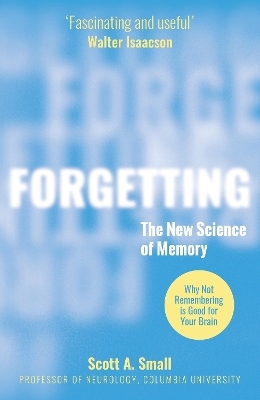
Forgetting
August Books (Verlag)
978-1-80436-966-1 (ISBN)
'Brilliant' Bill Clinton
'Fascinating and useful', Walter Isaacson, bestselling author of The Code Breaker and Leonardo da Vinci
'Upbeat', The Wall Street Journal
Racking your brain? Drawing a blank? Maybe it's not such a bad thingUntil recently, it was largely believed that forgetting served no purpose. Besides causing slight frustration, the odd slip of the mind was thought of as an inevitable but harmless defect in the brain's functionality.
But new research in psychology, neurobiology, and computer science tells a different story. Forgetting is not a failure of our minds, nor is it a benign glitch it is, in fact, good for us, and is a required function for our minds to work best. As annoying as a lapse can be, it's precisely this that opens up our minds to making better decisions, experiencing joy, and flourishing artistically.
Through case studies, personal anecdotes, and scientific explanations, Professor Scott A. Small challenges the conventional wisdom that memory retention is always beneficial. He provides a comprehensive look at the benefits that forgetting can bring to our cognitive and creative abilities, emotional well-being, and even our wider societal health.
So the next time you forget where you left your keys, remember that a little forgetting does a lot of good.
Scott A. Small MD is the Director of the Alzheimer's Disease Research Center at Columbia University. Dr. Small's lab focuses on disorders that effect the hippocampus, a brain circuit targeted by Alzheimer's disease, the normal wear & tear of the aging process ('cognitive aging'), and schizophrenia. The lab first optimized MRI tools applicable to patients and animal models that were then used to pinpoint the parts of the hippocampal circuit differentially vulnerable and resistant to each disorder (Nature Reviews Neuroscience, 2011). This anatomical information was then used as a guide to uncover pathogenic drivers (Neuron, 2014): Retromer-dependent endosomal recycling in Alzheimer's disease, dietary flavanols in cognitive aging, and the glutamate metabolic cycle in schizophrenia. Most recently, his lab has been developing interventions and biomarkers for each disorder, and the lab's discoveries were the cornerstone for the formation of a new biotechnology company, Retromer Therapeutics
| Erscheinungsdatum | 14.05.2025 |
|---|---|
| Sprache | englisch |
| Maße | 129 x 198 mm |
| Themenwelt | Geisteswissenschaften ► Psychologie ► Allgemeine Psychologie |
| Geisteswissenschaften ► Psychologie ► Biopsychologie / Neurowissenschaften | |
| Medizin / Pharmazie ► Medizinische Fachgebiete ► Geriatrie | |
| Naturwissenschaften ► Biologie ► Humanbiologie | |
| Naturwissenschaften ► Biologie ► Zoologie | |
| ISBN-10 | 1-80436-966-7 / 1804369667 |
| ISBN-13 | 978-1-80436-966-1 / 9781804369661 |
| Zustand | Neuware |
| Informationen gemäß Produktsicherheitsverordnung (GPSR) | |
| Haben Sie eine Frage zum Produkt? |
aus dem Bereich